
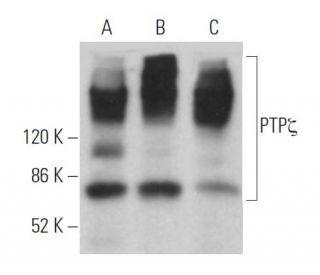
PTPζ Antibody (122.2): sc-33664
- PTPζ Antibody (122.2) is a mouse monoclonal IgM κ PTPζ antibody, cited in 9 publications, provided at 200 µg/ml
- immunized with purified proteoglycan fraction of infant rat brains
- recommended for detection of PTPζ of mouse, rat and human origin by WB, IP, IF and IHC(P)
- m-IgGκ BP-HRP is the preferred secondary detection reagent for PTPζ Antibody (122.2) for WB and IHC(P) applications. This reagent is now offered in a bundle with PTPζ Antibody (122.2) (see ordering information below). For additional m-IgGκ BP conjugates see our complete list of Mouse IgG Binding Proteins.

QUICK LINKS
SEE ALSO...
PTPζ Antibody (122.2) is a mouse monoclonal IgM antibody that detects PTPζ protein of mouse, rat, and human origin by western blotting (WB), immunoprecipitation (IP), immunofluorescence (IF), and immunohistochemistry. Anti-PTPζ antibody (122.2) is available as the non-conjugated format. PTPζ protein, a member of the protein tyrosine phosphatase family, plays a crucial role in cellular signaling pathways, particularly in the regulation of cell growth, differentiation, and survival. PTPζ (122.2) antibody is vital for studying functions in the nervous system, where PTPζ is involved in the modulation of synaptic plasticity and neuronal signaling. PTPζ protein interacts with various proteins, including the chondroitin sulfate proteoglycan phosphacan, which is generated through alternative splicing and is essential for neural development and regeneration. PTPζ presence in the cell membrane and ability to dephosphorylate tyrosine residues makes PTPζ a key player in the regulation of receptor tyrosine kinases, influencing processes such as insulin signaling and cell adhesion. Understanding PTPζ dynamics and interactions can provide insights into roles in diseases, including cancer and neurodegenerative disorders, making PTPζ (122.2) monoclonal antibody an invaluable tool for researchers studying these critical biological processes.
Alexa Fluor® is a trademark of Molecular Probes Inc., OR., USA
LI-COR® and Odyssey® are registered trademarks of LI-COR Biosciences
PTPζ Antibody (122.2) References:
- A receptor-like protein-tyrosine phosphatase PTPzeta/RPTPbeta binds a heparin-binding growth factor midkine. Involvement of arginine 78 of midkine in the high affinity binding to PTPzeta. | Maeda, N., et al. 1999. J Biol Chem. 274: 12474-9. PMID: 10212223
- A receptor-type protein tyrosine phosphatase PTP zeta is expressed in human cutaneous melanomas. | Goldmann, T., et al. 2000. Folia Histochem Cytobiol. 38: 19-20. PMID: 10763119
- Receptor-like protein tyrosine phosphatase gamma (RPTPgamma), but not PTPzeta/RPTPbeta, inhibits nerve-growth-factor-induced neurite outgrowth in PC12D cells. | Shintani, T., et al. 2001. Dev Neurosci. 23: 55-69. PMID: 11173927
- A chondroitin sulfate proteoglycan PTPzeta /RPTPbeta regulates the morphogenesis of Purkinje cell dendrites in the developing cerebellum. | Tanaka, M., et al. 2003. J Neurosci. 23: 2804-14. PMID: 12684467
- A human transmembrane protein-tyrosine-phosphatase, PTP zeta, is expressed in brain and has an N-terminal receptor domain homologous to carbonic anhydrases. | Krueger, NX. and Saito, H. 1992. Proc Natl Acad Sci U S A. 89: 7417-21. PMID: 1323835
- Complex-type asparagine-linked oligosaccharides on phosphacan and protein-tyrosine phosphatase-zeta/beta mediate their binding to neural cell adhesion molecules and tenascin. | Milev, P., et al. 1995. J Biol Chem. 270: 24650-3. PMID: 7559574
- Protein-tyrosine phosphatase epsilon. An isoform specifically expressed in mouse mammary tumors initiated by v-Ha-ras OR neu. | Elson, A. and Leder, P. 1995. J Biol Chem. 270: 26116-22. PMID: 7592814
- Receptor protein tyrosine phosphatase PTPmu associates with cadherins and catenins in vivo. | Brady-Kalnay, SM., et al. 1995. J Cell Biol. 130: 977-86. PMID: 7642713
- Increased abundance of the receptor-type protein-tyrosine phosphatase LAR accounts for the elevated insulin receptor dephosphorylating activity in adipose tissue of obese human subjects. | Ahmad, F., et al. 1995. J Clin Invest. 95: 2806-12. PMID: 7769120
- Homophilic interactions mediated by receptor tyrosine phosphatases mu and kappa. A critical role for the novel extracellular MAM domain. | Zondag, GC., et al. 1995. J Biol Chem. 270: 14247-50. PMID: 7782276
- Stimulation of receptor protein-tyrosine phosphatase alpha activity and phosphorylation by phorbol ester. | den Hertog, J., et al. 1995. Cell Growth Differ. 6: 303-7. PMID: 7794797
- Neurons as well as astrocytes express proteoglycan-type protein tyrosine phosphatase zeta/RPTPbeta: analysis of mice in which the PTPzeta/RPTPbeta gene was replaced with the LacZ gene. | Shintani, T., et al. 1998. Neurosci Lett. 247: 135-8. PMID: 9655611
Ordering Information
| Product Name | Catalog # | UNIT | Price | Qty | FAVORITES | |
PTPζ Antibody (122.2) | sc-33664 | 200 µg/ml | $322.00 | |||
PTPζ Antibody (122.2): m-IgGκ BP-HRP Bundle | sc-520874 | 200 µg Ab, 40 µg BP | $361.00 |