
Date published: 2026-5-1

1-800-457-3801

SCBT Portrait Logo
Seach Input

XPG Antibody (G-4): sc-393004

5.0(1)
Write a reviewAsk a question

Datasheets
  • XPG Antibody (G-4) is a mouse monoclonal IgG1 κ, cited in 1 publications, provided at 200 µg/ml
  • raised against amino acids 887-1186 mapping at the C-terminus of XPG of human origin
  • recommended for detection of XPG of human origin by WB, IP, IF and ELISA
  • See XPG (8H7): sc-13563 for XPG antibody conjugates, including AC, HRP, FITC, PE, Alexa Fluor® 488, 594, 647, 680 and 790.
  • m-IgG Fc BP-HRP and m-IgG1 BP-HRP are the preferred secondary detection reagents for XPG Antibody (G-4) for WB applications. These reagents are now offered in bundles with XPG Antibody (G-4) (see ordering information below).
Gene Editing Promo Banner

QUICK LINKS

SEE ALSO...

XPG Antibody (G-4) is a mouse monoclonal IgG1 antibody that detects XPG in human samples through applications such as western blotting (WB), immunoprecipitation (IP), immunofluorescence (IF), and enzyme-linked immunosorbent assay (ELISA). XPG, also known as ERCC5, plays a crucial role in the nucleotide excision repair pathway, which maintains genomic stability by repairing DNA lesions caused by ultraviolet radiation and various chemical agents. XPG functions as an endonuclease, specifically responsible for making the 3′ incision during the repair process, facilitating the removal of damaged DNA segments. XPG′s structure contains conserved catalytic residues critical for nuclease activity; mutations in these regions can lead to impaired DNA repair and increased susceptibility to skin cancers, particularly in individuals with xeroderma pigmentosum. Anti-XPG antibody (G-4) serves as an invaluable tool for researchers studying DNA repair mechanisms and XPG′s implications in cancer biology, providing insights into the molecular underpinnings of genomic integrity and disease.

For Research Use Only. Not Intended for Diagnostic or Therapeutic Use.

Alexa Fluor® is a trademark of Molecular Probes Inc., OR., USA

LI-COR® and Odyssey® are registered trademarks of LI-COR Biosciences

XPG Antibody (G-4) References:

  1. New insights into the combined Cockayne/xeroderma pigmentosum complex: human XPG protein can function in transcription factor stability.  |  Friedberg, EC. and Wood, RD. 2007. Mol Cell. 26: 162-4. PMID: 17466619
  2. Association between the XPG Asp1104His and XPF Arg415Gln polymorphisms and risk of cancer: a meta-analysis.  |  He, XF., et al. 2014. PLoS One. 9: e88490. PMID: 24802942
  3. Expression of XPG protein in the development, progression and prognosis of gastric cancer.  |  Deng, N., et al. 2014. PLoS One. 9: e108704. PMID: 25268735
  4. Xpg limits the expansion of haematopoietic stem and progenitor cells after ionising radiation.  |  Avila, AI., et al. 2016. Nucleic Acids Res. 44: 6252-61. PMID: 27137888
  5. XPG Gene Polymorphisms and the Risk of Gastric Cardia Adenocarcinoma.  |  Zhou, RM., et al. 2016. Genet Test Mol Biomarkers. 20: 432-7. PMID: 27228234
  6. Association between the XPG gene rs2094258 polymorphism and risk of gastric cancer.  |  Zhang, Z., et al. 2018. J Clin Lab Anal. 32: e22564. PMID: 29732643
  7. An insight into clinical outcome of XPG polymorphisms in breast cancer.  |  Malik, SS., et al. 2018. Mol Biol Rep. 45: 2369-2375. PMID: 30255276
  8. Association of XPG rs2094258 polymorphism with gastric cancer prognosis.  |  Wang, XQ., et al. 2019. World J Gastroenterol. 25: 5152-5161. PMID: 31558863
  9. Transcriptional Stress Induces Chromatin Relocation of the Nucleotide Excision Repair Factor XPG.  |  Scalera, C., et al. 2021. Int J Mol Sci. 22: PMID: 34205418
  10. Involvement of Xeroderma Pigmentosum Complementation Group G (XPG) in epigenetic regulation of T-Helper (TH) cell differentiation during breast cancer.  |  Pal, R., et al. 2022. Immunobiology. 227: 152259. PMID: 36037675

Ordering Information

Product NameCatalog #UNITPriceQtyFAVORITES

XPG Antibody (G-4)

sc-393004
200 µg/ml
$322.00

XPG Antibody (G-4): m-IgG Fc BP-HRP Bundle

sc-540883
200 µg Ab; 10 µg BP
$361.00

XPG Antibody (G-4): m-IgG1 BP-HRP Bundle

sc-542439
200 µg Ab; 20 µg BP
$361.00

What is the recommended starting dilution for Western blot for sc-393004: XPG (G-4) monoclonal antibody?

Asked by: DefinitelyNotMatt
The recommended starting dilution for Western blot is 1:100 with a dilution range of 1:100-1:1000. This information, along with other technical specifications, is available in the recommended protocol: https://www.scbt.com/scbt/resources/protocols/western-immuno-blotting
Answered by: Technical Support
Date published: 2017-03-22
  • y_2026, m_4, d_29, h_11CST
  • bvseo_bulk, prod_bvqa, vn_bulk_3.0.43
  • cp_1, bvpage1
  • co_hasquestionsanswers, tq_1
  • loc_en_US, sid_393004, prod, sort_[SortEntry(order=LAST_APPROVED_ANSWER_SUBMISSION_TIME, direction=DESCENDING)]
  • clientName_scbt
  • bvseo_sdk, java_sdk, bvseo-4.0.0
  • CLOUD, getContent, 98ms
  • QUESTIONS, PRODUCT
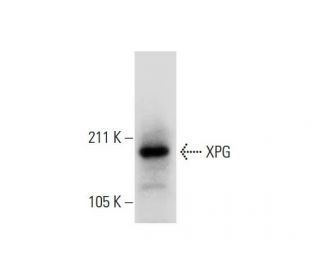
Rated 5 out of 5 by from Great Western blot data of XPG expressionGreat Western blot data of XPG expression in Jurkat nuclear extract. -SCBT QC
Date published: 2014-08-27
  • y_2026, m_4, d_29, h_11
  • bvseo_bulk, prod_bvrr, vn_bulk_3.0.43
  • cp_1, bvpage1
  • co_hasreviews, tv_0, tr_1
  • loc_en_US, sid_393004, prod, sort_[SortEntry(order=SUBMISSION_TIME, direction=DESCENDING)]
  • clientName_scbt
  • bvseo_sdk, java_sdk, bvseo-4.0.0
  • CLOUD, getReviews, 15ms
  • REVIEWS, PRODUCT
XPG Antibody (G-4) is rated 5.0 out of 5 by 1.
  • y_2026, m_4, d_29, h_11
  • bvseo_bulk, prod_bvrr, vn_bulk_3.0.43
  • cp_1, bvpage1
  • co_hasreviews, tv_0, tr_1
  • loc_en_US, sid_393004, prod, sort_[SortEntry(order=SUBMISSION_TIME, direction=DESCENDING)]
  • clientName_scbt
  • bvseo_sdk, java_sdk, bvseo-4.0.0
  • CLOUD, getAggregateRating, 102ms
  • REVIEWS, PRODUCT
