
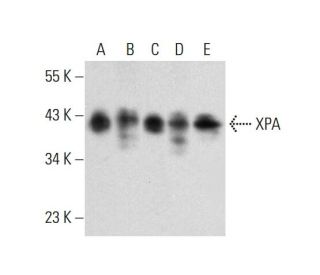


XPA Antibody (B-7): sc-398005
- XPA Antibody (B-7) is a mouse monoclonal mouse IgM κ κ provided at 200 µg/ml
- specific for an epitope mapping between amino acids 15-39 at the N-terminus of XPA of human origin
- recommended for detection of XPA of mouse, rat and human origin by WB, IP, IF and ELISA
- m-IgGκ BP-HRP is the preferred secondary detection reagent for XPA Antibody (B-7) for WB applications. This reagent is now offered in a bundle with XPA Antibody (B-7) (see ordering information below). For additional m-IgGκ BP conjugates see our complete list of Mouse IgG Binding Proteins.

QUICK LINKS
SEE ALSO...
XPA Antibody (B-7) is a mouse monoclonal IgM antibody that detects Xeroderma pigmentosum group A (XPA) in mouse, rat, and human samples through applications such as western blotting (WB), immunoprecipitation (IP), immunofluorescence (IF), and enzyme-linked immunosorbent assay (ELISA). XPA plays a crucial role in the nucleotide excision repair (NER) pathway, which is essential for repairing DNA damage caused by ultraviolet (UV) light. XPA is primarily located in the nucleus, where XPA coordinates the assembly of a preincision complex necessary for the effective processing of damaged DNA. XPA′s nuclear localization enables direct interaction with damaged DNA, facilitating the recognition and repair of lesions that could otherwise lead to mutations and skin cancers, particularly in individuals with xeroderma pigmentosum. XPA′s functionality is enhanced by forming a homodimer in the absence of DNA, which increases binding efficiency when DNA is present. Deficiencies in XPA result in an impaired response to UV-induced DNA damage, underscoring XPA′s critical role in maintaining genomic integrity and preventing skin malignancies. Anti-XPA antibody (B-7) serves as an invaluable tool for researchers studying DNA repair mechanisms and the pathogenesis of related disorders.
Alexa Fluor® is a trademark of Molecular Probes Inc., OR., USA
LI-COR® and Odyssey® are registered trademarks of LI-COR Biosciences
XPA Antibody (B-7) References:
- Photobiologic and photoimmunologic characteristics of XPA gene-deficient mice. | Horio, T., et al. 2001. J Investig Dermatol Symp Proc. 6: 58-63. PMID: 11764287
- Cooperative interaction of human XPA stabilizes and enhances specific binding of XPA to DNA damage. | Liu, Y., et al. 2005. Biochemistry. 44: 7361-8. PMID: 15882075
- XPA, haplotypes, and risk of basal and squamous cell carcinoma. | Miller, KL., et al. 2006. Carcinogenesis. 27: 1670-5. PMID: 16513681
- TP53 and lacZ mutagenesis induced by 3-nitrobenzanthrone in Xpa-deficient human TP53 knock-in mouse embryo fibroblasts. | Kucab, JE., et al. 2016. DNA Repair (Amst). 39: 21-33. PMID: 26723900
- EZH2 suppresses the nucleotide excision repair in nasopharyngeal carcinoma by silencing XPA gene. | Huang, Y., et al. 2017. Mol Carcinog. 56: 447-463. PMID: 27253463
- Inflammation Due to Voriconazole-induced Photosensitivity Enhanced Skin Phototumorigenesis in Xpa-knockout Mice. | Kunisada, M., et al. 2018. Photochem Photobiol. 94: 1077-1081. PMID: 29968917
- Neurological manifestations of xeroderma pigmentosum due to XPA gene mutation. | Salomão, RPA., et al. 2018. Pract Neurol. 18: 489-491. PMID: 30077970
- Investigation of the probable homo-dimer model of the Xeroderma pigmentosum complementation group A (XPA) protein to represent the DNA-binding core. | Pradhan, S., et al. 2019. J Biomol Struct Dyn. 37: 3322-3336. PMID: 30205752
- DNA repair protein XPA binds replication protein A (RPA). | Matsuda, T., et al. 1995. J Biol Chem. 270: 4152-7. PMID: 7876167
Ordering Information
| Product Name | Catalog # | UNIT | Price | Qty | FAVORITES | |
XPA Antibody (B-7) | sc-398005 | 200 µg/ml | $322.00 | |||
XPA Antibody (B-7): m-IgGκ BP-HRP Bundle | sc-552593 | 200 µg Ab; 40 µg BP | $361.00 | |||
XPA (B-7) Neutralizing Peptide | sc-398005 P | 100 µg/0.5 ml | $69.00 |