
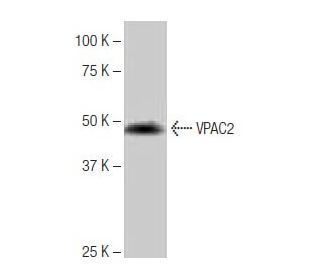

VPAC2 Antibody (5B3): sc-135604
- VPAC2 Antibody (5B3) is a mouse monoclonal IgG2a κ VPAC2 antibody provided at 100 µg/ml
- raised against a partial recombinant protein mapping to an internal region of VPAC2 of human origin
- recommended for detection of VPAC2 of human origin by WB, IP and ELISA
- At present, we have not yet completed the identification of the preferred secondary detection reagent(s) for VPAC2 Antibody (5B3). This work is in progress.

QUICK LINKS
SEE ALSO...
VPAC2 Antibody (5B3) is a mouse monoclonal IgG2a kappa light chain antibody that detects VPAC2 protein of human origin by western blotting (WB), immunoprecipitation (IP), and enzyme-linked immunosorbent assay (ELISA). VPAC2 (5B3) antibody is available as a non-conjugated format. VPAC2 protein is a member of the vasoactive intestinal peptide (VIP) and pituitary adenylate cyclase-activating polypeptide (PACAP) receptor family, which plays a crucial role in various physiological processes, including neuronal differentiation and immune response modulation. Located predominantly in the brain and T cells, VPAC2 interacts with both VIP and PACAP, activating adenylyl cyclase and subsequently increasing cyclic AMP levels, which is vital for signaling pathways that influence cell growth and function. VPAC2 receptor is part of a larger superfamily of G-protein coupled receptors, which also includes VPAC1 and PACAP receptor, each exhibiting unique expression patterns and signaling capabilities. VPAC2′s ability to mediate important cellular responses underscores its significance in neurobiology and immunology, making anti-VPAC2 antibody (5B3) an essential tool for researchers studying these pathways.
Alexa Fluor® is a trademark of Molecular Probes Inc., OR., USA
LI-COR® and Odyssey® are registered trademarks of LI-COR Biosciences
VPAC2 Antibody (5B3) References:
- Pituitary adenylate cyclase-activating polypeptide and its receptors: from structure to functions. | Vaudry, D., et al. 2000. Pharmacol Rev. 52: 269-324. PMID: 10835102
- Overexpression of the human VPAC2 receptor in the suprachiasmatic nucleus alters the circadian phenotype of mice. | Shen, S., et al. 2000. Proc Natl Acad Sci U S A. 97: 11575-80. PMID: 11027354
- Expression of vasoactive intestinal peptide (VIP) receptors in human uterus. | Bajo, AM., et al. 2000. Peptides. 21: 1383-8. PMID: 11072126
- Vasoactive intestinal peptide: cardiovascular effects. | Henning, RJ. and Sawmiller, DR. 2001. Cardiovasc Res. 49: 27-37. PMID: 11121793
- Selective gene expression and activation-dependent regulation of vasoactive intestinal peptide receptor type 1 and type 2 in human T cells. | Lara-Marquez, M., et al. 2001. J Immunol. 166: 2522-30. PMID: 11160313
- Regulation of vasoactive intestinal peptide receptor expression in developing nervous systems. | Karacay, B., et al. 2000. Ann N Y Acad Sci. 921: 165-74. PMID: 11193820
- Vasoactive intestinal peptide (VIP) receptor type 2 (VPAC2) is the predominant receptor expressed in human thymocytes. | Lara-Marquez, ML., et al. 2000. Ann N Y Acad Sci. 921: 45-54. PMID: 11193874
- Pituitary adenylate cyclase-activating polypeptide (PACAP) and its receptors in the brain. | Shioda, S. 2000. Kaibogaku Zasshi. 75: 487-507. PMID: 11197592
- c-Maf and JunB mediation of Th2 differentiation induced by the type 2 G protein-coupled receptor (VPAC2) for vasoactive intestinal peptide. | Voice, J., et al. 2004. J Immunol. 172: 7289-96. PMID: 15187104
- Region-specific changes in the immunoreactivity of vasoactive intestinal peptide and pituitary adenylate cyclase-activating polypeptide receptors (VPAC2, and PAC1 receptor) in the aged rat brains. | Lee, JC., et al. 2010. Brain Res. 1351: 32-40. PMID: 20599818
- VIP Regulates Morphology and F-Actin Distribution of Schlemm's Canal in a Chronic Intraocular Pressure Hypertension Model via the VPAC2 Receptor. | Chen, L., et al. 2018. Invest Ophthalmol Vis Sci. 59: 2848-2860. PMID: 30025111
- Cross-talk between fetal membranes and visceral adipose tissue involves HMGB1-RAGE and VIP-VPAC2 pathways in human gestational diabetes mellitus. | Santangelo, C., et al. 2019. Acta Diabetol. 56: 681-689. PMID: 30820673
Ordering Information
| Product Name | Catalog # | UNIT | Price | Qty | FAVORITES | |
VPAC2 Antibody (5B3) | sc-135604 | 100 µg/ml | $339.00 |