
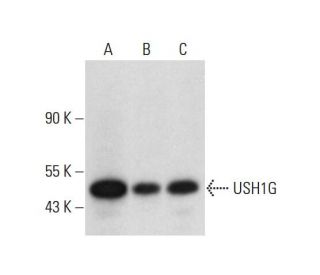


USH1G Antibody (D-10): sc-514418
- USH1G Antibody (D-10) is a mouse monoclonal IgG1 κ USH1G antibody, cited in 2 publications, provided at 200 µg/ml
- specific for an epitope mapping between amino acids 1-17 at the N-terminus of USH1G of human origin
- USH1G Antibody (D-10) is recommended for detection of USH1G of mouse, rat and human origin by WB, IP, IF and ELISA
- Anti-USH1G Antibody (D-10) is available conjugated to agarose for IP; HRP for WB, IHC(P) and ELISA; and to either phycoerythrin or FITC for IF, IHC(P) and FCM
- also available conjugated to Alexa Fluor® 488, Alexa Fluor® 546, Alexa Fluor® 594 or Alexa Fluor® 647 for WB (RGB), IF, IHC(P) and FCM, and for use with RGB fluorescent imaging systems, such as iBright™ FL1000, FluorChem™, Typhoon, Azure and other comparable systems
- also available conjugated to Alexa Fluor® 680 or Alexa Fluor® 790 for WB (NIR), IF and FCM; for use with Near-Infrared (NIR) detection systems, such as LI-COR®Odyssey®, iBright™ FL1000, FluorChem™, Typhoon, Azure and other comparable systems
- m-IgG Fc BP-HRP, m-IgG1 BP-HRP and m-IgGκ BP-HRP are the preferred secondary detection reagents for USH1G Antibody (D-10) for WB applications. These reagents are now offered in bundles with USH1G Antibody (D-10) (see ordering information below).

QUICK LINKS
USH1G Antibody (D-10) is a mouse monoclonal IgG1 kappa light chain antibody that detects USH1G protein of mouse, rat, and human origin by western blotting (WB), immunoprecipitation (IP), immunofluorescence (IF), and enzyme-linked immunosorbent assay (ELISA). USH1G (D-10) antibody is available in both non-conjugated and various conjugated forms, including agarose, horseradish peroxidase (HRP), phycoerythrin (PE), fluorescein isothiocyanate (FITC), and multiple Alexa Fluor® conjugates. USH1G protein, also known as ANKS4A or SANS, is a 461 amino acid protein characterized by three ankyrin repeats and one sterile alpha motif (SAM) domain, which are crucial for structural integrity and function. USH1G protein is predominantly expressed in the small intestine, as well as in the eye and inner ear tissues, where USH1G protein plays a vital role in the development and maintenance of auditory and visual systems by facilitating the cohesion of hair bundles formed by inner ear sensory cells. USH1G protein interaction with Harmonin is particularly significant, as this interaction is believed to be essential for proper functioning of the auditory system. Mutations in the gene encoding USH1G lead to Usher syndrome type 1G, a condition marked by profound congenital sensorineural deafness, absent vestibular function, and early onset of progressive retinitis pigmentosa, ultimately resulting in blindness.
Alexa Fluor® is a trademark of Molecular Probes Inc., OR., USA
LI-COR® and Odyssey® are registered trademarks of LI-COR Biosciences
USH1G Antibody (D-10) References:
- Mutations in a new scaffold protein Sans cause deafness in Jackson shaker mice. | Kikkawa, Y., et al. 2003. Hum Mol Genet. 12: 453-61. PMID: 12588793
- Usher syndrome type I G (USH1G) is caused by mutations in the gene encoding SANS, a protein that associates with the USH1C protein, harmonin. | Weil, D., et al. 2003. Hum Mol Genet. 12: 463-71. PMID: 12588794
- Ultrastructural findings in the inner ear of Jackson shaker mice. | Kitamura, K., et al. 1992. Acta Otolaryngol. 112: 622-7. PMID: 1442008
- Interactions in the network of Usher syndrome type 1 proteins. | Adato, A., et al. 2005. Hum Mol Genet. 14: 347-56. PMID: 15590703
- Characterization of Usher syndrome type I gene mutations in an Usher syndrome patient population. | Ouyang, XM., et al. 2005. Hum Genet. 116: 292-9. PMID: 15660226
- Screening of the USH1G gene among Spanish patients with Usher syndrome. Lack of mutations and evidence of a minor role in the pathogenesis of the syndrome. | Aller, E., et al. 2007. Ophthalmic Genet. 28: 151-5. PMID: 17896313
- UMD-USHbases: a comprehensive set of databases to record and analyse pathogenic mutations and unclassified variants in seven Usher syndrome causing genes. | Baux, D., et al. 2008. Hum Mutat. 29: E76-87. PMID: 18484607
- Novel USH1G homozygous variant underlying USH2-like phenotype of Usher syndrome. | D'Esposito, F., et al. 2021. Eur J Ophthalmol. 31: NP18-NP22. PMID: 31566003
- SANS (USH1G) regulates pre-mRNA splicing by mediating the intra-nuclear transfer of tri-snRNP complexes. | Yildirim, A., et al. 2021. Nucleic Acids Res. 49: 5845-5866. PMID: 34023904
- Pathogenic Variants in USH1G/SANS Alter Protein Interaction with Pre-RNA Processing Factors PRPF6 and PRPF31 of the Spliceosome. | Fritze, JS., et al. 2023. Int J Mol Sci. 24: PMID: 38139438
Ordering Information
| Product Name | Catalog # | UNIT | Price | Qty | FAVORITES | |
USH1G Antibody (D-10) | sc-514418 | 200 µg/ml | $322.00 | |||
USH1G Antibody (D-10): m-IgG Fc BP-HRP Bundle | sc-531118 | 200 µg Ab; 10 µg BP | $361.00 | |||
USH1G Antibody (D-10): m-IgGκ BP-HRP Bundle | sc-524717 | 200 µg Ab, 40 µg BP | $361.00 | |||
USH1G Antibody (D-10): m-IgG1 BP-HRP Bundle | sc-544405 | 200 µg Ab; 20 µg BP | $361.00 | |||
USH1G Antibody (D-10) AC | sc-514418 AC | 500 µg/ml, 25% agarose | $424.00 | |||
USH1G Antibody (D-10) HRP | sc-514418 HRP | 200 µg/ml | $322.00 | |||
USH1G Antibody (D-10) FITC | sc-514418 FITC | 200 µg/ml | $336.00 | |||
USH1G Antibody (D-10) PE | sc-514418 PE | 200 µg/ml | $349.00 | |||
USH1G Antibody (D-10) Alexa Fluor® 488 | sc-514418 AF488 | 200 µg/ml | $364.00 | |||
USH1G Antibody (D-10) Alexa Fluor® 546 | sc-514418 AF546 | 200 µg/ml | $364.00 | |||
USH1G Antibody (D-10) Alexa Fluor® 594 | sc-514418 AF594 | 200 µg/ml | $364.00 | |||
USH1G Antibody (D-10) Alexa Fluor® 647 | sc-514418 AF647 | 200 µg/ml | $364.00 | |||
USH1G Antibody (D-10) Alexa Fluor® 680 | sc-514418 AF680 | 200 µg/ml | $364.00 | |||
USH1G Antibody (D-10) Alexa Fluor® 790 | sc-514418 AF790 | 200 µg/ml | $364.00 | |||
USH1G (D-10) Neutralizing Peptide | sc-514418 P | 100 µg/0.5 ml | $69.00 |