
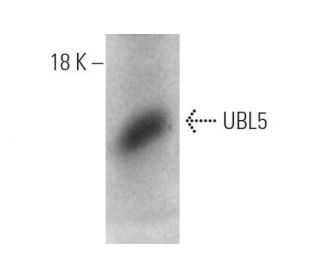

UBL5 Antibody (429CT16.3.1): sc-517371
- UBL5 Antibody (429CT16.3.1) is a mouse monoclonal IgG1 UBL5 antibody provided at 100 µg/ml
- raised against purified His-tagged UBL5 protein fragment of human origin
- recommended for detection of UBL5 of mouse, rat and human origin by WB and IP
- At present, we have not yet completed the identification of the preferred secondary detection reagent(s) for UBL5 Antibody (429CT16.3.1). This work is in progress.

QUICK LINKS
UBL5 Antibody (429CT16.3.1) is a mouse monoclonal IgG1 antibody that detects UBL5 protein of mouse, rat, and human origin by western blotting (WB) and immunoprecipitation (IP). Anti-UBL5 antibody (429CT16.3.1) is available as a non-conjugated format. UBL5, also known as Ubiquitin-like protein 5 or Beacon, is a 73 amino acid cytoplasmic protein that plays a crucial role in cellular processes by interacting with various target proteins. One of the significant aspects of UBL5 is involvement in post-translational modifications, particularly forming isopeptide bonds with lysine residues on target proteins, which is essential for regulating protein function and stability. Unlike ubiquitin, UBL5 lacks glycine residues at C-terminus, which influences conjugation dynamics and functional interactions. UBL5 is ubiquitously expressed across various tissues, with highest levels found in iris, kidney, muscle, brain, heart, liver, and lymphoblasts. In brain, UBL5 is notably expressed in vasopressin- and oxytocin-positive neurons, suggesting a role in neuroendocrine functions and osmoregulation. Unique structural characteristics and functional implications of UBL5 make this protein important for understanding cellular signaling pathways and potential therapeutic targets.
Alexa Fluor® is a trademark of Molecular Probes Inc., OR., USA
LI-COR® and Odyssey® are registered trademarks of LI-COR Biosciences
UBL5 Antibody (429CT16.3.1) References:
- Isolation of a ubiquitin-like (UBL5) gene from a screen identifying highly expressed and conserved iris genes. | Friedman, JS., et al. 2001. Genomics. 71: 252-5. PMID: 11161819
- Role of a ubiquitin-like modification in polarized morphogenesis. | Dittmar, GA., et al. 2002. Science. 295: 2442-6. PMID: 11923536
- Structural analysis of UBL5, a novel ubiquitin-like modifier. | McNally, T., et al. 2003. Protein Sci. 12: 1562-6. PMID: 12824502
- Beacon/ubiquitin-like 5-immunoreactivity in the hypothalamus and pituitary of the mouse. | Brailoiu, GC., et al. 2003. Brain Res. 984: 215-23. PMID: 12932856
- Genetic variation in BEACON influences quantitative variation in metabolic syndrome-related phenotypes. | Jowett, JB., et al. 2004. Diabetes. 53: 2467-72. PMID: 15331561
- Hypo-osmotic shock induces nuclear export and proteasome-dependent decrease of UBL5. | Hatanaka, K., et al. 2006. Biochem Biophys Res Commun. 350: 610-5. PMID: 17026961
- Association of genetic variation within UBL5 with phenotypes of metabolic syndrome. | Bozaoglu, K., et al. 2006. Hum Biol. 78: 147-59. PMID: 17036923
- Identification of sequence variants in the UBL5 (ubiquitin-like 5 or BEACON) gene in obese children by PCR-SSCP: no evidence for association with obesity. | Sentinelli, F., et al. 2008. J Pediatr Endocrinol Metab. 21: 1139-45. PMID: 19189687
Ordering Information
| Product Name | Catalog # | UNIT | Price | Qty | FAVORITES | |
UBL5 Antibody (429CT16.3.1) | sc-517371 | 100 µg/ml | $322.00 |