
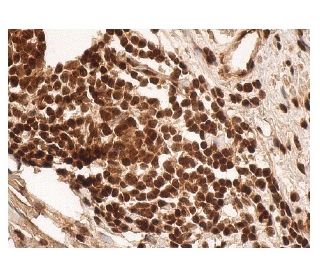
Ubiquitin Antibody (P4G7): sc-53509
- Ubiquitin Antibody (P4G7) is a mouse monoclonal IgG1 κ, cited in 20 publications, provided at 200 µg/ml
- raised against full length denatured ubiquitin of bovine origin
- Anti-Ubiquitin Antibody (P4G7) is recommended for detection of Ubiquitin, polyubiquitin and Ubiquitin-conjugated proteins of mouse, rat, human, bovine and yeast origin by WB, IP, IF, IHC(P) and ELISA
- Anti-Ubiquitin Antibody (P4G7) is available conjugated to agarose for IP; HRP for WB, IHC(P) and ELISA; and to either phycoerythrin or FITC for IF, IHC(P) and FCM
- also available conjugated to Alexa Fluor® 488, Alexa Fluor® 546, Alexa Fluor® 594 or Alexa Fluor® 647 for WB (RGB), IF, IHC(P) and FCM, and for use with RGB fluorescent imaging systems, such as iBright™ FL1000, FluorChem™, Typhoon, Azure and other comparable systems
- also available conjugated to Alexa Fluor® 680 or Alexa Fluor® 790 for WB (NIR), IF and FCM; for use with Near-Infrared (NIR) detection systems, such as LI-COR®Odyssey®, iBright™ FL1000, FluorChem™, Typhoon, Azure and other comparable systems
- m-IgG Fc BP-HRP and m-IgG1 BP-HRP are the preferred secondary detection reagents for Ubiquitin Antibody (P4G7) for WB and IHC(P) applications. These reagents are now offered in bundles with Ubiquitin Antibody (P4G7) (see ordering information below).

Ubiquitin Antibody (P4G7) is a mouse monoclonal IgG1 kappa light chain antibody engineered to detect full-length denatured Ubiquitin protein of bovine origin. Anti-Ubiquitin antibody (P4G7) recognizes Ubiquitin from mouse, rat, human, bovine, and yeast sources across a variety of applications including western blotting (WB), immunoprecipitation (IP), immunofluorescence (IF), immunohistochemistry with paraffin-embedded sections (IHCP), and enzyme-linked immunosorbent assay (ELISA). Available in both non-conjugated and multiple conjugated forms such as agarose, horseradish peroxidase (HRP), phycoerythrin (PE), fluorescein isothiocyanate (FITC), and various Alexa Fluor® conjugates, Ubiquitin monoclonal antibody (P4G7) offers versatile solutions to meet diverse experimental requirements. Ubiquitin is one of the most evolutionarily conserved proteins, ubiquitously localized within various cellular compartments including the cytoplasm, nucleus, and mitochondria, which is crucial for maintaining cellular homeostasis. Ubiquitin′s primary function involves tagging abnormal, foreign, and improperly folded proteins for degradation by the 26S Proteasome, a process essential for protein quality control and regulation of numerous cellular pathways. This tagging is achieved through the covalent attachment of Ubiquitin to substrate proteins via an isopeptide bond between its carboxy-terminal glycine and lysine residues on target proteins, enabling the formation of polyubiquitin chains, particularly through Lysine 48 linkages that signal for proteolysis. Beyond protein degradation, Ubiquitin plays a vital role in regulating signal transduction pathways, DNA repair, and cell cycle progression by modulating the stability and function of key regulatory proteins such as IκB-α and p27. Ubiquitin also contributes to endocytosis and receptor trafficking, expanding its role beyond intracellular protein turnover. Strategic localization of Ubiquitin within different cellular compartments ensures efficient regulation of these processes, highlighting Ubiquitin (P4G7) antibody as an essential tool for researchers studying protein turnover, cellular signaling mechanisms, and the intricate networks governing cellular regulation.
Alexa Fluor® is a trademark of Molecular Probes Inc., OR., USA
LI-COR® and Odyssey® are registered trademarks of LI-COR Biosciences
Ubiquitin Antibody (P4G7) References:
- Kinetic analysis of the conjugation of ubiquitin to picornavirus 3C proteases catalyzed by the mammalian ubiquitin-protein ligase E3alpha. | Lawson, TG., et al. 2001. J Biol Chem. 276: 39629-37. PMID: 11526102
- Ubiquitin protein ligase Nedd4 binds to connexin43 by a phosphorylation-modulated process. | Leykauf, K., et al. 2006. J Cell Sci. 119: 3634-42. PMID: 16931598
- Adenovirus ubiquitin-protein ligase stimulates viral late mRNA nuclear export. | Woo, JL. and Berk, AJ. 2007. J Virol. 81: 575-87. PMID: 17079297
- Multiple forms of ubiquitin-protein ligase. Binding of activated ubiquitin to protein substrates. | Lee, PL., et al. 1986. Biochemistry. 25: 3134-8. PMID: 3015198
- Alterations in components of the ubiquitin-protein ligase system following maturation of reticulocytes to erythrocytes. | Raviv, O., et al. 1987. Biochem Biophys Res Commun. 145: 658-65. PMID: 3593363
- Ubiquitin-mediated processing of NF-kappa B transcriptional activator precursor p105. Reconstitution of a cell-free system and identification of the ubiquitin-carrier protein, E2, and a novel ubiquitin-protein ligase, E3, involved in conjugation. | Orian, A., et al. 1995. J Biol Chem. 270: 21707-14. PMID: 7665588
- The HPV-16 E6 and E6-AP complex functions as a ubiquitin-protein ligase in the ubiquitination of p53. | Scheffner, M., et al. 1993. Cell. 75: 495-505. PMID: 8221889
- Ubiquitination mediated by the Npi1p/Rsp5p ubiquitin-protein ligase is required for endocytosis of the yeast uracil permease. | Galan, JM., et al. 1996. J Biol Chem. 271: 10946-52. PMID: 8631913
- Subcellular localization and ubiquitin-conjugating enzyme (E2) interactions of mammalian HECT family ubiquitin protein ligases. | Hatakeyama, S., et al. 1997. J Biol Chem. 272: 15085-92. PMID: 9182527
- Human ubiquitin-protein ligase Nedd4: expression, subcellular localization and selective interaction with ubiquitin-conjugating enzymes. | Anan, T., et al. 1998. Genes Cells. 3: 751-63. PMID: 9990509
Ordering Information
| Product Name | Catalog # | UNIT | Price | Qty | FAVORITES | |
Ubiquitin Antibody (P4G7) | sc-53509 | 200 µg/ml | $322.00 | |||
Ubiquitin Antibody (P4G7): m-IgG Fc BP-HRP Bundle | sc-526821 | 200 µg Ab; 10 µg BP | $361.00 | |||
Ubiquitin Antibody (P4G7): m-IgG1 BP-HRP Bundle | sc-532194 | 200 µg Ab; 20 µg BP | $361.00 | |||
Ubiquitin Antibody (P4G7) AC | sc-53509 AC | 500 µg/ml, 25% agarose | $424.00 | |||
Ubiquitin Antibody (P4G7) HRP | sc-53509 HRP | 200 µg/ml | $322.00 | |||
Ubiquitin Antibody (P4G7) FITC | sc-53509 FITC | 200 µg/ml | $336.00 | |||
Ubiquitin Antibody (P4G7) PE | sc-53509 PE | 200 µg/ml | $349.00 | |||
Ubiquitin Antibody (P4G7) Alexa Fluor® 488 | sc-53509 AF488 | 200 µg/ml | $364.00 | |||
Ubiquitin Antibody (P4G7) Alexa Fluor® 546 | sc-53509 AF546 | 200 µg/ml | $364.00 | |||
Ubiquitin Antibody (P4G7) Alexa Fluor® 594 | sc-53509 AF594 | 200 µg/ml | $364.00 | |||
Ubiquitin Antibody (P4G7) Alexa Fluor® 647 | sc-53509 AF647 | 200 µg/ml | $364.00 | |||
Ubiquitin Antibody (P4G7) Alexa Fluor® 680 | sc-53509 AF680 | 200 µg/ml | $364.00 | |||
Ubiquitin Antibody (P4G7) Alexa Fluor® 790 | sc-53509 AF790 | 200 µg/ml | $364.00 |