
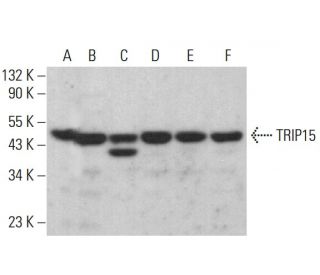
TRIP15 Antibody (42): sc-136511
- TRIP15 Antibody (42) is a mouse monoclonal IgG2b κ TRIP15 antibody provided at 200 µg/ml
- raised against amino acids 172-299 of TRIP15 of human origin
- recommended for detection of TRIP15 of mouse, rat, human and canine origin by WB and IP
- available conjugated to agarose for IP; and to HRP for WB, IHC(P) and ELISA
- m-IgGκ BP-HRP is the preferred secondary detection reagent for TRIP15 Antibody (42) for WB applications. This reagent is now offered in a bundle with TRIP15 Antibody (42) (see ordering information below). For additional m-IgGκ BP conjugates see our complete list of Mouse IgG Binding Proteins.

QUICK LINKS
SEE ALSO...
TRIP15 Antibody (42) is a mouse monoclonal IgG2b kappa light chain antibody that detects TRIP15 protein of mouse, rat, human, and canine origin by western blotting (WB) and immunoprecipitation (IP). Anti-TRIP15 antibody (42) is available in both non-conjugated and various conjugated forms, including agarose and horseradish peroxidase (HRP). TRIP15 protein plays a crucial role in cellular regulation as part of the COP9 signalosome, a multi-subunit complex essential for modulating protein degradation pathways. TRIP15, along with Cops2 and Alien, forms the second subunit (CSN2) of this complex, which regulates Skp1-cullin-F-box protein (SCF) ubiquitin ligases. By deconjugating Nedd8 from the Cul1 component of SCF, TRIP15 helps inhibit ligase activity, impacting cell cycle by preventing progression from G1 to S phase. Structural features of TRIP15, including an acidic region at N-terminus, a putative zinc finger at C-terminus, and a central hydrophobic core flanked by two potential alpha-helical structures, along with a nuclear localization signal, are vital for function and interaction with other proteins. These characteristics underscore TRIP15′s importance in maintaining cellular homeostasis and regulating critical signaling pathways.
Alexa Fluor® is a trademark of Molecular Probes Inc., OR., USA
LI-COR® and Odyssey® are registered trademarks of LI-COR Biosciences
TRIP15 Antibody (42) References:
- Interaction between interferon consensus sequence-binding protein and COP9/signalosome subunit CSN2 (Trip15). A possible link between interferon regulatory factor signaling and the COP9/signalosome. | Cohen, H., et al. 2000. J Biol Chem. 275: 39081-9. PMID: 10991940
- The COP9 signalosome inhibits p27(kip1) degradation and impedes G1-S phase progression via deneddylation of SCF Cul1. | Yang, X., et al. 2002. Curr Biol. 12: 667-72. PMID: 11967155
- The role of transcriptional corepressor Nif3l1 in early stage of neural differentiation via cooperation with Trip15/CSN2. | Akiyama, H., et al. 2003. J Biol Chem. 278: 10752-62. PMID: 12522100
- Implication of Trip15/CSN2 in early stage of neuronal differentiation of P19 embryonal carcinoma cells. | Akiyama, H., et al. 2003. Brain Res Dev Brain Res. 140: 45-56. PMID: 12524175
- Disruption of the COP9 signalosome Csn2 subunit in mice causes deficient cell proliferation, accumulation of p53 and cyclin E, and early embryonic death. | Lykke-Andersen, K., et al. 2003. Mol Cell Biol. 23: 6790-7. PMID: 12972599
- Identification and characterization of TRIP8 gene in silico. | Katoh, M. and Katoh, M. 2003. Int J Mol Med. 12: 817-21. PMID: 14533015
Ordering Information
| Product Name | Catalog # | UNIT | Price | Qty | FAVORITES | |
TRIP15 Antibody (42) | sc-136511 | 200 µg/ml | $322.00 | |||
TRIP15 Antibody (42): m-IgGκ BP-HRP Bundle | sc-552273 | 200 µg Ab; 40 µg BP | $361.00 | |||
TRIP15 Antibody (42) AC | sc-136511 AC | 500 µg/ml, 25% agarose | $424.00 | |||
TRIP15 Antibody (42) HRP | sc-136511 HRP | 200 µg/ml | $322.00 |