
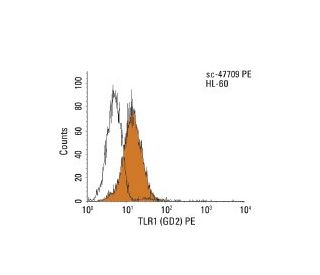

TLR1 Antibody (GD2): sc-47709
- TLR1 Antibody (GD2) is a mouse monoclonal IgG1 κ, cited in 2 publications, provided at 200 µg/ml
- raised against human recombinant soluble TLR1 extracellular domain (TLR1-Fc)
- recommended for detection of TLR1 of human origin by IF and FCM
- available conjugated to either phycoerythrin or FITC for IF, IHC(P) and FCM
- m-IgG Fc BP-HRP, m-IgG1 BP-HRP and m-IgGκ BP-HRP are the preferred secondary detection reagents for TLR1 Antibody (GD2). These reagents are now offered in bundles with TLR1 Antibody (GD2) (see ordering information below).

TLR1 Antibody (GD2) is a mouse monoclonal IgG1 antibody that detects TLR1 in human samples through applications such as immunofluorescence (IF) and flow cytometry (FCM). TLR1 plays a crucial role in the immune system by recognizing pathogen-associated molecular patterns, which is essential for initiating immune responses against infections. TLR1 is primarily located on the cell surface of immune cells, including macrophages and dendritic cells, where TLR1 functions as a type I transmembrane receptor. TLR1′s presence on these immune cells enables detection of bacterial lipoproteins, leading to the activation of downstream signaling pathways that promote inflammation and the recruitment of additional immune cells to sites of infection. TLR1′s ability to form heterodimers with TLR2 enhances specificity and sensitivity to various microbial components, thereby amplifying the immune response. Anti-TLR1 antibody (GD2) serves as an invaluable tool for researchers studying immune signaling pathways and the role of TLRs in host defense mechanisms.
Alexa Fluor® is a trademark of Molecular Probes Inc., OR., USA
LI-COR® and Odyssey® are registered trademarks of LI-COR Biosciences
TLR1 Antibody (GD2) References:
- Association between TLR1 polymorphisms and alopecia areata. | Seok, H., et al. 2014. Autoimmunity. 47: 372-7. PMID: 24780078
- Association of TLR1, TLR2, TLR4, TLR6, and TIRAP polymorphisms with disease susceptibility. | Noreen, M. and Arshad, M. 2015. Immunol Res. 62: 234-52. PMID: 25784622
- TLR1 expression in mouse brain was increased in a KA-induced seizure model. | Wang, FX., et al. 2015. Inflamm Res. 64: 487-95. PMID: 26021825
- TLR1, 2, 4, 6 and 9 Variants Associated with Tuberculosis Susceptibility: A Systematic Review and Meta-Analysis. | Schurz, H., et al. 2015. PLoS One. 10: e0139711. PMID: 26430737
- The TLR1 gene is associated with higher protection from leprosy in women. | Alvarenga Niitsuma, EN., et al. 2018. PLoS One. 13: e0205234. PMID: 30289892
- Structural Basis of TLR2/TLR1 Activation by the Synthetic Agonist Diprovocim. | Su, L., et al. 2019. J Med Chem. 62: 2938-2949. PMID: 30829478
- Curcumin interferes with sepsis-induced cardiomyocyte apoptosis via TLR1 inhibition. | Chen, D., et al. 2023. Rev Port Cardiol. 42: 209-221. PMID: 36702348
- Sperm activate TLR2/TLR1 heterodimerization to induce a weak proinflammatory response in the bovine uterus. | Mansouri, A., et al. 2023. Front Immunol. 14: 1158090. PMID: 37180107
- Dysfunctional TLR1 reduces the therapeutic efficacy of chemotherapy by attenuating HMGB1-mediated antitumor immunity in locally advanced colorectal cancer. | Huang, KC., et al. 2023. Sci Rep. 13: 19440. PMID: 37945630
- Metabolic trade-offs in Neonatal sepsis triggered by TLR4 and TLR1/2 ligands result in unique dysfunctions in neural breathing circuits. | Joana Alves, M., et al. 2024. Brain Behav Immun. 119: 333-350. PMID: 38561095
Ordering Information
| Product Name | Catalog # | UNIT | Price | Qty | FAVORITES | |
TLR1 Antibody (GD2) | sc-47709 | 200 µg/ml | $322.00 | |||
TLR1 Antibody (GD2): m-IgG Fc BP-HRP Bundle | sc-536801 | 200 µg Ab; 10 µg BP | $361.00 | |||
TLR1 Antibody (GD2): m-IgGκ BP-HRP Bundle | sc-533965 | 200 µg Ab; 40 µg BP | $361.00 | |||
TLR1 Antibody (GD2): m-IgG1 BP-HRP Bundle | sc-544827 | 200 µg Ab; 20 µg BP | $361.00 | |||
TLR1 Antibody (GD2) FITC | sc-47709 FITC | 200 µg/ml | $336.00 | |||
TLR1 Antibody (GD2) PE | sc-47709 PE | 200 µg/ml | $349.00 |