
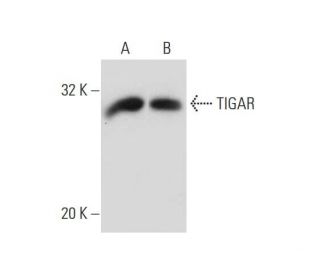


TIGAR Antibody (9C10): sc-101535
- TIGAR Antibody (9C10) is a mouse monoclonal IgG2b κ, cited in 1 publications, provided at 200 µg/ml
- raised against a 15-amino acid peptide corresponding to the exon C-terminal region of TIGAR of human origin
- recommended for detection of TIGAR of human origin by WB and IP
- m-IgG2b BP-HRP is the preferred secondary detection reagent for TIGAR Antibody (9C10) for WB applications. This reagent is now offered in a bundle with TIGAR Antibody (9C10) (see ordering information below).

QUICK LINKS
SEE ALSO...
TIGAR Antibody (9C10) is a mouse monoclonal IgG2b antibody that detects TIGAR (TP53-induced glycolysis and apoptosis regulator) in human samples through western blotting (WB) and immunoprecipitation (IP) applications. TIGAR, also known as C12orf5, is a 270 amino acid protein that plays a crucial role in cellular metabolism and stress response by modulating glycolysis and the pentose phosphate pathway. Induced by the p53 tumor suppressor pathway, anti-TIGAR antibody (9C10) helps protect cells from oxidative stress by lowering intracellular levels of fructose-2,6-bisphosphate, which in turn inhibits glycolysis and redirects metabolic flux towards the pentose phosphate shunt. This metabolic shift is vital as TIGAR not only reduces the production of reactive oxygen species, which can cause DNA damage and trigger apoptosis, but also enhances the generation of NADPH, a critical cofactor for biosynthetic reactions and antioxidant defense. TIGAR′s ability to regulate these pathways underscores its importance in maintaining cellular homeostasis and potential implications in cancer biology, where p53 mutations can disrupt these protective mechanisms. TIGAR monoclonal antibody (9C10) serves as an essential tool for researchers investigating the intricate balance between metabolism and cell survival in various physiological and pathological contexts.
Alexa Fluor® is a trademark of Molecular Probes Inc., OR., USA
LI-COR® and Odyssey® are registered trademarks of LI-COR Biosciences
TIGAR Antibody (9C10) References:
- TIGAR inhibits ischemia/reperfusion-induced inflammatory response of astrocytes. | Chen, J., et al. 2018. Neuropharmacology. 131: 377-388. PMID: 29331305
- TIGAR regulates mitochondrial functions through SIRT1-PGC1α pathway and translocation of TIGAR into mitochondria in skeletal muscle. | Geng, J., et al. 2019. FASEB J. 33: 6082-6098. PMID: 30726106
- TIGAR impedes compression-induced intervertebral disc degeneration by suppressing nucleus pulposus cell apoptosis and autophagy. | Li, Z., et al. 2020. J Cell Physiol. 235: 1780-1794. PMID: 31317559
- TIGAR promotes growth, survival and metastasis through oxidation resistance and AKT activation in glioblastoma. | Tang, Z. and He, Z. 2019. Oncol Lett. 18: 2509-2517. PMID: 31402948
- TP53, TP53 Target Genes (DRAM, TIGAR), and Autophagy. | Hu, W., et al. 2019. Adv Exp Med Biol. 1206: 127-149. PMID: 31776983
- Sirtuin 3 Alleviates Diabetic Cardiomyopathy by Regulating TIGAR and Cardiomyocyte Metabolism. | Li, L., et al. 2021. J Am Heart Assoc. 10: e018913. PMID: 33586458
- TIGAR mitigates atherosclerosis by promoting cholesterol efflux from macrophages. | Zhao, ZW., et al. 2021. Atherosclerosis. 327: 76-86. PMID: 33994201
- TIGAR deficiency enhances skeletal muscle thermogenesis by increasing neuromuscular junction cholinergic signaling. | Tang, Y., et al. 2022. Elife. 11: PMID: 35254259
- TIGAR deficiency sensitizes angiotensin-II-induced renal fibrosis and glomerular injury. | He, X., et al. 2022. Physiol Rep. 10: e15234. PMID: 35441828
Ordering Information
| Product Name | Catalog # | UNIT | Price | Qty | FAVORITES | |
TIGAR Antibody (9C10) | sc-101535 | 200 µg/ml | $322.00 | |||
TIGAR Antibody (9C10): m-IgG2b BP-HRP Bundle | sc-548477 | 200 µg Ab; 10 µg BP | $361.00 |