
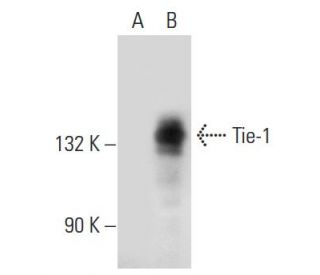

Tie-1 Antibody (12D9): sc-101587
- Tie-1 Antibody (12D9) is a mouse monoclonal IgG1 provided at 100 µg/ml
- raised against the extracellular domain of Tie-1 of human origin
- recommended for detection of Tie-1 of human origin by WB, IP, IF and IHC(P); non cross-reactive with Tie-2
- At present, we have not yet completed the identification of the preferred secondary detection reagent(s) for Tie-1 Antibody (12D9). This work is in progress.

Tie-1 Antibody (12D9) is a mouse monoclonal IgG1 antibody that detects Tie-1 in human samples through applications such as western blotting (WB), immunoprecipitation (IP), immunofluorescence (IF), and immunohistochemistry. Tie-1 is a crucial receptor tyrosine kinase that plays a significant role in regulating endothelial cell function and vascular development, making Tie-1 essential for maintaining vascular integrity and homeostasis. Tie-1 is primarily located on the surface of endothelial cells, where Tie-1 participates in signaling pathways that influence cell proliferation, migration, and survival. This localization allows Tie-1 to interact with other signaling molecules and receptors, such as Tie-2, to modulate angiogenesis and vascular permeability. The unique multidomain structure of Tie-1, which includes epidermal growth factor homology motifs and fibronectin type III repeats, facilitates ligand binding and activation of downstream signaling cascades. Anti-Tie-1 antibody (12D9) enables researchers to gain insights into vascular biology mechanisms and pathophysiology of diseases related to endothelial dysfunction.
Alexa Fluor® is a trademark of Molecular Probes Inc., OR., USA
LI-COR® and Odyssey® are registered trademarks of LI-COR Biosciences
Tie-1 Antibody (12D9) References:
- Role of Tie1 in shear stress and atherosclerosis. | Woo, KV. and Baldwin, HS. 2011. Trends Cardiovasc Med. 21: 118-23. PMID: 22681967
- LECT2, a Ligand for Tie1, Plays a Crucial Role in Liver Fibrogenesis. | Xu, M., et al. 2019. Cell. 178: 1478-1492.e20. PMID: 31474362
- TIE1 as a Candidate Gene for Lymphatic Malformations with or without Lymphedema. | Michelini, S., et al. 2020. Int J Mol Sci. 21: PMID: 32947856
- Involvement of small extracellular vesicle-derived TIE-1 in the chemoresistance of ovarian cancer cells. | Misawa, T., et al. 2021. Cancer Treat Res Commun. 27: 100364. PMID: 33812182
- Serum Tie-1 is a Valuable Marker for Predicting the Progression and Prognosis of Cervical Cancer. | Bai, R., et al. 2021. Pathol Oncol Res. 27: 1610006. PMID: 34975347
- Protein Interactions in Rhodopseudomonas palustris TIE-1 Reveal the Molecular Basis for Resilient Photoferrotrophic Iron Oxidation. | Trindade, IB., et al. 2023. Molecules. 28: PMID: 37375288
- TIE1 and TEK signalling, intraocular pressure, and primary open-angle glaucoma: a Mendelian randomization study. | Rajasundaram, S., et al. 2023. J Transl Med. 21: 847. PMID: 37996923
- TIE1 promotes cervical cancer progression via Basigin-matrix metalloproteinase axis. | Liu, P., et al. 2024. Int J Biol Sci. 20: 2297-2309. PMID: 38617545
- Identification of the Expression of TIE1 and Its Mediated Immunosuppression in Gastric Cancer. | Gong, Z., et al. 2024. J Cancer. 15: 2994-3009. PMID: 38706903
- Loss-of-function mutations of the TIE1 receptor tyrosine kinase cause late-onset primary lymphedema. | Brouillard, P., et al. 2024. J Clin Invest. 134: PMID: 38820174
Ordering Information
| Product Name | Catalog # | UNIT | Price | Qty | FAVORITES | |
Tie-1 Antibody (12D9) | sc-101587 | 100 µg/ml | $322.00 |