
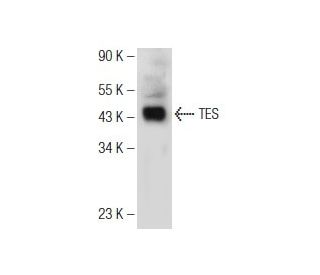


TES Antibody (G-5): sc-373913
- TES Antibody (G-5) is a mouse monoclonal IgG1 κ, cited in 1 publications, provided at 200 µg/ml
- raised against amino acids 304-398 mapping near the C-terminus of TES of human origin
- recommended for detection of TES of mouse, rat and human origin by WB, IP, IF and ELISA; also reactive with additional species, including equine
- m-IgG Fc BP-HRP, m-IgG1 BP-HRP and m-IgGκ BP-HRP are the preferred secondary detection reagents for TES Antibody (G-5) for WB applications. These reagents are now offered in bundles with TES Antibody (G-5) (see ordering information below).

QUICK LINKS
SEE ALSO...
TES Antibody (G-5) is a mouse monoclonal IgG1 antibody that detects TES in mouse, rat, and human samples through applications such as western blotting (WB), immunoprecipitation (IP), immunofluorescence (IF), and enzyme-linked immunosorbent assay (ELISA). TES, also known as Testin, is a crucial focal adhesion protein that plays a significant role in cellular adhesion and signaling. TES (G-5) antibody targets proteins primarily located at cell-cell contacts and along actin stress fibers, where TES interacts with a variety of cytoskeletal proteins, including Zyxin, Mena, VASP, Talin, and Actin. TES localization is vital for maintaining cellular architecture and facilitating communication between cells, which is essential for tissue integrity and function. Notably, TES contains three LIM zinc-binding domains that contribute to structural stability and functional versatility, allowing TES to act as a potential tumor suppressor. Dysregulation of TES expression can lead to increased cell spreading and decreased motility, highlighting TES importance in cancer biology and cellular dynamics. With insights into mechanisms of cell adhesion and motility, anti-TES antibody (G-5) serves as an invaluable tool for researchers studying these critical processes.
Alexa Fluor® is a trademark of Molecular Probes Inc., OR., USA
LI-COR® and Odyssey® are registered trademarks of LI-COR Biosciences
TES Antibody (G-5) References:
- OY-TES-1 expression and serum immunoreactivity in epithelial ovarian cancer. | Tammela, J., et al. 2006. Int J Oncol. 29: 903-10. PMID: 16964386
- TES was epigenetically silenced and suppressed the epithelial-mesenchymal transition in breast cancer. | Yongbin, Y., et al. 2014. Tumour Biol. 35: 11381-9. PMID: 25119600
- Delineating the Tes Interaction Site in Zyxin and Studying Cellular Effects of Its Disruption. | Hadzic, E., et al. 2015. PLoS One. 10: e0140511. PMID: 26509500
- TES inhibits colorectal cancer progression through activation of p38. | Li, H., et al. 2016. Oncotarget. 7: 45819-45836. PMID: 27323777
- Proteomic analysis of Toxocara canis excretory and secretory (TES) proteins. | Sperotto, RL., et al. 2017. Mol Biochem Parasitol. 211: 39-47. PMID: 27638150
- Testin (TES) as a candidate tumour suppressor and prognostic marker in human astrocytoma. | Steponaitis, G., et al. 2016. Oncol Lett. 12: 3305-3311. PMID: 27899997
- Cancer-testis Antigen OY-TES-1 Expression and Immunogenicity in Hepatocellular Carcinoma. | Luo, B., et al. 2020. Curr Med Sci. 40: 719-728. PMID: 32862383
- Preparation of Non-overlapping Transposable Elements (TEs) Annotation by Interval Tree. | Kojima, S. 2022. Methods Mol Biol. 2509: 353-360. PMID: 35796974
- Ribonucleoprotein Granules: Between Stress and Transposable Elements. | Moon, S. and Namkoong, S. 2023. Biomolecules. 13: PMID: 37509063
- Behavioral Validation of Individualized Low-Intensity Transcranial Electrical Stimulation (tES) Protocols. | Joshi, R., et al. 2023. eNeuro. 10: PMID: 38135512
Ordering Information
| Product Name | Catalog # | UNIT | Price | Qty | FAVORITES | |
TES Antibody (G-5) | sc-373913 | 200 µg/ml | $322.00 | |||
TES Antibody (G-5): m-IgG Fc BP-HRP Bundle | sc-537885 | 200 µg Ab; 10 µg BP | $361.00 | |||
TES Antibody (G-5): m-IgGκ BP-HRP Bundle | sc-535337 | 200 µg Ab; 40 µg BP | $361.00 | |||
TES Antibody (G-5): m-IgG1 BP-HRP Bundle | sc-545429 | 200 µg Ab; 20 µg BP | $361.00 |