
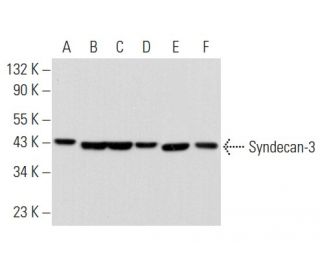
SYND3/SDC3/Syndecan-3 Antibody (G-2): sc-398194
- SYND3/SDC3/Syndecan-3 Antibody (G-2) is a mouse monoclonal IgM κ SYND3/SDC3/Syndecan-3 antibody, cited in 3 publications, provided at 200 µg/ml
- specific for an epitope mapping between amino acids 64-91 within an internal region of syndecan-3 of rat origin
- recommended for detection of Syndecan-3 of mouse, rat and human origin by WB, IP, IF and ELISA; also reactive with additional species, including and equine, canine and bovine
- m-IgGκ BP-HRP is the preferred secondary detection reagent for SYND3/SDC3/Syndecan-3 Antibody (G-2) for WB applications. This reagent is now offered in a bundle with SYND3/SDC3/Syndecan-3 Antibody (G-2) (see ordering information below). For additional m-IgGκ BP conjugates see our complete list of Mouse IgG Binding Proteins.

QUICK LINKS
Syndecan-3 Antibody (G-2) is a mouse monoclonal IgM antibody that detects Syndecan-3 protein of mouse, rat, and human origin by western blotting (WB), immunoprecipitation (IP), immunofluorescence (IF), and enzyme-linked immunosorbent assay (ELISA). Anti-Syndecan-3 antibody (G-2) is available as a non-conjugated format. Syndecan-3, also known as N-Syndecan, plays a crucial role in cell signaling and communication by acting as a co-receptor for various growth factors, including midkine, which is essential for the development of the central nervous system. This interaction regulates cellular processes such as proliferation, migration, and differentiation, particularly during embryogenesis. Heparan sulfate chains on Syndecan-3 enhance binding to growth factors and extracellular matrix components, thereby influencing cell behavior and tissue organization. Syndecan-3 also modulates cell-extracellular matrix adhesion, which maintains tissue integrity and facilitates cellular responses to environmental cues. With diverse functions and interactions, Syndecan-3 serves as an important protein in developmental biology and tissue homeostasis, making anti-Syndecan-3 antibody (G-2) a valuable research tool for studying these processes.
Alexa Fluor® is a trademark of Molecular Probes Inc., OR., USA
LI-COR® and Odyssey® are registered trademarks of LI-COR Biosciences
SYND3/SDC3/Syndecan-3 Antibody (G-2) References:
- Syndecan-4 signals cooperatively with integrins in a Rho-dependent manner in the assembly of focal adhesions and actin stress fibers. | Saoncella, S., et al. 1999. Proc Natl Acad Sci U S A. 96: 2805-10. PMID: 10077592
- Syndecan-3: a cell-surface heparan sulfate proteoglycan important for chondrocyte proliferation and function during limb skeletogenesis. | Pacifici, M., et al. 2005. J Bone Miner Metab. 23: 191-9. PMID: 15838620
- Adhesion of B lymphoid (MPC-11) cells to type I collagen is mediated by integral membrane proteoglycan, syndecan. | Sanderson, RD., et al. 1992. J Immunol. 148: 3902-11. PMID: 1602136
- Syndecan-3 is selectively pro-inflammatory in the joint and contributes to antigen-induced arthritis in mice. | Kehoe, O., et al. 2014. Arthritis Res Ther. 16: R148. PMID: 25015005
- Syndecan-3 in Inflammation and Angiogenesis. | Arokiasamy, S., et al. 2019. Front Immunol. 10: 3031. PMID: 31998313
- Hypoxia Promotes Syndecan-3 Expression in the Tumor Microenvironment. | Prieto-Fernández, E., et al. 2020. Front Immunol. 11: 586977. PMID: 33117401
- Syndecan-3 enhances anabolic bone formation through WNT signaling. | Johnson de Sousa Brito, FM., et al. 2021. FASEB J. 35: e21246. PMID: 33769615
- Syndecan-3 as a Novel Biomarker in Alzheimer's Disease. | Hudák, A., et al. 2022. Int J Mol Sci. 23: PMID: 35328830
- The Cell Surface Heparan Sulfate Proteoglycan Syndecan-3 Promotes Ovarian Cancer Pathogenesis. | Hillemeyer, L., et al. 2022. Int J Mol Sci. 23: PMID: 35628603
- Syndecan family of cell surface proteoglycans: developmentally regulated receptors for extracellular effector molecules. | Salmivirta, M. and Jalkanen, M. 1995. Experientia. 51: 863-72. PMID: 7556568
- Spatial and temporal changes in the expression of fibroglycan (syndecan-2) during mouse embryonic development. | David, G., et al. 1993. Development. 119: 841-54. PMID: 8187643
- Expression of syndecan-1 and -3 during embryogenesis of the central nervous system in relation to binding with midkine. | Nakanishi, T., et al. 1997. J Biochem. 121: 197-205. PMID: 9089390
Ordering Information
| Product Name | Catalog # | UNIT | Price | Qty | FAVORITES | |
SYND3/SDC3/Syndecan-3 Antibody (G-2) | sc-398194 | 200 µg/ml | $322.00 | |||
SYND3/SDC3/Syndecan-3 Antibody (G-2): m-IgGκ BP-HRP Bundle | sc-524248 | 200 µg Ab, 40 µg BP | $361.00 | |||
SYND3/SDC3/Syndecan-3 (G-2) Neutralizing Peptide | sc-398194 P | 100 µg/0.5 ml | $69.00 |