
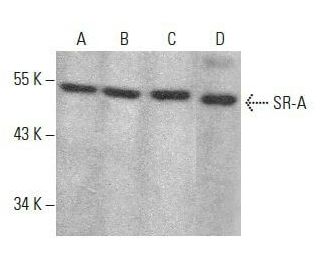
SR-A Antibody (E-10): sc-374130
- SR-A Antibody (E-10) is a mouse monoclonal IgG2a κ, cited in 1 publications, provided at 200 µg/ml
- specific for an epitope mapping between amino acids 119-152 within an internal region of SR-A of human origin
- recommended for detection of SR-A isoforms I and II of human origin by WB, IP, IF and ELISA
- See SR-A (E-5): sc-166184 for SR-A antibody conjugates, including AC, HRP, FITC, PE, Alexa Fluor® 488, 594, 647, 680 and 790.
- m-IgG Fc BP-HRP, m-IgG2a BP-HRP and m-IgGκ BP-HRP are the preferred secondary detection reagents for SR-A Antibody (E-10) for WB applications. These reagents are now offered in bundles with SR-A Antibody (E-10) (see ordering information below).

QUICK LINKS
SR-A Antibody (E-10) is a mouse monoclonal IgG2a antibody that detects scavenger receptor class A (SR-A) in human samples through applications such as western blotting (WB), immunoprecipitation (IP), immunofluorescence (IF), and enzyme-linked immunosorbent assay (ELISA). SR-A is a critical protein involved in the uptake of modified low-density lipoprotein (LDL), playing a significant role in lipid metabolism and atherosclerosis. SR-A is primarily located on the surface of macrophages, where SR-A facilitates the recognition and internalization of oxidized LDL particles, thereby influencing cholesterol homeostasis and inflammatory responses. This function is particularly important as oxidized LDL accumulation in macrophages can lead to foam cell formation, a key event in atherosclerotic plaque development. SR-A is expressed in various tissues, including the liver, placenta, and brain, highlighting diverse roles in both physiological and pathological processes. The gene encoding human SR-A is located on chromosome 8 and produces two main isoforms, SR-AI and SR-AII, which differ in ligand recognition capabilities and functional implications in diseases such as atherosclerosis and Alzheimer′s disease. Anti-SR-A antibody (E-10) is an invaluable tool for researchers studying these critical pathways and their implications in cardiovascular and neurodegenerative diseases.
Alexa Fluor® is a trademark of Molecular Probes Inc., OR., USA
LI-COR® and Odyssey® are registered trademarks of LI-COR Biosciences
SR-A Antibody (E-10) References:
- Phosphorothioate oligodeoxynucleotides distribute similarly in class A scavenger receptor knockout and wild-type mice. | Butler, M., et al. 2000. J Pharmacol Exp Ther. 292: 489-96. PMID: 10640284
- Expression of class A scavenger receptor inhibits apoptosis of macrophages triggered by oxidized low density lipoprotein and oxysterol. | Liao, HS., et al. 2000. Arterioscler Thromb Vasc Biol. 20: 1968-75. PMID: 10938019
- Adipocyte-derived plasma protein, adiponectin, suppresses lipid accumulation and class A scavenger receptor expression in human monocyte-derived macrophages. | Ouchi, N., et al. 2001. Circulation. 103: 1057-63. PMID: 11222466
- Biomechanical strain induces class a scavenger receptor expression in human monocyte/macrophages and THP-1 cells: a potential mechanism of increased atherosclerosis in hypertension. | Sakamoto, H., et al. 2001. Circulation. 104: 109-14. PMID: 11435347
- Expression of class A scavenger receptor is enhanced by high glucose in vitro and under diabetic conditions in vivo: one mechanism for an increased rate of atherosclerosis in diabetes. | Fukuhara-Takaki, K., et al. 2005. J Biol Chem. 280: 3355-64. PMID: 15556945
- Nobiletin, a citrus flavonoid isolated from tangerines, selectively inhibits class A scavenger receptor-mediated metabolism of acetylated LDL by mouse macrophages. | Whitman, SC., et al. 2005. Atherosclerosis. 178: 25-32. PMID: 15585197
- A novel peptide binding to the cytoplasmic domain of class A scavenger receptor reduces lipid uptake in THP-1 macrophages. | Wang, X., et al. 2009. Biochim Biophys Acta. 1791: 76-83. PMID: 19049904
- Regulation of class A scavenger receptor-mediated cell adhesion and surface localization by PI3K: identification of a regulatory cytoplasmic motif. | Cholewa, J., et al. 2010. J Leukoc Biol. 87: 443-9. PMID: 19952357
- The class A scavenger receptor SR-A/CD204 and the class B scavenger receptor CD36 regulate immune functions of macrophages differently. | Józefowski, S., et al. 2014. Innate Immun. 20: 826-47. PMID: 24257313
- Housing conditions modulate the severity of Mycoplasma pulmonis infection in mice deficient in class A scavenger receptor. | Booth, JL., et al. 2014. Comp Med. 64: 424-39. PMID: 25527023
Ordering Information
| Product Name | Catalog # | UNIT | Price | Qty | FAVORITES | |
SR-A Antibody (E-10) | sc-374130 | 200 µg/ml | $322.00 | |||
SR-A Antibody (E-10): m-IgG Fc BP-HRP Bundle | sc-537919 | 200 µg Ab; 10 µg BP | $361.00 | |||
SR-A Antibody (E-10): m-IgGκ BP-HRP Bundle | sc-535394 | 200 µg Ab; 40 µg BP | $361.00 | |||
SR-A Antibody (E-10): m-IgG2a BP-HRP Bundle | sc-548150 | 200 µg Ab; 10 µg BP | $361.00 | |||
SR-A (E-10) Neutralizing Peptide | sc-374130 P | 100 µg/0.5 ml | $69.00 |