
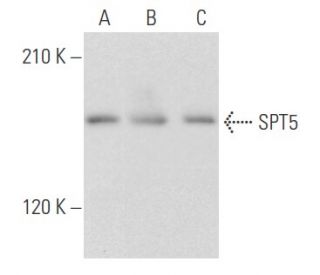
SPT5 Antibody (A-3): sc-133097
- SPT5 Antibody (A-3) is a mouse monoclonal IgG1 κ, cited in 1 publications, provided at 200 µg/ml
- raised against amino acids 61-360 mapping near the N-terminus of SPT5 of human origin
- recommended for detection of SPT5 of mouse, rat and human origin by WB, IP, IF and ELISA
- TransCruz reagent for ChIP application (sc-133097 X, 200 µg/0.1 ml)
- m-IgG Fc BP-HRP and m-IgG1 BP-HRP are the preferred secondary detection reagents for SPT5 Antibody (A-3) for WB applications. These reagents are now offered in bundles with SPT5 Antibody (A-3) (see ordering information below).

SPT5 Antibody (A-3) is a mouse monoclonal IgG1 antibody that detects SPT5 in mouse, rat, and human samples through applications such as western blotting (WB), immunoprecipitation (IP), immunofluorescence (IF), and enzyme-linked immunosorbent assay (ELISA). SPT5, also known as DSIF p160, plays a crucial role in regulating transcriptional elongation, particularly in RNA polymerase II activity. SPT5 is essential for forming the DRB-sensitivity-inducing factor (DSIF) complex when binding to SPT4, which is vital for modulating the transcription process. Notably, SPT5 undergoes significant post-translational modifications, particularly phosphorylation, which affects mobility on SDS-PAGE; SPT5 from mitotic HeLa cells migrates more slowly than from interphase cells due to enhanced phosphorylation. The C-terminal CTR1 domain of SPT5 is specifically targeted for phosphorylation by the positive transcription elongation factor b (P-TEFb), a modification critical for function as a transcriptional elongation regulator. SPT5′s interaction with various transcription factors and RNA polymerase II underscores importance in gene expression regulation, making anti-SPT5 antibody (A-3) an invaluable tool for researchers studying transcriptional mechanisms and cellular processes.
Alexa Fluor® is a trademark of Molecular Probes Inc., OR., USA
LI-COR® and Odyssey® are registered trademarks of LI-COR Biosciences
SPT5 Antibody (A-3) References:
- A nexus for gene expression-molecular mechanisms of Spt5 and NusG in the three domains of life. | Werner, F. 2012. J Mol Biol. 417: 13-27. PMID: 22306403
- Spt5 Plays Vital Roles in the Control of Sense and Antisense Transcription Elongation. | Shetty, A., et al. 2017. Mol Cell. 66: 77-88.e5. PMID: 28366642
- Targeting Spt5-Pol II by Small-Molecule Inhibitors Uncouples Distinct Activities and Reveals Additional Regulatory Roles. | Bahat, A., et al. 2019. Mol Cell. 76: 617-631.e4. PMID: 31564557
- Spt5-mediated enhancer transcription directly couples enhancer activation with physical promoter interaction. | Fitz, J., et al. 2020. Nat Genet. 52: 505-515. PMID: 32251373
- SPT5 stabilization of promoter-proximal RNA polymerase II. | Aoi, Y., et al. 2021. Mol Cell. 81: 4413-4424.e5. PMID: 34480849
- SPT5 stabilizes RNA polymerase II, orchestrates transcription cycles, and maintains the enhancer landscape. | Hu, S., et al. 2021. Mol Cell. 81: 4425-4439.e6. PMID: 34534457
- Spt5 histone binding activity preserves chromatin during transcription by RNA polymerase II. | Evrin, C., et al. 2022. EMBO J. 41: e109783. PMID: 35102600
- Spt5 C-terminal repeat domain phosphorylation and length negatively regulate heterochromatin through distinct mechanisms. | MacKinnon, S., et al. 2023. PLoS Genet. 19: e1010492. PMID: 37939109
- Binding of small molecule inhibitors to RNA polymerase-Spt5 complex impacts RNA and DNA stability. | Gallardo, A. and Dutagaci, B. 2023. J Comput Aided Mol Des. 38: 1. PMID: 37987925
- The CDK9-SPT5 Axis in Control of Transcription Elongation by RNAPII. | Sun, R. and Fisher, RP. 2024. J Mol Biol. 168746. PMID: 39147127
Ordering Information
| Product Name | Catalog # | UNIT | Price | Qty | FAVORITES | |
SPT5 Antibody (A-3) | sc-133097 | 200 µg/ml | $322.00 | |||
SPT5 Antibody (A-3): m-IgG Fc BP-HRP Bundle | sc-539847 | 200 µg Ab; 10 µg BP | $361.00 | |||
SPT5 Antibody (A-3): m-IgG1 BP-HRP Bundle | sc-541746 | 200 µg Ab; 20 µg BP | $361.00 | |||
SPT5 Antibody (A-3) X | sc-133097 X | 200 µg/0.1 ml | $322.00 |