
Not CRISPR data: the image illustrates antibody quality for visualizing CRISPR experiment results.
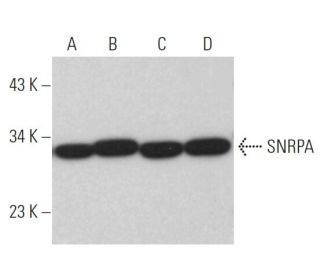
SNRPA Antibody (B-12): sc-376027. Western blot analysis of SNRPA expression in A549 (A), Neuro-2A (B) and KNRK (C) whole cell lysates and rat testis tissue extract (D).
Not CRISPR data: the image illustrates antibody quality for visualizing CRISPR experiment results.
Not CRISPR data: the image illustrates antibody quality for visualizing CRISPR experiment results.
SNRPA CRISPR/Cas9 KO质粒 (h): sc-404128
- 针对种属:human
- 20 µg 纯化的即用型的质粒DNA,最多可供20次转染
- SNRPA CRISPR/Cas9 基因敲除(KO)质粒(h) 是一组质粒混合物,每种质粒均编码 Cas9 核酸酶及针对特定靶点的 20 核苷酸引导 RNA(gRNA),其设计基于 GeCKO v2 文库中的序列,旨在实现最高的基因敲除效率
- gRNA序列引导Cas9在SNRPA基因组位点诱导位点特异性双链断裂(DSBs),从而通过非同源末端连接(NHEJ)实现基因敲除
- 嘌呤霉素抗性基因和 RFP 基因两侧有 LoxP 位点,因此在建立稳定的基因敲除细胞系后,可以通过 Cre 重组酶(Cre 向量:sc-418923)去除选择标记。
- 转染后,基因敲除效率可以用抗体:SNRPA: sc-376027,通过WB, IF或者IHC分析

订购信息
| 产品名称 | 产品编号 | 规格 | 价格 | 数量 | 收藏夹 | |
SNRPA CRISPR/Cas9 KO质粒 (h) | sc-404128 | 20 µg | $397.00 |
概述
SNRPA 编码 U1 小核核糖核蛋白 A(U1 snRNP A),它是 U1 snRNP 的关键核心组分之一,负责在 pre-mRNA 剪接过程中识别 5′ 剪接位点。通过参与剪接体的早期装配,SNRPA 有助于确保内含子被准确移除、转录本成熟,并协调与转录及 RNA 加工相耦联的基因表达程序。U1 snRNP 功能受损可引发广泛的可变剪接和转录本不稳定,这些过程常与致癌转化以及神经发育和神经退行性表型相关。作为基础性的剪接体因子,SNRPA 常被用于研究剪接保真性与蛋白质稳态、细胞周期调控以及应激响应型 RNA 调控网络之间的联系。
SNRPA CRISPR/Cas9 KO质粒(h)是一组旨在针对性地破坏human细胞系中SNRPA基因的质粒池。每条质粒均共表达一种独特的单引导RNA(sgRNA),该sgRNA针对SNRPA基因内的特定位点,并携带来自化脓性链球菌的Cas9核酸酶。这些质粒还编码GFP,可通过荧光显微镜或流式细胞术对成功转染的细胞进行荧光标记和富集。
多引导设计提高了在Cas9介导的双链断裂形成后,产生破坏SNRPA开放阅读框的插入或缺失(indels)的概率。CRISPR/Cas9系统引入的DNA断裂通过内源性非同源末端连接(NHEJ)途径修复,通常会导致移码突变,从而使SNRPA蛋白表达失活。
该CRISPR敲除系统能够高效构建SNRPA缺失的细胞模型,用于SNRPA信号传导研究、功能基因组学研究、癌症生物学研究以及人类细胞系中治疗反应的评估。
主要特点
- 针对对 SNRPA 功能至关重要的 SNRPA 外显子的 sgRNA
通过单质粒共表达 SpCas9 和 sgRNA 以简化递送过程
GFP 报告基因用于识别转染细胞
针对多个 SNRPA 基因组位点的质粒池以提高敲除效率
兼容转染递送
设计变体
CRISPRs +/- HDR
- 由 SNRPA CRISPR/Cas9 KO 质粒 (h) 和 SNRPA CRISPR/Cas9 KO 质粒 (h2) 编码的 gRNA 分别靶向 SNRPA 基因座内的不同位点。可能提供其中一种或两种靶向设计。具体供应情况请参见相关产品。
由 SNRPA HDR 质粒(h)编码的 HDR 供体构建体以及 SNRPA HDR质粒(h2)编码的HDR供体构建体包含一个嘌呤霉素抗性盒和一个RFP报告基因,其两侧由SNRPA同源臂包围,以支持在与CRISPR/Cas9敲除设计对应的特定SNRPA靶位点进行同源导向修复。HDR供体的供应情况可能有所不同。请查看“相关产品”了解供应情况。
仅供研究使用。不用于诊断或治疗。