
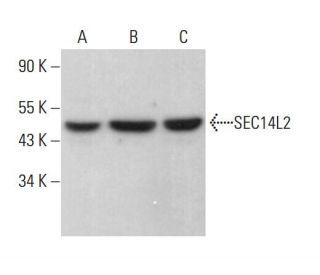
SEC14L2 Antibody (H-4): sc-271905
- SEC14L2 Antibody (H-4) is a mouse monoclonal IgM κ SEC14L2 antibody provided at 200 µg/ml
- raised against amino acids 1-300 mapping at the N-terminus of SEC14L2 of human origin
- recommended for detection of SEC14L2 of mouse, rat and human origin by WB, IP, IF and ELISA
- m-IgGκ BP-HRP is the preferred secondary detection reagent for SEC14L2 Antibody (H-4) for WB applications. This reagent is now offered in a bundle with SEC14L2 Antibody (H-4) (see ordering information below). For additional m-IgGκ BP conjugates see our complete list of Mouse IgG Binding Proteins.

QUICK LINKS
SEC14L2 Antibody (H-4) is a mouse monoclonal IgM antibody that detects SEC14L2 of mouse, rat, and human origin by western blotting (WB), immunoprecipitation (IP), immunofluorescence (IF), and enzyme-linked immunosorbent assay (ELISA). Anti-SEC14L2 antibody (H-4) is available as a non-conjugated monoclonal isotype antibody. SEC14L2, also known as supernatant protein factor (SPF), α-tocopherol-associated protein, or squalene transfer protein, plays a crucial role in lipid metabolism by functioning as a carrier protein that transfers tocopherols and acts as a transcriptional activator through interaction with α-tocopherol. This interaction maintains cellular health and regulates gene expression related to antioxidant defense. SEC14L2 is predominantly expressed in liver, brain, intestine, and prostate, highlighting importance in various physiological processes. While SEC14L2 is primarily localized in cytoplasm, nuclear presence is induced by α-tocopherol, suggesting a regulatory mechanism that may influence gene transcription. SEC14L2 activity is modulated by post-translational modifications, particularly phosphorylation by protein kinase A and protein kinase C, which are essential for functional regulation and interaction with other cellular pathways.
Alexa Fluor® is a trademark of Molecular Probes Inc., OR., USA
LI-COR® and Odyssey® are registered trademarks of LI-COR Biosciences
SEC14L2 Antibody (H-4) References:
- Supernatant protein factor, which stimulates the conversion of squalene to lanosterol, is a cytosolic squalene transfer protein and enhances cholesterol biosynthesis. | Shibata, N., et al. 2001. Proc Natl Acad Sci U S A. 98: 2244-9. PMID: 11226224
- Phosphorylation of supernatant protein factor enhances its ability to stimulate microsomal squalene monooxygenase. | Singh, DK., et al. 2003. J Biol Chem. 278: 5646-51. PMID: 12454003
- Supernatant protein factor in complex with RRR-alpha-tocopherylquinone: a link between oxidized Vitamin E and cholesterol biosynthesis. | Stocker, A. and Baumann, U. 2003. J Mol Biol. 332: 759-65. PMID: 12972248
- Supernatant protein factor stimulates HMG-CoA reductase in cell culture and in vitro. | Mokashi, V., et al. 2005. Arch Biochem Biophys. 433: 474-80. PMID: 15581604
- Regulation of hepatic cholesterol synthesis by a novel protein (SPF) that accelerates cholesterol biosynthesis. | Shibata, N., et al. 2006. FASEB J. 20: 2642-4. PMID: 17077281
- Effects of a supernatant protein activator on microsomal squalene-2,3-oxide-lanosterol cyclase. | Caras, IW. and Bloch, K. 1979. J Biol Chem. 254: 11816-21. PMID: 500676
- Role of supernatant protein factor and anionic phospholipid in squalene uptake and conversion by microsomes. | Chin, J. and Bloch, K. 1984. J Biol Chem. 259: 11735-8. PMID: 6480582
- Supernatant protein factor facilitates intermembrane transfer of squalene. | Friedlander, EJ., et al. 1980. J Biol Chem. 255: 8042-5. PMID: 7410347
Ordering Information
| Product Name | Catalog # | UNIT | Price | Qty | FAVORITES | |
SEC14L2 Antibody (H-4) | sc-271905 | 200 µg/ml | $322.00 | |||
SEC14L2 Antibody (H-4): m-IgGκ BP-HRP Bundle | sc-522095 | 200 µg Ab, 40 µg BP | $361.00 |