
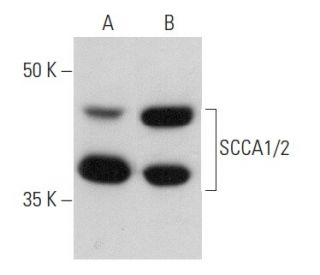
SCCA1/2 Antibody (B-9): sc-28384
- SCCA1/2 Antibody (B-9) is a mouse monoclonal IgG1 κ SCCA1/2 antibody, cited in 2 publications, provided at 200 µg/ml
- raised against amino acids 1-390 representing full length SCCA2 of human origin
- SCCA1/2 Antibody (B-9) is recommended for detection of SCCA1 and SCCA2 of mouse, rat and human origin by WB, IP, IF, IHC(P) and ELISA
- Anti-SCCA1/2 Antibody (B-9) is available conjugated to agarose for IP; HRP for WB, IHC(P) and ELISA; and to either phycoerythrin or FITC for IF, IHC(P) and FCM
- also available conjugated to Alexa Fluor® 488, Alexa Fluor® 546, Alexa Fluor® 594 or Alexa Fluor® 647 for WB (RGB), IF, IHC(P) and FCM, and for use with RGB fluorescent imaging systems, such as iBright™ FL1000, FluorChem™, Typhoon, Azure and other comparable systems
- also available conjugated to Alexa Fluor® 680 or Alexa Fluor® 790 for WB (NIR), IF and FCM; for use with Near-Infrared (NIR) detection systems, such as LI-COR®Odyssey®, iBright™ FL1000, FluorChem™, Typhoon, Azure and other comparable systems
- m-IgG Fc BP-HRP and m-IgG1 BP-HRP are the preferred secondary detection reagents for SCCA1/2 Antibody (B-9) for WB and IHC(P) applications. These reagents are now offered in bundles with SCCA1/2 Antibody (B-9) (see ordering information below).

QUICK LINKS
SCCA1/2 Antibody (B-9) is a mouse monoclonal IgG1 kappa light chain antibody that detects SCCA1/2 of mouse, rat, and human origin by western blotting (WB), immunoprecipitation (IP), immunofluorescence (IF), immunohistochemistry, and enzyme-linked immunosorbent assay (ELISA). Anti-SCCA1/2 antibody (B-9) is available in both non-conjugated and various conjugated forms, including agarose, horseradish peroxidase (HRP), phycoerythrin (PE), fluorescein isothiocyanate (FITC), and multiple Alexa Fluor® conjugates. SCCA1 and SCCA2 proteins, which are part of the serpin family of serine protease inhibitors, play a crucial role in regulating proteolytic activity in the extracellular matrix, thereby influencing processes such as tumor progression and metastasis. SCCA1 and SCCA2 proteins are primarily located in the cytoplasm and are secreted into the extracellular space, where SCCA1 and SCCA2 interact with serine proteases to inhibit their activity. Such inhibition is vital for maintaining tissue homeostasis and preventing excessive degradation of the extracellular matrix, which can lead to tumor invasion and metastasis. SCCA1, which encodes a 390 amino acid protein, was initially identified in metastatic cervical squamous cell carcinoma, and SCCA1 expression levels have been associated with various cancer stages, making SCCA1 a potential biomarker for cancer diagnosis and prognosis. SCCA1/2 proteins are encoded by two nearly identical genes located on human chromosome 18q21.3, and SCCA1/2 aberrant expression can indicate the presence and progression of several malignancies, including cervical, lung, esophageal, and head and neck cancers.
Alexa Fluor® is a trademark of Molecular Probes Inc., OR., USA
LI-COR® and Odyssey® are registered trademarks of LI-COR Biosciences
SCCA1/2 Antibody (B-9) References:
- Development of specific monoclonal antibodies and a sensitive discriminatory immunoassay for the circulating tumor markers SCCA1 and SCCA2. | Cataltepe, S., et al. 2000. Clin Chim Acta. 295: 107-27. PMID: 10767398
- Circulating serpin tumor markers SCCA1 and SCCA2 are not actively secreted but reside in the cytosol of squamous carcinoma cells. | Uemura, Y., et al. 2000. Int J Cancer. 89: 368-77. PMID: 10956412
- Relative levels of SCCA2 and SCCA1 mRNA in primary tumors predicts recurrent disease in squamous cell cancer of the head and neck. | Stenman, J., et al. 2001. Int J Cancer. 95: 39-43. PMID: 11241309
- Effect of SCCA1 and SCCA2 on the suppression of TNF-alpha-induced cell death by impeding the release of mitochondrial cytochrome c in an oral squamous cell carcinoma cell line. | Hashimoto, K., et al. 2005. Tumour Biol. 26: 165-72. PMID: 16006770
- Differential effects of periopathogens on host protease inhibitors SLPI, elafin, SCCA1, and SCCA2. | Yin, L., et al. 2010. J Oral Microbiol. 2: PMID: 21523231
- Squamous Cell Carcinoma Antigen 2 (SCCA2, SERPINB4): An Emerging Biomarker for Skin Inflammatory Diseases. | Izuhara, K., et al. 2018. Int J Mol Sci. 19: PMID: 29642409
- Salivary Scca1, Scca2 and Trop2 in Oral Cancer Patients-A Cross-Sectional Pilot Study. | Karmelić, I., et al. 2022. Dent J (Basel). 10: PMID: 35448064
- SCCA1/SERPINB3 suppresses antitumor immunity and blunts therapy-induced T cell responses via STAT-dependent chemokine production. | Chen, L., et al. 2023. J Clin Invest. 133: PMID: 37279067
- SCCA1 and SCCA2 are proteinase inhibitors that map to the serpin cluster at 18q21.3. | Silverman, GA., et al. 1998. Tumour Biol. 19: 480-7. PMID: 9817977
- An 18q- syndrome breakpoint resides between the duplicated serpins SCCA1 and SCCA2 and arises via a cryptic rearrangement with satellite III DNA. | Katz, SG., et al. 1999. Hum Mol Genet. 8: 87-92. PMID: 9887335
Ordering Information
| Product Name | Catalog # | UNIT | Price | Qty | FAVORITES | |
SCCA1/2 Antibody (B-9) | sc-28384 | 200 µg/ml | $322.00 | |||
SCCA1/2 Antibody (B-9): m-IgG Fc BP-HRP Bundle | sc-526667 | 200 µg Ab; 10 µg BP | $361.00 | |||
SCCA1/2 Antibody (B-9): m-IgG1 BP-HRP Bundle | sc-532040 | 200 µg Ab; 20 µg BP | $361.00 | |||
SCCA1/2 Antibody (B-9) AC | sc-28384 AC | 500 µg/ml, 25% agarose | $424.00 | |||
SCCA1/2 Antibody (B-9) HRP | sc-28384 HRP | 200 µg/ml | $322.00 | |||
SCCA1/2 Antibody (B-9) FITC | sc-28384 FITC | 200 µg/ml | $336.00 | |||
SCCA1/2 Antibody (B-9) PE | sc-28384 PE | 200 µg/ml | $349.00 | |||
SCCA1/2 Antibody (B-9) Alexa Fluor® 488 | sc-28384 AF488 | 200 µg/ml | $364.00 | |||
SCCA1/2 Antibody (B-9) Alexa Fluor® 546 | sc-28384 AF546 | 200 µg/ml | $364.00 | |||
SCCA1/2 Antibody (B-9) Alexa Fluor® 594 | sc-28384 AF594 | 200 µg/ml | $364.00 | |||
SCCA1/2 Antibody (B-9) Alexa Fluor® 647 | sc-28384 AF647 | 200 µg/ml | $364.00 | |||
SCCA1/2 Antibody (B-9) Alexa Fluor® 680 | sc-28384 AF680 | 200 µg/ml | $364.00 | |||
SCCA1/2 Antibody (B-9) Alexa Fluor® 790 | sc-28384 AF790 | 200 µg/ml | $364.00 |