
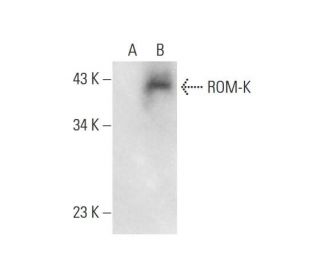


ROM-K Antibody (D-3): sc-393189
- ROM-K Antibody (D-3) is a mouse monoclonal IgG2a κ ROM-K antibody provided at 200 µg/ml
- raised against amino acids 321-390 mapping at the C-terminus of ROM-K of human origin
- ROM-K Antibody (D-3) is recommended for detection of ROM-K of mouse, rat and human origin by WB, IP, IF and ELISA
- Anti-ROM-K Antibody (D-3) is available conjugated to agarose for IP; HRP for WB, IHC(P) and ELISA; and to either phycoerythrin or FITC for IF, IHC(P) and FCM
- also available conjugated to Alexa Fluor® 488, Alexa Fluor® 546, Alexa Fluor® 594 or Alexa Fluor® 647 for WB (RGB), IF, IHC(P) and FCM, and for use with RGB fluorescent imaging systems, such as iBright™ FL1000, FluorChem™, Typhoon, Azure and other comparable systems
- also available conjugated to Alexa Fluor® 680 or Alexa Fluor® 790 for WB (NIR), IF and FCM; for use with Near-Infrared (NIR) detection systems, such as LI-COR®Odyssey®, iBright™ FL1000, FluorChem™, Typhoon, Azure and other comparable systems
- m-IgG Fc BP-HRP, m-IgG2a BP-HRP and m-IgGκ BP-HRP are the preferred secondary detection reagents for ROM-K Antibody (D-3) for WB applications. These reagents are now offered in bundles with ROM-K Antibody (D-3) (see ordering information below).

QUICK LINKS
SEE ALSO...
ROM-K Antibody (D-3) is a mouse monoclonal IgG2a kappa light chain antibody that detects ROM-K protein of mouse, rat, and human origin by western blotting (WB), immunoprecipitation (IP), immunofluorescence (IF), and enzyme-linked immunosorbent assay (ELISA). ROM-K (D-3) antibody is available in both non-conjugated and various conjugated forms, including agarose, horseradish peroxidase (HRP), phycoerythrin (PE), fluorescein isothiocyanate (FITC), and multiple Alexa Fluor® conjugates. ROM-K, also known as KIR1.1, is an ATP-sensitive inward rectifying potassium channel that plays a crucial role in regulating renal potassium secretion, which is vital for maintaining electrolyte balance and proper kidney function. This channel is characterized by preferentially conducting inward currents, remaining constitutively open, and is composed of a complex of four Kir subunits (Kir1-6). ROM-K (D-3) monoclonal antibody recognizes a protein that is activated by protein kinase A, and ROM-K activity is intricately regulated by phosphatidylinositol 4,5-bisphosphate and intracellular pH levels. Alternative splicing of ROM-K mRNA results in various isoforms that exhibit differential expression in the nephrons of the mammalian kidney, highlighting ROM-K′s functional diversity. Mutations in ROM-K have been associated with antenatal Bartter syndrome, an autosomal recessive disorder that disrupts renal electrolyte transport, underscoring ROM-K′s significance in renal physiology and potential implications in clinical conditions.
Alexa Fluor® is a trademark of Molecular Probes Inc., OR., USA
LI-COR® and Odyssey® are registered trademarks of LI-COR Biosciences
ROM-K Antibody (D-3) References:
- Regulation of ROMK1 channel by protein kinase A via a phosphatidylinositol 4,5-bisphosphate-dependent mechanism. | Liou, HH., et al. 1999. Proc Natl Acad Sci U S A. 96: 5820-5. PMID: 10318968
- Developmental expression of ROMK in rat kidney. | Zolotnitskaya, A. and Satlin, LM. 1999. Am J Physiol. 276: F825-36. PMID: 10362771
- A mutation linked with Bartter's syndrome locks Kir 1.1a (ROMK1) channels in a closed state. | Flagg, TP., et al. 1999. J Gen Physiol. 114: 685-700. PMID: 10532965
- Structure and dynamics of the pore of inwardly rectifying K(ATP) channels. | Loussouarn, G., et al. 2000. J Biol Chem. 275: 1137-44. PMID: 10625656
- Phosphatidylinositol 4,5-bisphosphate and intracellular pH regulate the ROMK1 potassium channel via separate but interrelated mechanisms. | Leung, YM., et al. 2000. J Biol Chem. 275: 10182-9. PMID: 10744702
- ROMK inwardly rectifying ATP-sensitive K+ channel. II. Cloning and distribution of alternative forms. | Boim, MA., et al. 1995. Am J Physiol. 268: F1132-40. PMID: 7611454
- An ATP-regulated, inwardly rectifying potassium channel from rat kidney (ROMK). | Hebert, SC. 1995. Kidney Int. 48: 1010-6. PMID: 8569061
- Cloning and functional expression of a novel isoform of ROMK inwardly rectifying ATP-dependent K+ channel, ROMK6 (Kir1.1f). | Kondo, C., et al. 1996. FEBS Lett. 399: 122-6. PMID: 8980134
Ordering Information
| Product Name | Catalog # | UNIT | Price | Qty | FAVORITES | |
ROM-K Antibody (D-3) | sc-393189 | 200 µg/ml | $322.00 | |||
ROM-K Antibody (D-3): m-IgG Fc BP-HRP Bundle | sc-530388 | 200 µg Ab; 10 µg BP | $361.00 | |||
ROM-K Antibody (D-3): m-IgGκ BP-HRP Bundle | sc-523845 | 200 µg Ab, 40 µg BP | $361.00 | |||
ROM-K Antibody (D-3): m-IgG2a BP-HRP Bundle | sc-547491 | 200 µg Ab; 10 µg BP | $361.00 | |||
ROM-K Antibody (D-3) AC | sc-393189 AC | 500 µg/ml, 25% agarose | $424.00 | |||
ROM-K Antibody (D-3) HRP | sc-393189 HRP | 200 µg/ml | $322.00 | |||
ROM-K Antibody (D-3) FITC | sc-393189 FITC | 200 µg/ml | $336.00 | |||
ROM-K Antibody (D-3) PE | sc-393189 PE | 200 µg/ml | $349.00 | |||
ROM-K Antibody (D-3) Alexa Fluor® 488 | sc-393189 AF488 | 200 µg/ml | $364.00 | |||
ROM-K Antibody (D-3) Alexa Fluor® 546 | sc-393189 AF546 | 200 µg/ml | $364.00 | |||
ROM-K Antibody (D-3) Alexa Fluor® 594 | sc-393189 AF594 | 200 µg/ml | $364.00 | |||
ROM-K Antibody (D-3) Alexa Fluor® 647 | sc-393189 AF647 | 200 µg/ml | $364.00 | |||
ROM-K Antibody (D-3) Alexa Fluor® 680 | sc-393189 AF680 | 200 µg/ml | $364.00 | |||
ROM-K Antibody (D-3) Alexa Fluor® 790 | sc-393189 AF790 | 200 µg/ml | $364.00 |