
Date published: 2026-4-24

1-800-457-3801

SCBT Portrait Logo
Seach Input

Raptor Antibody (B-8): sc-518111

5.0(1)
Write a reviewAsk a question

Datasheets
  • Raptor Antibody (B-8) is a mouse monoclonal IgG2a κ provided at 200 µg/ml
  • specific for an epitope mapping between amino acids 83-111 near the N-terminus of Raptor of human origin
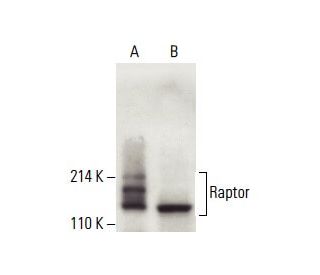
  • recommended for detection of Raptor of mouse, rat and human origin by WB, IP, IF and ELISA
  • m-IgGκ BP-HRP is the preferred secondary detection reagent for Raptor Antibody (B-8) for WB applications. This reagent is now offered in a bundle with Raptor Antibody (B-8) (see ordering information below). For additional m-IgGκ BP conjugates see our complete list of Mouse IgG Binding Proteins.
    Gene Editing Promo Banner

    QUICK LINKS

    SEE ALSO...

    Raptor Antibody (B-8) is a mouse monoclonal IgG2a antibody that detects Raptor in mouse, rat, and human samples through applications such as western blotting (WB), immunoprecipitation (IP), immunofluorescence (IF), and enzyme-linked immunosorbent assay (ELISA). Anti-Raptor antibody (B-8) plays a crucial role in studying the mammalian target of rapamycin (mTOR) signaling pathway, which is vital for cellular growth and metabolism. Raptor (B-8) antibody enables detection of Raptor protein primarily in the cytoplasm, where Raptor acts as a scaffold facilitating the assembly of the mTOR complex 1 (mTORC1). This localization is significant because Raptor interacts with various substrates and signaling molecules, thereby integrating nutrient availability and growth factor signals to modulate cellular responses. Through binding to mTOR, Raptor is essential for the phosphorylation of downstream targets, such as 4E-BP1, which regulates protein synthesis and cell proliferation. The dynamic nature of Raptor′s interaction with mTOR and sensitivity to nutrient levels underscores Raptor′s importance in maintaining cellular homeostasis and responding to environmental changes. Raptor monoclonal antibody (B-8) detects high expression in skeletal muscle, with lower levels in brain, kidney, lung, and placenta, making this antibody valuable for studying the mTOR pathway in various biological contexts.

    For Research Use Only. Not Intended for Diagnostic or Therapeutic Use.

    Alexa Fluor® is a trademark of Molecular Probes Inc., OR., USA

    LI-COR® and Odyssey® are registered trademarks of LI-COR Biosciences

    Raptor Antibody (B-8) References:

    1. mTORC1-independent Raptor prevents hepatic steatosis by stabilizing PHLPP2.  |  Kim, K., et al. 2016. Nat Commun. 7: 10255. PMID: 26743335
    2. Raptor localization predicts prognosis and tamoxifen response in estrogen receptor-positive breast cancer.  |  Bostner, J., et al. 2018. Breast Cancer Res Treat. 168: 17-27. PMID: 29128895
    3. Conditional Knockout of Raptor/mTORC1 Results in Dentin Malformation.  |  Xie, F., et al. 2019. Front Physiol. 10: 250. PMID: 30984011
    4. RAPTOR promotes colorectal cancer proliferation by inducing mTORC1 and upregulating ribosome assembly factor URB1.  |  Wang, T., et al. 2020. Cancer Med. 9: 1529-1543. PMID: 31886628
    5. A review of constraints and solutions for collecting raptor samples and contextual data for a European Raptor Biomonitoring Facility.  |  Dulsat-Masvidal, M., et al. 2021. Sci Total Environ. 793: 148599. PMID: 34328978
    6. Real age prediction from the transcriptome with RAPToR.  |  Bulteau, R. and Francesconi, M. 2022. Nat Methods. 19: 969-975. PMID: 35817937
    7. Inferring biological age from the transcriptome with RAPToR.  |  . 2022. Nat Methods. 19: 936-937. PMID: 35817939
    8. Raptor couples mTORC1 and ERK1/2 inhibition by cardamonin with oxidative stress induction in ovarian cancer cells.  |  Zhu, Y., et al. 2023. PeerJ. 11: e15498. PMID: 37304865
    9. Raptor mediates the selective inhibitory effect of cardamonin on RRAGC-mutant B cell lymphoma.  |  Liu, Y., et al. 2023. BMC Complement Med Ther. 23: 336. PMID: 37749558
    10. Mycobacterial SapM hampers host autophagy initiation for intracellular bacillary survival via dephosphorylating Raptor.  |  Zhang, W., et al. 2024. iScience. 27: 109671. PMID: 38646170

    Ordering Information

    Product NameCatalog #UNITPriceQtyFAVORITES

    Raptor Antibody (B-8)

    sc-518111
    200 µg/ml
    $322.00

    Raptor Antibody (B-8): m-IgGκ BP-HRP Bundle

    sc-525377
    200 µg Ab, 40 µg BP
    $361.00
