
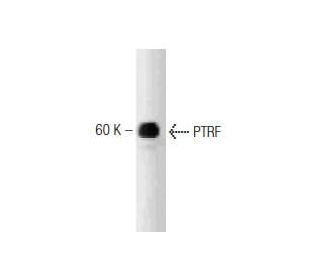

PTRF Anticuerpo (4a): sc-517589
- PTRF Anticuerpo 4a es un monoclonal de ratón IgG1 (kappa light chain) PTRF Anticuerpo proporcionado como 200 µg/ml
- producido contra los amino ácidos 157-272 de de origen mouse
- recomendado para detectarPTRF de mouse, rat y human origen, mediante WB, IP y IF
- disponible conjugado a agarosa (sc-517589 AC), 500 µg/ml, 25% agarose, para IP; y a HRP (sc-517589 HRP), 200 µg/ml, para WB, IHC(P) y ELISA
- m-IgG Fc BP-HRP, 1 BP-HRP">m-IgG1 BP-HRP y m-IgGκ BP-HRP son los reactivos de detección secundarios preferidos para PTRF Anticuerpo (4a) para aplicaciones WB. Estos reactivos se ofrecen ahora en paquetes con PTRF Anticuerpo (4a)(véase la información de pedido más abajo).

ENLACES RÁPIDOS
VER TAMBIÉN ....
El anticuerpo anti-PTRF (4a) es un anticuerpo monoclonal IgG1 de ratón de cadena ligera kappa que detecta la proteína PTRF de origen de ratón, rata y humano mediante western blotting (WB), inmunoprecipitación (IP) e inmunofluorescencia (IF). El anticuerpo anti-PTRF (4a) está disponible tanto en forma no conjugada como en diversas formas conjugadas, incluidas la agarosa y la peroxidasa de rábano picante (HRP). La proteína PTRF, también conocida como polimerasa I y factor de liberación de la transcripción o FKSG13, desempeña un papel crucial en la terminación de la transcripción por la ARN polimerasa I (Pol I). El anticuerpo monoclonal PTRF (4a) es esencial para la disociación del complejo de transcripción, que es un paso vital en la síntesis del ARN ribosómico. Esta proteína de 390 aminoácidos se une al extremo 3' del pre-ARNr mientras interacciona con Pol I y TTF-1 (factor de transcripción tiroideo-1), facilitando la liberación del complejo Pol I de la plantilla de ADN. El funcionamiento adecuado del PTRF es crítico para mantener la eficiencia de la biogénesis de los ribosomas, que es fundamental para el crecimiento y la proliferación celulares. El anticuerpo PTRF (4a) se localiza en varios compartimentos celulares, como la membrana celular, el microsoma, el núcleo y el citoplasma, lo que pone de relieve su papel versátil en los procesos celulares. Se producen tres isoformas de PTRF mediante splicing alternativo, lo que puede contribuir a su diversidad funcional y a sus mecanismos reguladores en diferentes contextos celulares.
Alexa Fluor® es una marca registrada de Molecular Probes Inc., OR., USA
REIVEW LI-COR® y Odyssey® son marcas registradas de LI-COR Biosciences.
PTRF Referencias:
- El PTRF (factor de liberación de la polimerasa I y de la transcripción) es específico de un tejido e interactúa con el factor de transcripción de dedos de zinc BFCOL1 (factor de unión de un promotor de colágeno de tipo I) que se une a los dos promotores del gen del colágeno de tipo I del ratón. | Hasegawa, T., et al. 2000. Biochem J. 347 Pt 1: 55-9. PMID: 10727401
- El factor de liberación de transcripción PTRF aumenta la transcripción de genes ribosómicos facilitando la reiniciación de la ARN polimerasa I. | Jansa, P., et al. 2001. Nucleic Acids Res. 29: 423-9. PMID: 11139612
- La proteómica vectorial revela la orientación, fosforilación y fragmentación específica de la polimerasa I y el factor de liberación de transcripción (PTRF) en la superficie de las caveolas en adipocitos humanos. | Aboulaich, N., et al. 2004. Biochem J. 383: 237-48. PMID: 15242332
- Identificación de una proteína principal en la cara citosólica de las caveolas. | Vinten, J., et al. 2005. Biochim Biophys Acta. 1717: 34-40. PMID: 16236245
- Asociación y translocación regulada por insulina de la lipasa sensible a hormonas con PTRF. | Aboulaich, N., et al. 2006. Biochem Biophys Res Commun. 350: 657-61. PMID: 17026959
- PTRF desencadena una caveola. | Chadda, R. and Mayor, S. 2008. Cell. 132: 23-4. PMID: 18191216
- PTRF-Cavin, una proteína citoplasmática conservada necesaria para la formación y función de la caveola. | Hill, MM., et al. 2008. Cell. 132: 113-24. PMID: 18191225
- Identificación de una actividad de liberación de transcritos que actúa sobre complejos de transcripción ternarios que contienen ARN polimerasa I murina. | Mason, SW., et al. 1997. EMBO J. 16: 163-72. PMID: 9009277
- Clonación y caracterización funcional de PTRF, una nueva proteína que induce la disociación de complejos de transcripción ternarios en pausa. | Jansa, P., et al. 1998. EMBO J. 17: 2855-64. PMID: 9582279
Información sobre pedidos
| Nombre del producto | Número de catálogo | UNIDAD | Precio | CANTIDAD | Favoritos | |
PTRF Anticuerpo (4a) | sc-517589 | 200 µg/ml | $322.00 | |||
Paquete de PTRF (4a): m-IgG Fc BP-HRP | sc-531582 | 200 µg Ab; 10 µg BP | $361.00 | |||
Paquete de PTRF (4a): m-IgGκ BP-HRP | sc-525313 | 200 µg Ab, 40 µg BP | $361.00 | |||
Paquete de PTRF (4a): m-IgG1 BP-HRP | sc-544639 | 200 µg Ab; 20 µg BP | $361.00 | |||
PTRF Anticuerpo (4a) AC | sc-517589 AC | 500 µg/ml, 25% agarose | $424.00 | |||
PTRF Anticuerpo (4a) HRP | sc-517589 HRP | 200 µg/ml | $322.00 |