
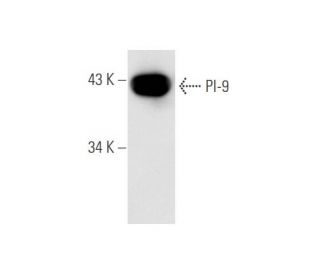
PI-9 抗体 (PI9-17): sc-57531. K-562 全细胞裂解液中 PI-9 表达的 Western 印迹分析.
PI-9 抗体 (PI9-17): sc-57531
- PI-9 抗体 PI9-17 是小鼠单克隆 IgG1, 在3篇文献中引用,提供 500 µl supernatant
- 针对全长重组蛋白PI9的抗体,来源于human
- 推荐用于 mouse, rat 和 human 来源的PI-9 WB, IP, IF, IHC(P) 和 ELISA检测; 不会与 PI6, PI8, PAI-2产生交联反应
- 目前,我们还没有完成PI-9 抗体 (PI9-17)的首选二抗检测试剂的鉴定。这项工作正在进行中。

快捷链接
相关产品
描述
基因信息
说明书与实验方案
研究信息
関連項目
PI-9抗体(PI9-17)是一种IgG1小鼠单克隆PI-9抗体,可通过蛋白质印迹(WB)、免疫沉淀(IP)、免疫荧光(IF)、免疫组织化学(IHC(P))和酶联免疫吸附测定(ELISA)检测小鼠、大鼠和人类来源的PI-9。PI-9抗体(PI9-17)为非偶联形式的抗PI-9抗体。丝氨酸蛋白酶抑制剂(serpins)在各种生理过程中起着调节丝氨酸蛋白酶活性的作用。蛋白酶抑制剂-9(PI-9,也被称为细胞质抗蛋白酶3,或CAP3)是卵白蛋白家族丝氨酸蛋白酶抑制剂的成员之一,在胎盘、肺和细胞毒性淋巴细胞中表达。PI-9是颗粒酶B及其介导的细胞凋亡的有效抑制剂,同时也是caspase-1的抑制剂,对caspase-4和caspase-8的抑制作用较小。由于颗粒酶B促进DNA降解并迅速转移到细胞核与核成分结合,因此PI-9存在于人类细胞毒性细胞、内皮细胞和上皮细胞的细胞核中。PI-9通过雷公藤素B敏感途径从细胞核中输出,这表明PI-9的核质分布涉及非传统的核输入途径和输出因子CRM1。雌激素可迅速且强烈地诱导PI-9,这是一种受雌激素调节的人类基因。PI-9的表达也会因炎症刺激而上调。这种上调作用保护细胞免受内源性表达或释放的颗粒酶B诱导的细胞凋亡,特别是在靶细胞杀伤过程中。此外,PI-9在各种人类和鼠类肿瘤中也有表达。
仅限研究使用。不适用于诊断和治疗用途。
订购信息
| 产品名称 | 产品编号 | 规格 | 价格 | 数量 | 收藏夹 | |
PI-9 抗体 (PI9-17) | sc-57531 | 500 µl supernatant | $322.00 |