
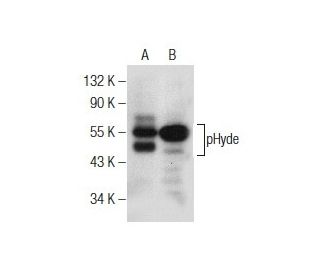
pHyde Antibody (H-4): sc-376327
- pHyde Antibody (H-4) is a mouse monoclonal IgG1 κ pHyde antibody, cited in 3 publications, provided at 200 µg/ml
- raised against amino acids 140-203 mapping within an internal region of pHyde of human origin
- pHyde Antibody (H-4) is recommended for detection of pHyde of mouse, rat, human origin by WB, IP, IF, IHC(P) and ELISA
- Anti-pHyde Antibody (H-4) is available conjugated to agarose for IP; HRP for WB, IHC(P) and ELISA; and to either phycoerythrin or FITC for IF, IHC(P) and FCM
- also available conjugated to Alexa Fluor® 488, Alexa Fluor® 546, Alexa Fluor® 594 or Alexa Fluor® 647 for WB (RGB), IF, IHC(P) and FCM, and for use with RGB fluorescent imaging systems, such as iBright™ FL1000, FluorChem™, Typhoon, Azure and other comparable systems
- also available conjugated to Alexa Fluor® 680 or Alexa Fluor® 790 for WB (NIR), IF and FCM; for use with Near-Infrared (NIR) detection systems, such as LI-COR®Odyssey®, iBright™ FL1000, FluorChem™, Typhoon, Azure and other comparable systems
- m-IgGκ BP-HRP is the preferred secondary detection reagent for pHyde Antibody (H-4) for WB and IHC(P) applications. This reagent is now offered in a bundle with pHyde Antibody (H-4) (see ordering information below). For additional m-IgGκ BP conjugates see our complete list of Mouse IgG Binding Proteins.

QUICK LINKS
SEE ALSO...
pHyde Antibody (H-4) is a mouse monoclonal IgG1 kappa light chain antibody that detects pHyde protein of mouse, rat, and human origin by western blotting (WB), immunoprecipitation (IP), immunofluorescence (IF), immunohistochemistry with paraffin-embedded sections (IHCP), and enzyme-linked immunosorbent assay (ELISA). pHyde (H-4) antibody is available in both non-conjugated and various conjugated forms, including agarose, horseradish peroxidase (HRP), phycoerythrin (PE), fluorescein isothiocyanate (FITC), and multiple Alexa Fluor® conjugates. pHyde plays a crucial role in regulating apoptosis, particularly through interaction with caspases, which are essential for programmed cell death. pHyde has been shown to induce caspase-3-mediated apoptosis, a process vital for eliminating damaged or unwanted cells, thereby contributing to tumor suppression. pHyde′s ability to stimulate p53 expression further underscores its importance in cancer biology, as p53 is a well-known tumor suppressor that regulates the cell cycle and promotes apoptosis in response to cellular stress. Research indicates that recombinant pHyde can significantly inhibit the growth of human prostate cancer cell lines, such as DU145 and LNCaP, in vitro, and reduces tumor size in vivo when administered to nude mice. pHyde exhibits growth inhibitory effects on human breast cancer cells, suggesting potential as a therapeutic agent across various cancer types. pHyde′s implications in cancer gene therapy highlight its promise in enhancing apoptosis pathways, making anti-pHyde antibody (H-4) a valuable tool for researchers studying cancer mechanisms and potential treatments.
Alexa Fluor® is a trademark of Molecular Probes Inc., OR., USA
LI-COR® and Odyssey® are registered trademarks of LI-COR Biosciences
pHyde Antibody (H-4) References:
- Emerging roles of caspase-3 in apoptosis. | Porter, AG. and Jänicke, RU. 1999. Cell Death Differ. 6: 99-104. PMID: 10200555
- Serial killers: ordering caspase activation events in apoptosis. | Slee, EA., et al. 1999. Cell Death Differ. 6: 1067-74. PMID: 10578175
- Role of pHyde novel gene product as an intrinsic factor for apoptotic pathway in prostate cancer. | Rinaldy, AR., et al. 2000. Gan To Kagaku Ryoho. 27 Suppl 2: 215-22. PMID: 10895157
- Growth inhibition of prostate cancer by an adenovirus expressing a novel tumor suppressor gene, pHyde. | Steiner, MS., et al. 2000. Cancer Res. 60: 4419-25. PMID: 10969787
- Apoptosis induction in prostate cancer cells by a novel gene product, pHyde, involves caspase-3. | Zhang, X., et al. 2001. Oncogene. 20: 5982-90. PMID: 11593405
- The Steap proteins are metalloreductases. | Ohgami, RS., et al. 2006. Blood. 108: 1388-94. PMID: 16609065
- Steap proteins: implications for iron and copper metabolism. | Knutson, MD. 2007. Nutr Rev. 65: 335-40. PMID: 17695374
Ordering Information
| Product Name | Catalog # | UNIT | Price | Qty | FAVORITES | |
pHyde Antibody (H-4) | sc-376327 | 200 µg/ml | $322.00 | |||
pHyde Antibody (H-4): m-IgGκ BP-HRP Bundle | sc-522916 | 200 µg Ab, 40 µg BP | $361.00 | |||
pHyde Antibody (H-4) AC | sc-376327 AC | 500 µg/ml, 25% agarose | $424.00 | |||
pHyde Antibody (H-4) HRP | sc-376327 HRP | 200 µg/ml | $322.00 | |||
pHyde Antibody (H-4) FITC | sc-376327 FITC | 200 µg/ml | $336.00 | |||
pHyde Antibody (H-4) PE | sc-376327 PE | 200 µg/ml | $349.00 | |||
pHyde Antibody (H-4) Alexa Fluor® 488 | sc-376327 AF488 | 200 µg/ml | $364.00 | |||
pHyde Antibody (H-4) Alexa Fluor® 546 | sc-376327 AF546 | 200 µg/ml | $364.00 | |||
pHyde Antibody (H-4) Alexa Fluor® 594 | sc-376327 AF594 | 200 µg/ml | $364.00 | |||
pHyde Antibody (H-4) Alexa Fluor® 647 | sc-376327 AF647 | 200 µg/ml | $364.00 | |||
pHyde Antibody (H-4) Alexa Fluor® 680 | sc-376327 AF680 | 200 µg/ml | $364.00 | |||
pHyde Antibody (H-4) Alexa Fluor® 790 | sc-376327 AF790 | 200 µg/ml | $364.00 |