
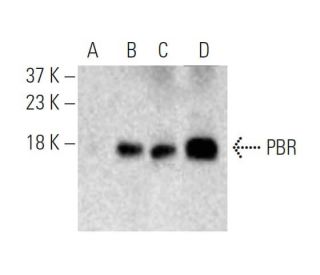

PBR Antibody (E-3): sc-518127
- PBR Antibody (E-3) is a mouse monoclonal IgM κ PBR antibody provided at 200 µg/ml
- specific for an epitope mapping between amino acids 62-81 within an internal region of PBR of human origin
- recommended for detection of PBR of human origin by WB, IP, IF and ELISA
- Anti-PBR Antibody (E-3) is available conjugated to agarose for IP; HRP for WB, IHC(P) and ELISA; and to either phycoerythrin or FITC for IF, IHC(P) and FCM
- also available conjugated to Alexa Fluor® 488, Alexa Fluor® 546, Alexa Fluor® 594 or Alexa Fluor® 647 for WB (RGB), IF, IHC(P) and FCM, and for use with RGB fluorescent imaging systems, such as iBright™ FL1000, FluorChem™, Typhoon, Azure and other comparable systems
- also available conjugated to Alexa Fluor® 680 or Alexa Fluor® 790 for WB (NIR), IF and FCM; for use with Near-Infrared (NIR) detection systems, such as LI-COR®Odyssey®, iBright™ FL1000, FluorChem™, Typhoon, Azure and other comparable systems
- m-IgGκ BP-HRP is the preferred secondary detection reagent for PBR Antibody (E-3) for WB applications. This reagent is now offered in a bundle with PBR Antibody (E-3) (see ordering information below). For additional m-IgGκ BP conjugates see our complete list of Mouse IgG Binding Proteins.

QUICK LINKS
SEE ALSO...
PBR Antibody (E-3) is a mouse monoclonal IgM antibody that detects PBR protein of human origin by western blotting (WB), immunoprecipitation (IP), immunofluorescence (IF), and enzyme-linked immunosorbent assay (ELISA). PBR Antibody (E-3) is available in both non-conjugated and various conjugated forms, including agarose, horseradish peroxidase (HRP), phycoerythrin (PE), fluorescein isothiocyanate (FITC), and multiple Alexa Fluor® conjugates. The mitochondrial peripheral-type benzodiazepine receptor (PBR) plays a crucial role in steroidogenic processes by facilitating cholesterol transport to the inner mitochondrial membrane, where PBR is essential for steroid hormone synthesis. Structurally, PBR consists of three distinct subunits, including an isoquinoline binding site, a voltage-dependent anion channel, and an adenine nucleotide carrier, highlighting PBR′s complex functionality in cellular processes. PBR is evolutionarily conserved across species, from bacteria to humans, and exhibits a unique expression pattern, predominantly found in peripheral organs while showing limited presence in brain, primarily localized to glial cells. The interaction of PBR with specific ligands, such as endogenous diazepam binding inhibitor, underscores PBR′s regulatory role in cholesterol transport and steroidogenesis, making PBR a significant target for research in steroid-related pathways and potential therapeutic interventions.
Alexa Fluor® is a trademark of Molecular Probes Inc., OR., USA
LI-COR® and Odyssey® are registered trademarks of LI-COR Biosciences
PBR Antibody (E-3) References:
- Peripheral-type benzodiazepine receptor (PBR) in human breast cancer: correlation of breast cancer cell aggressive phenotype with PBR expression, nuclear localization, and PBR-mediated cell proliferation and nuclear transport of cholesterol. | Hardwick, M., et al. 1999. Cancer Res. 59: 831-42. PMID: 10029072
- The peroxisome proliferator perfluorodecanoic acid inhibits the peripheral-type benzodiazepine receptor (PBR) expression and hormone-stimulated mitochondrial cholesterol transport and steroid formation in Leydig cells. | Boujrad, N., et al. 2000. Endocrinology. 141: 3137-48. PMID: 10965884
- Synthesis of new molecular probes for investigation of steroid biosynthesis induced by selective interaction with peripheral type benzodiazepine receptors (PBR). | Campiani, G., et al. 2002. J Med Chem. 45: 4276-81. PMID: 12213069
- Peripheral-type benzodiazepine receptor (PBR) and PBR drug ligands in fibroblast and fibrosarcoma cell proliferation: role of ERK, c-Jun and ligand-activated PBR-independent pathways. | Kletsas, D., et al. 2004. Biochem Pharmacol. 67: 1927-32. PMID: 15130769
- Hormonal regulation of peripheral-type benzodiazepine receptors. | Gavish, M. 1995. J Steroid Biochem Mol Biol. 53: 57-9. PMID: 7542903
- Molecular cellular and behavioral aspects of peripheral-type benzodiazepine receptors. | Weizman, R. and Gavish, M. 1993. Clin Neuropharmacol. 16: 401-17. PMID: 8221702
- Cardiovascular characterization of pyrrolo[2,1-d][1,5]benzothiazepine derivatives binding selectively to the peripheral-type benzodiazepine receptor (PBR): from dual PBR affinity and calcium antagonist activity to novel and selective calcium entry blockers. | Campiani, G., et al. 1996. J Med Chem. 39: 2922-38. PMID: 8709127
- Ex vivo regulation of adrenal cortical cell steroid and protein synthesis, in response to adrenocorticotropic hormone stimulation, by the Ginkgo biloba extract EGb 761 and isolated ginkgolide B. | Amri, H., et al. 1997. Endocrinology. 138: 5415-26. PMID: 9389527
- Targeted disruption of the peripheral-type benzodiazepine receptor gene inhibits steroidogenesis in the R2C Leydig tumor cell line. | Papadopoulos, V., et al. 1997. J Biol Chem. 272: 32129-35. PMID: 9405411
- Effects of peripheral-type benzodiazepine receptor antisense knockout on MA-10 Leydig cell proliferation and steroidogenesis. | Kelly-Hershkovitz, E., et al. 1998. J Biol Chem. 273: 5478-83. PMID: 9488670
- In vivo studies on the role of the peripheral benzodiazepine receptor (PBR) in steroidogenesis. | Papadopoulos, V., et al. 1998. Endocr Res. 24: 479-87. PMID: 9888528
- Cloning and characterization of PRAX-1. A new protein that specifically interacts with the peripheral benzodiazepine receptor. | Galiègue, S., et al. 1999. J Biol Chem. 274: 2938-52. PMID: 9915832
Ordering Information
| Product Name | Catalog # | UNIT | Price | Qty | FAVORITES | |
PBR Antibody (E-3) | sc-518127 | 200 µg/ml | $322.00 | |||
PBR Antibody (E-3): m-IgGκ BP-HRP Bundle | sc-525391 | 200 µg Ab, 40 µg BP | $361.00 | |||
PBR Antibody (E-3) AC | sc-518127 AC | 500 µg/ml, 25% agarose | $424.00 | |||
PBR Antibody (E-3) HRP | sc-518127 HRP | 200 µg/ml | $322.00 | |||
PBR Antibody (E-3) FITC | sc-518127 FITC | 200 µg/ml | $336.00 | |||
PBR Antibody (E-3) PE | sc-518127 PE | 200 µg/ml | $349.00 | |||
PBR Antibody (E-3) Alexa Fluor® 488 | sc-518127 AF488 | 200 µg/ml | $364.00 | |||
PBR Antibody (E-3) Alexa Fluor® 546 | sc-518127 AF546 | 200 µg/ml | $364.00 | |||
PBR Antibody (E-3) Alexa Fluor® 594 | sc-518127 AF594 | 200 µg/ml | $364.00 | |||
PBR Antibody (E-3) Alexa Fluor® 647 | sc-518127 AF647 | 200 µg/ml | $364.00 | |||
PBR Antibody (E-3) Alexa Fluor® 680 | sc-518127 AF680 | 200 µg/ml | $364.00 | |||
PBR Antibody (E-3) Alexa Fluor® 790 | sc-518127 AF790 | 200 µg/ml | $364.00 |