
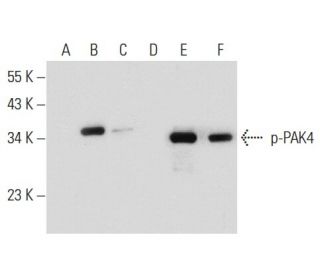
PAK4 Antibody (6C1): sc-81532
- PAK4 Antibody (6C1) is a mouse monoclonal IgG1, cited in 1 publications, provided at 50 µg/0.5 ml
- raised against a synthetic peptide corresponding to the kinase activation loop of PAK4 of human origin
- recommended for detection of PAK4 of mouse, rat, human and canine origin by WB and IP
- At present, we have not yet completed the identification of the preferred secondary detection reagent(s) for PAK4 Antibody (6C1). This work is in progress.

QUICK LINKS
SEE ALSO...
PAK4 Antibody (6C1) is a mouse monoclonal IgG1 antibody that detects PAK4 in mouse, rat, human, and canine samples through applications such as western blotting (WB) and immunoprecipitation (IP). PAK4 is a serine/threonine kinase that plays a crucial role in various cellular processes, including cell proliferation, survival, and cytoskeletal dynamics. PAK4 function is particularly important in the regulation of the JNK signaling pathway, which is involved in stress responses and apoptosis. PAK4 interacts specifically with the active GTP-bound forms of Rac1 and Cdc42, leading to autophosphorylation and subsequent dissociation from these complexes to phosphorylate downstream substrates like MEK kinase. This interaction is vital for the formation of actin-enriched filopodia, which are essential for cell motility and signaling. PAK4 is highly expressed in tissues such as the prostate, testis, and colon, and PAK4 dysregulation has been implicated in various cancers, making PAK4 a significant target for therapeutic intervention. The gene encoding PAK4 is located on human chromosome 19, highlighting evolutionary conservation and importance across species. Anti-PAK4 antibody (6C1) is an invaluable tool for researchers studying the intricate roles of this kinase in cellular signaling and disease mechanisms.
Alexa Fluor® is a trademark of Molecular Probes Inc., OR., USA
LI-COR® and Odyssey® are registered trademarks of LI-COR Biosciences
PAK4 Antibody (6C1) References:
- PAK4 pathway as a potential therapeutic target in pancreatic cancer. | Thillai, K., et al. 2018. Future Oncol. 14: 579-582. PMID: 29508632
- Cyclic AMP-dependent protein kinase A and EPAC mediate VIP and secretin stimulation of PAK4 and activation of Na+,K+-ATPase in pancreatic acinar cells. | Ramos-Alvarez, I., et al. 2019. Am J Physiol Gastrointest Liver Physiol. 316: G263-G277. PMID: 30520694
- PAK4 signaling in health and disease: defining the PAK4-CREB axis. | Won, SY., et al. 2019. Exp Mol Med. 51: 1-9. PMID: 30755582
- Group II p21-activated kinase, PAK4, is needed for activation of focal adhesion kinases, MAPK, GSK3, and β-catenin in rat pancreatic acinar cells. | Ramos-Álvarez, I., et al. 2020. Am J Physiol Gastrointest Liver Physiol. 318: G490-G503. PMID: 31984786
- CDK15 promotes colorectal cancer progression via phosphorylating PAK4 and regulating β-catenin/ MEK-ERK signaling pathway. | Huang, C., et al. 2022. Cell Death Differ. 29: 14-27. PMID: 34262144
- Activation of GPR40 attenuates neuroinflammation and improves neurological function via PAK4/CREB/KDM6B pathway in an experimental GMH rat model. | Xiao, J., et al. 2021. J Neuroinflammation. 18: 160. PMID: 34275493
- PAK4 inhibition improves PD-1 blockade immunotherapy. | Abril-Rodriguez, G., et al. 2020. Nat Cancer. 1: 46-58. PMID: 34368780
- Targeting PAK4 to reprogram the vascular microenvironment and improve CAR-T immunotherapy for glioblastoma. | Ma, W., et al. 2021. Nat Cancer. 2: 83-97. PMID: 35121889
- PAK4 in cancer development: Emerging player and therapeutic opportunities. | Yuan, Y., et al. 2022. Cancer Lett. 545: 215813. PMID: 35798086
- PAK4 phosphorylates and inhibits AMPKα to control glucose uptake. | Wu, D., et al. 2024. Nat Commun. 15: 6858. PMID: 39127697
Ordering Information
| Product Name | Catalog # | UNIT | Price | Qty | FAVORITES | |
PAK4 Antibody (6C1) | sc-81532 | 50 µg/0.5 ml | $322.00 |