
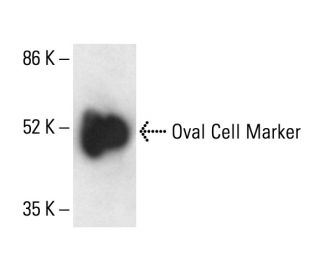
Oval Cell Marker Antibody (OV-6): sc-101863
- Oval Cell Marker Antibody (OV-6) is a mouse monoclonal IgG1 κ Oval Cell Marker antibody, cited in 8 publications, provided at 200 µg/ml
- raised against carcinogen-treated nodular hepatocytes of rat origin
- Oval Cell Marker Antibody (OV-6) is recommended for detection of OV-6 antigen of mouse, rat and human origin by WB, IP, IF and FCM
- Anti-Oval Cell Marker Antibody (OV-6) is available conjugated to agarose for IP; HRP for WB, IHC(P) and ELISA; and to either phycoerythrin or FITC for IF, IHC(P) and FCM
- also available conjugated to Alexa Fluor® 488, Alexa Fluor® 546, Alexa Fluor® 594 or Alexa Fluor® 647 for WB (RGB), IF, IHC(P) and FCM, and for use with RGB fluorescent imaging systems, such as iBright™ FL1000, FluorChem™, Typhoon, Azure and other comparable systems
- also available conjugated to Alexa Fluor® 680 or Alexa Fluor® 790 for WB (NIR), IF and FCM; for use with Near-Infrared (NIR) detection systems, such as LI-COR®Odyssey®, iBright™ FL1000, FluorChem™, Typhoon, Azure and other comparable systems
- m-IgG Fc BP-HRP, m-IgG1 BP-HRP and m-IgGκ BP-HRP are the preferred secondary detection reagents for Oval Cell Marker Antibody (OV-6) for WB applications. These reagents are now offered in bundles with Oval Cell Marker Antibody (OV-6) (see ordering information below).

QUICK LINKS
SEE ALSO...
Oval Cell Marker (OV-6) is a mouse monoclonal IgG1 kappa light chain antibody that detects Oval Cell Marker protein in mouse, rat, and human samples by western blotting (WB), immunoprecipitation (IP), immunofluorescence (IF), and flow cytometry (FCM). Anti-Oval Cell Marker antibody (OV-6) is available non-conjugated and conjugated to agarose, horseradish peroxidase (HRP), phycoerythrin (PE), fluorescein isothiocyanate (FITC), and multiple Alexa Fluor® dyes. Stem cells exist in nearly all multi-cellular organisms, characterized by their ability to self-renew and differentiate into multiple cell types. Adult stem cells maintain tissue repair and organ maintenance, while embryonic stem cells found in blastocysts can form any embryonic tissue. Stem cells′ unique ability to mature into any cell type makes these cells valuable for treating human diseases, including cancer, muscle damage, spinal cord injuries, Parkinson′s disease, Amyotrophic lateral sclerosis, and organ regeneration. Oval Cells are hepatic stem cells that differentiate into multiple cell types and play roles in liver development and chronic liver disease pathogenesis. Oval Cell Marker (OV-6) enables detection of Oval Cells within samples.
Alexa Fluor® is a trademark of Molecular Probes Inc., OR., USA
LI-COR® and Odyssey® are registered trademarks of LI-COR Biosciences
Oval Cell Marker Antibody (OV-6) References:
- The potential of stem cells. | Pfendler, KC. and Kawase, E. 2003. Obstet Gynecol Surv. 58: 197-208. PMID: 12612460
- Embryonic stem cells as a cell source for treating Parkinson's disease. | Fukuda, H. and Takahashi, J. 2005. Expert Opin Biol Ther. 5: 1273-80. PMID: 16197334
- Stem cells--a clinical update. | Tuch, BE. 2006. Aust Fam Physician. 35: 719-21. PMID: 16969445
- Embryonic stem cell transplantation: potential applicability in cell replacement therapy and regenerative medicine. | Wu, DC., et al. 2007. Front Biosci. 12: 4525-35. PMID: 17485394
- Review: ex vivo engineering of living tissues with adult stem cells. | Barrilleaux, B., et al. 2006. Tissue Eng. 12: 3007-19. PMID: 17518617
- Stem cell therapy for Parkinson's disease. | Takahashi, J. 2007. Expert Rev Neurother. 7: 667-75. PMID: 17563250
- Stem cells: the magic brew. | Rossant, J. 2007. Nature. 448: 260-2. PMID: 17637646
- Stem cell transplantation: a promising therapy for Parkinson's disease. | Wang, Y., et al. 2007. J Neuroimmune Pharmacol. 2: 243-50. PMID: 18040857
- ENGOT-ov-6/TRINOVA-2: Randomised, double-blind, phase 3 study of pegylated liposomal doxorubicin plus trebananib or placebo in women with recurrent partially platinum-sensitive or resistant ovarian cancer. | Marth, C., et al. 2017. Eur J Cancer. 70: 111-121. PMID: 27914241
- Prognostic significance of combining high mobility group Box-1 and OV-6 expression in hepatocellular carcinoma. | Zhu, J., et al. 2018. Sci China Life Sci. 61: 912-923. PMID: 29441453
- Immunolocalization of OV-6, a putative progenitor cell marker in human fetal and diseased pediatric liver. | Crosby, HA., et al. 1998. Hepatology. 28: 980-5. PMID: 9755234
- Embryonic stem cell lines derived from human blastocysts. | Thomson, JA., et al. 1998. Science. 282: 1145-7. PMID: 9804556
Ordering Information
| Product Name | Catalog # | UNIT | Price | Qty | FAVORITES | |
Oval Cell Marker Antibody (OV-6) | sc-101863 | 200 µg/ml | $322.00 | |||
Oval Cell Marker Antibody (OV-6): m-IgG Fc BP-HRP Bundle | sc-528725 | 200 µg Ab; 10 µg BP | $361.00 | |||
Oval Cell Marker Antibody (OV-6): m-IgGκ BP-HRP Bundle | sc-521203 | 200 µg Ab, 40 µg BP | $361.00 | |||
Oval Cell Marker Antibody (OV-6): m-IgG1 BP-HRP Bundle | sc-543093 | 200 µg Ab; 20 µg BP | $361.00 | |||
Oval Cell Marker Antibody (OV-6) AC | sc-101863 AC | 500 µg/ml, 25% agarose | $424.00 | |||
Oval Cell Marker Antibody (OV-6) HRP | sc-101863 HRP | 200 µg/ml | $322.00 | |||
Oval Cell Marker Antibody (OV-6) FITC | sc-101863 FITC | 200 µg/ml | $336.00 | |||
Oval Cell Marker Antibody (OV-6) PE | sc-101863 PE | 200 µg/ml | $349.00 | |||
Oval Cell Marker Antibody (OV-6) Alexa Fluor® 488 | sc-101863 AF488 | 200 µg/ml | $364.00 | |||
Oval Cell Marker Antibody (OV-6) Alexa Fluor® 546 | sc-101863 AF546 | 200 µg/ml | $364.00 | |||
Oval Cell Marker Antibody (OV-6) Alexa Fluor® 594 | sc-101863 AF594 | 200 µg/ml | $364.00 | |||
Oval Cell Marker Antibody (OV-6) Alexa Fluor® 647 | sc-101863 AF647 | 200 µg/ml | $364.00 | |||
Oval Cell Marker Antibody (OV-6) Alexa Fluor® 680 | sc-101863 AF680 | 200 µg/ml | $364.00 | |||
Oval Cell Marker Antibody (OV-6) Alexa Fluor® 790 | sc-101863 AF790 | 200 µg/ml | $364.00 |