
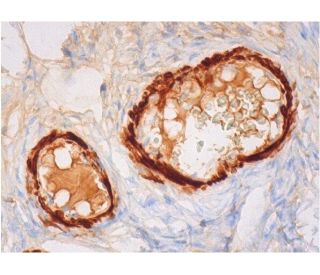
Ob Antibody (F-3): sc-48408
- Ob Antibody (F-3) is a mouse monoclonal IgG2a κ Ob antibody, cited in 4 publications, provided at 200 µg/ml
- raised against amino acids 92-145 of human Ob
- Ob Antibody (F-3) is recommended for detection of Ob of human origin by WB, IP, IF, IHC(P) and ELISA
- Anti-Ob Antibody (F-3) is available conjugated to agarose for IP; HRP for WB, IHC(P) and ELISA; and to either phycoerythrin or FITC for IF, IHC(P) and FCM
- also available conjugated to Alexa Fluor® 488, Alexa Fluor® 546, Alexa Fluor® 594 or Alexa Fluor® 647 for WB (RGB), IF, IHC(P) and FCM, and for use with RGB fluorescent imaging systems, such as iBright™ FL1000, FluorChem™, Typhoon, Azure and other comparable systems
- also available conjugated to Alexa Fluor® 680 or Alexa Fluor® 790 for WB (NIR), IF and FCM; for use with Near-Infrared (NIR) detection systems, such as LI-COR®Odyssey®, iBright™ FL1000, FluorChem™, Typhoon, Azure and other comparable systems
- m-IgG Fc BP-HRP and m-IgG2a BP-HRP are the preferred secondary detection reagents for Ob Antibody (F-3) for WB and IHC(P) applications. These reagents are now offered in bundles with Ob Antibody (F-3) (see ordering information below).

QUICK LINKS
SEE ALSO...
Ob Antibody (F-3) is a mouse monoclonal IgG2a kappa light chain antibody that detects Ob protein of human origin by western blotting (WB), immunoprecipitation (IP), immunofluorescence (IF), immunohistochemistry with paraffin-embedded sections (IHCP), and enzyme-linked immunosorbent assay (ELISA). anti-Ob antibody (F-3) is available in both non-conjugated and various conjugated forms, including agarose, horseradish peroxidase (HRP), phycoerythrin (PE), fluorescein isothiocyanate (FITC), and multiple Alexa Fluor® conjugates. Ob protein, also known as leptin, plays a crucial role in regulating energy balance by inhibiting hunger, which is vital for maintaining body weight homeostasis. Leptin is primarily produced by adipose (fat) tissue and acts on receptors in the hypothalamus to signal satiety, thereby influencing food intake and energy expenditure. Dysregulation of leptin signaling is implicated in obesity and metabolic disorders, making Ob protein essential for understanding the molecular mechanisms underlying these conditions. Ob gene encodes a 167 amino acid protein that is highly conserved across species, with an 84% identity between human and mouse sequences, highlighting evolutionary importance. A nonsense mutation in Ob gene has been identified in the original congenic C57BL/6J Ob/Ob mouse strain, which serves as a model for studying obesity and related metabolic diseases.
Alexa Fluor® is a trademark of Molecular Probes Inc., OR., USA
LI-COR® and Odyssey® are registered trademarks of LI-COR Biosciences
Ob Antibody (F-3) References:
- Leptin and undernutrition. | Prentice, AM., et al. 2002. Nutr Rev. 60: S56-67; discussion S68-84, 85-7. PMID: 12403085
- Leptin and the cardiovascular system. | Rahmouni, K. and Haynes, WG. 2004. Recent Prog Horm Res. 59: 225-44. PMID: 14749504
- Tackling a weighty problem. | Friedman, JM. and Leibel, RL. 1992. Cell. 69: 217-20. PMID: 1568242
- Molecular mapping of the mouse ob mutation. | Friedman, JM., et al. 1991. Genomics. 11: 1054-62. PMID: 1686014
- Leptin and cardiovascular diseases. | Hou, N. and Luo, JD. 2011. Clin Exp Pharmacol Physiol. 38: 905-13. PMID: 21957899
- Leptin promotes glioblastoma. | Lawrence, JE., et al. 2012. Neurol Res Int. 2012: 870807. PMID: 22263109
- Leptin and cognition. | Warren, MW., et al. 2012. Dement Geriatr Cogn Disord. 33: 410-5. PMID: 22814193
- Leptin and reproductive function. | Hausman, GJ., et al. 2012. Biochimie. 94: 2075-81. PMID: 22980196
- Structural organization and chromosomal assignment of the human obese gene. | Isse, N., et al. 1995. J Biol Chem. 270: 27728-33. PMID: 7499240
- Genetics. In search of a satiety factor. | Rink, TJ. 1994. Nature. 372: 406-7. PMID: 7984230
- Positional cloning of the mouse obese gene and its human homologue. | Zhang, Y., et al. 1994. Nature. 372: 425-32. PMID: 7984236
- Obesity and hypertension. | El-Atat, F., et al. 2003. Endocrinol Metab Clin North Am. 32: 823-54. PMID: 14711064
Ordering Information
| Product Name | Catalog # | UNIT | Price | Qty | FAVORITES | |
Ob Antibody (F-3) | sc-48408 | 200 µg/ml | $322.00 | |||
Ob Antibody (F-3): m-IgG Fc BP-HRP Bundle | sc-525563 | 200 µg Ab; 10 µg BP | $361.00 | |||
Ob Antibody (F-3): m-IgG2a BP-HRP Bundle | sc-546316 | 200 µg Ab; 10 µg BP | $361.00 | |||
Ob Antibody (F-3) AC | sc-48408 AC | 500 µg/ml, 25% agarose | $424.00 | |||
Ob Antibody (F-3) HRP | sc-48408 HRP | 200 µg/ml | $322.00 | |||
Ob Antibody (F-3) FITC | sc-48408 FITC | 200 µg/ml | $336.00 | |||
Ob Antibody (F-3) PE | sc-48408 PE | 200 µg/ml | $349.00 | |||
Ob Antibody (F-3) Alexa Fluor® 488 | sc-48408 AF488 | 200 µg/ml | $364.00 | |||
Ob Antibody (F-3) Alexa Fluor® 546 | sc-48408 AF546 | 200 µg/ml | $364.00 | |||
Ob Antibody (F-3) Alexa Fluor® 594 | sc-48408 AF594 | 200 µg/ml | $364.00 | |||
Ob Antibody (F-3) Alexa Fluor® 647 | sc-48408 AF647 | 200 µg/ml | $364.00 | |||
Ob Antibody (F-3) Alexa Fluor® 680 | sc-48408 AF680 | 200 µg/ml | $364.00 | |||
Ob Antibody (F-3) Alexa Fluor® 790 | sc-48408 AF790 | 200 µg/ml | $364.00 |