
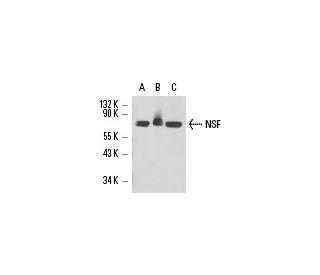
NSF Antibody (E-6): sc-74458
- NSF Antibody (E-6) is a mouse monoclonal IgG1 κ, cited in 3 publications, provided at 200 µg/ml
- raised against amino acids 1-300 mapping near the N-terminus of NSF of human origin
- recommended for detection of NSF of mouse, rat and human origin by WB, IP, IF and ELISA
- m-IgG Fc BP-HRP, m-IgG1 BP-HRP and m-IgGκ BP-HRP are the preferred secondary detection reagents for NSF Antibody (E-6) for WB applications. These reagents are now offered in bundles with NSF Antibody (E-6) (see ordering information below).

QUICK LINKS
SEE ALSO...
NSF Antibody (E-6) is a mouse monoclonal IgG1 antibody that detects NSF in mouse, rat, and human samples through applications such as western blotting (WB), immunoprecipitation (IP), immunofluorescence (IF), and enzyme-linked immunosorbent assay (ELISA). NSF, or N-ethylmaleimide-sensitive factor, plays a crucial role in the process of membrane fusion, which is essential for various cellular functions, including neurotransmitter release and vesicle trafficking. Anti-NSF antibody (E-6) targets a protein primarily located in the cytoplasm, where NSF interacts with soluble NSF attachment proteins (SNAPs) and syntaxins to facilitate the assembly of the SNARE complex, a key component in the exocytosis pathway. Proper functioning of NSF is vital for maintaining synaptic transmission and cellular communication, making NSF a significant target for research in neurobiology and cell biology. NSF monoclonal antibody (E-6) provides a reliable tool for studying the dynamics of membrane fusion and the molecular mechanisms underlying synaptic function, thereby contributing to our understanding of various physiological and pathological processes.
Alexa Fluor® is a trademark of Molecular Probes Inc., OR., USA
LI-COR® and Odyssey® are registered trademarks of LI-COR Biosciences
NSF Antibody (E-6) References:
- N-ethylmaleimide-sensitive factor is associated with the nuclear envelope. | Mashima, J., et al. 2000. Biochem Biophys Res Commun. 274: 559-64. PMID: 10913377
- Unraveling the mechanism of the vesicle transport ATPase NSF, the N-ethylmaleimide-sensitive factor. | May, AP., et al. 2001. J Biol Chem. 276: 21991-4. PMID: 11301340
- N-ethylmaleimide-sensitive factor is required to organize functional exocytotic microdomains in paramecium. | Froissard, M., et al. 2002. Genetics. 161: 643-50. PMID: 12072461
- The activity of Golgi transport vesicles depends on the presence of the N-ethylmaleimide-sensitive factor (NSF) and a soluble NSF attachment protein (alpha SNAP) during vesicle formation. | Wattenberg, BW., et al. 1992. J Cell Biol. 118: 1321-32. PMID: 1522110
- Thioredoxin increases exocytosis by denitrosylating N-ethylmaleimide-sensitive factor. | Ito, T., et al. 2011. J Biol Chem. 286: 11179-84. PMID: 21324905
- Processive ATP-driven substrate disassembly by the N-ethylmaleimide-sensitive factor (NSF) molecular machine. | Cipriano, DJ., et al. 2013. J Biol Chem. 288: 23436-45. PMID: 23775070
- Disassembly of all SNARE complexes by N-ethylmaleimide-sensitive factor (NSF) is initiated by a conserved 1:1 interaction between α-soluble NSF attachment protein (SNAP) and SNARE complex. | Vivona, S., et al. 2013. J Biol Chem. 288: 24984-91. PMID: 23836889
- Three αSNAP and 10 ATP molecules are used in SNARE complex disassembly by N-ethylmaleimide-sensitive factor (NSF). | Shah, N., et al. 2015. J Biol Chem. 290: 2175-88. PMID: 25492864
- Association of N-ethylmaleimide-sensitive factor with synaptic vesicles. | Hong, RM., et al. 1994. FEBS Lett. 350: 253-7. PMID: 8070574
- Interaction of the N-ethylmaleimide-sensitive factor with AMPA receptors. | Song, I., et al. 1998. Neuron. 21: 393-400. PMID: 9728920
Ordering Information
| Product Name | Catalog # | UNIT | Price | Qty | FAVORITES | |
NSF Antibody (E-6) | sc-74458 | 200 µg/ml | $322.00 | |||
NSF Antibody (E-6): m-IgG Fc BP-HRP Bundle | sc-537229 | 200 µg Ab; 10 µg BP | $361.00 | |||
NSF Antibody (E-6): m-IgGκ BP-HRP Bundle | sc-534443 | 200 µg Ab; 40 µg BP | $361.00 | |||
NSF Antibody (E-6): m-IgG1 BP-HRP Bundle | sc-545092 | 200 µg Ab; 20 µg BP | $361.00 |