
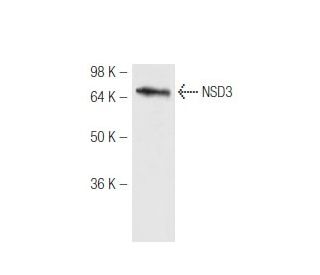


NSD3 Antibody (2E9): sc-130009
- NSD3 Antibody (2E9) is a mouse monoclonal IgG2b, cited in 1 publications, provided at 50 µg/500 µl
- raised against amino acids 383-660 of NSD3 of human origin
- recommended for detection of NSD3 of human origin by WB, IP and ELISA
- At present, we have not yet completed the identification of the preferred secondary detection reagent(s) for NSD3 Antibody (2E9). This work is in progress.

QUICK LINKS
NSD3 Antibody (2E9) is a mouse monoclonal IgG2b antibody that detects NSD3 in human samples through applications such as western blotting (WB), immunoprecipitation (IP), and enzyme-linked immunosorbent assay (ELISA). NSD3 is a critical protein involved in the regulation of gene expression and chromatin remodeling, playing a significant role in various cellular processes, including development and differentiation. NSD3 is primarily located in the nucleus, where NSD3 interacts with chromatin and other nuclear proteins to modulate transcriptional activity. This nuclear localization is essential for NSD3′s function, as such positioning allows NSD3 to influence the epigenetic landscape and maintain proper gene expression patterns. Notably, NSD3 contains multiple functional domains, including PWWP and PHD-type zinc finger motifs, which facilitate interactions with other proteins and chromatin, underscoring NSD3′s importance in cellular regulation. NSD3 expression is notably high in brain, heart, and skeletal muscle tissues, indicating potential involvement in the physiological functions of these organs. Additionally, NSD3 variants, such as the shorter form arising from alternative splicing, highlight the complexity of regulation and function. With a critical role in gene expression and cellular processes, NSD3 serves as a valuable target for research in developmental biology and disease mechanisms.
Alexa Fluor® is a trademark of Molecular Probes Inc., OR., USA
LI-COR® and Odyssey® are registered trademarks of LI-COR Biosciences
NSD3 Antibody (2E9) References:
- The role of histone lysine methyltransferase NSD3 in cancer. | Han, X., et al. 2018. Onco Targets Ther. 11: 3847-3852. PMID: 30013365
- NSD3-Induced Methylation of H3K36 Activates NOTCH Signaling to Drive Breast Tumor Initiation and Metastatic Progression. | Jeong, GY., et al. 2021. Cancer Res. 81: 77-90. PMID: 32967925
- Elevated NSD3 histone methylation activity drives squamous cell lung cancer. | Yuan, G., et al. 2021. Nature. 590: 504-508. PMID: 33536620
- Structure, Activity and Function of the NSD3 Protein Lysine Methyltransferase. | Rathert, P. 2021. Life (Basel). 11: PMID: 34440470
- A NSD3-targeted PROTAC suppresses NSD3 and cMyc oncogenic nodes in cancer cells. | Xu, C., et al. 2022. Cell Chem Biol. 29: 386-397.e9. PMID: 34469831
- The role of NSD1, NSD2, and NSD3 histone methyltransferases in solid tumors. | Topchu, I., et al. 2022. Cell Mol Life Sci. 79: 285. PMID: 35532818
- NSD3: Advances in cancer therapeutic potential and inhibitors research. | Xiu, S., et al. 2023. Eur J Med Chem. 256: 115440. PMID: 37182335
- Prospect of targeting lysine methyltransferase NSD3 for tumor therapy. | Li, D., et al. 2023. Pharmacol Res. 194: 106839. PMID: 37400043
- NSD3 in Cancer: Unraveling Methyltransferase-Dependent and Isoform-Specific Functions. | Nuñez, Y., et al. 2024. Int J Mol Sci. 25: PMID: 38256018
- Histones Methyltransferase NSD3 Inhibits Lung Adenocarcinoma Glycolysis Through Interacting with PPP1CB to Decrease STAT3 Signaling Pathway. | Zhou, Y., et al. 2024. Adv Sci (Weinh). 11: e2400381. PMID: 39119928
Ordering Information
| Product Name | Catalog # | UNIT | Price | Qty | FAVORITES | |
NSD3 Antibody (2E9) | sc-130009 | 50 µg/500 µl | $322.00 |