
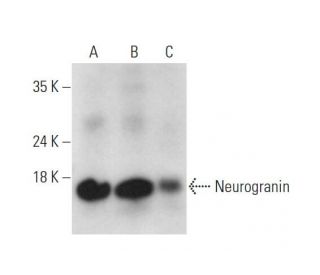

Neurogranin Antibody (C-7): sc-515092
- Neurogranin Antibody (C-7) is a mouse monoclonal IgG1 κ Neurogranin antibody, cited in 1 publications, provided at 200 µg/ml
- raised against amino acids 1-50 mapping at the N-terminus of Neurogranin of human origin
- Neurogranin Antibody (C-7) is recommended for detection of Neurogranin of mouse, rat and human origin by WB, IP, IF and ELISA
- Anti-Neurogranin Antibody (C-7) is available conjugated to agarose for IP; HRP for WB, IHC(P) and ELISA; and to either phycoerythrin or FITC for IF, IHC(P) and FCM
- also available conjugated to Alexa Fluor® 488, Alexa Fluor® 546, Alexa Fluor® 594 or Alexa Fluor® 647 for WB (RGB), IF, IHC(P) and FCM, and for use with RGB fluorescent imaging systems, such as iBright™ FL1000, FluorChem™, Typhoon, Azure and other comparable systems
- also available conjugated to Alexa Fluor® 680 or Alexa Fluor® 790 for WB (NIR), IF and FCM; for use with Near-Infrared (NIR) detection systems, such as LI-COR®Odyssey®, iBright™ FL1000, FluorChem™, Typhoon, Azure and other comparable systems
- m-IgG Fc BP-HRP and m-IgG1 BP-HRP are the preferred secondary detection reagents for Neurogranin Antibody (C-7) for WB applications. These reagents are now offered in bundles with Neurogranin Antibody (C-7) (see ordering information below).

QUICK LINKS
SEE ALSO...
Neurogranin Antibody (C-7) is a mouse monoclonal IgG1 kappa light chain antibody that detects Neurogranin of mouse, rat, and human origin by western blotting (WB), immunoprecipitation (IP), immunofluorescence (IF), and enzyme-linked immunosorbent assay (ELISA). anti-Neurogranin antibody (C-7) is available in both non-conjugated and various conjugated forms, including agarose, horseradish peroxidase (HRP), phycoerythrin (PE), fluorescein isothiocyanate (FITC), and multiple Alexa Fluor® conjugates. Neurogranin, also known as p17, RC3, and BICKS, is a critical postsynaptic protein predominantly found in the brain, particularly in regions such as the cortex, striatum, hippocampus, thalamus, hypothalamus, and olfactory bulb nuclei. Neurogranin plays a vital role in synaptic plasticity and memory formation by acting as a substrate for protein kinase C (PKC), which phosphorylates Neurogranin, thereby modulating its interaction with calmodulin. This interaction is crucial because Neurogranin binds calmodulin at low calcium levels, influencing calmodulin-dependent nitric oxide synthase activity. Additionally, nitric oxide can post-translationally modify Neurogranin, which reduces calmodulin binding ability and affects PKC phosphorylation. Understanding these interactions and modifications is essential for elucidating the mechanisms underlying synaptic signaling and neuroplasticity, making Neurogranin (C-7) antibody a valuable tool for researchers studying neurological processes and disorders.
Alexa Fluor® is a trademark of Molecular Probes Inc., OR., USA
LI-COR® and Odyssey® are registered trademarks of LI-COR Biosciences
Neurogranin Antibody (C-7) References:
- Localization of the protein kinase C phosphorylation/calmodulin-binding substrate RC3 in dendritic spines of neostriatal neurons. | Watson, JB., et al. 1992. Proc Natl Acad Sci U S A. 89: 8581-5. PMID: 1528865
- Purification and characterization of a brain-specific protein kinase C substrate, neurogranin (p17). Identification of a consensus amino acid sequence between neurogranin and neuromodulin (GAP43) that corresponds to the protein kinase C phosphorylation site and the calmodulin-binding domain. | Baudier, J., et al. 1991. J Biol Chem. 266: 229-37. PMID: 1824695
- Subtractive cDNA cloning of RC3, a rodent cortex-enriched mRNA encoding a novel 78 residue protein. | Watson, JB., et al. 1990. J Neurosci Res. 26: 397-408. PMID: 2231781
- Protein kinase C substrates from bovine brain. Purification and characterization of neuromodulin, a neuron-specific calmodulin-binding protein. | Baudier, J., et al. 1989. J Biol Chem. 264: 1824-8. PMID: 2521487
- The dendritic peptide neurogranin can regulate a calmodulin-dependent target. | Martzen, MR. and Slemmon, JR. 1995. J Neurochem. 64: 92-100. PMID: 7528268
- Characterization of a 7.5-kDa protein kinase C substrate (RC3 protein, neurogranin) from rat brain. | Huang, KP., et al. 1993. Arch Biochem Biophys. 305: 570-80. PMID: 8080473
- Nitric oxide modification of rat brain neurogranin affects its phosphorylation by protein kinase C and affinity for calmodulin. | Sheu, FS., et al. 1996. J Biol Chem. 271: 22407-13. PMID: 8798403
Ordering Information
| Product Name | Catalog # | UNIT | Price | Qty | FAVORITES | |
Neurogranin Antibody (C-7) | sc-515092 | 200 µg/ml | $322.00 | |||
Neurogranin Antibody (C-7): m-IgG Fc BP-HRP Bundle | sc-527982 | 200 µg Ab; 10 µg BP | $361.00 | |||
Neurogranin Antibody (C-7): m-IgG1 BP-HRP Bundle | sc-533355 | 200 µg Ab; 20 µg BP | $361.00 | |||
Neurogranin Antibody (C-7) AC | sc-515092 AC | 500 µg/ml, 25% agarose | $424.00 | |||
Neurogranin Antibody (C-7) HRP | sc-515092 HRP | 200 µg/ml | $322.00 | |||
Neurogranin Antibody (C-7) FITC | sc-515092 FITC | 200 µg/ml | $336.00 | |||
Neurogranin Antibody (C-7) PE | sc-515092 PE | 200 µg/ml | $349.00 | |||
Neurogranin Antibody (C-7) Alexa Fluor® 488 | sc-515092 AF488 | 200 µg/ml | $364.00 | |||
Neurogranin Antibody (C-7) Alexa Fluor® 546 | sc-515092 AF546 | 200 µg/ml | $364.00 | |||
Neurogranin Antibody (C-7) Alexa Fluor® 594 | sc-515092 AF594 | 200 µg/ml | $364.00 | |||
Neurogranin Antibody (C-7) Alexa Fluor® 647 | sc-515092 AF647 | 200 µg/ml | $364.00 | |||
Neurogranin Antibody (C-7) Alexa Fluor® 680 | sc-515092 AF680 | 200 µg/ml | $364.00 | |||
Neurogranin Antibody (C-7) Alexa Fluor® 790 | sc-515092 AF790 | 200 µg/ml | $364.00 |