
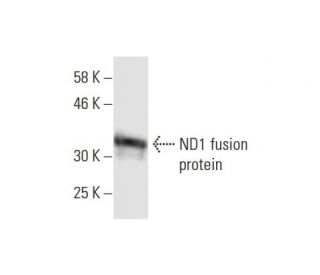

ND1 Antibody (3H3): sc-293243
- ND1 Antibody (3H3) is a mouse monoclonal IgG2a κ ND1 antibody, cited in 3 publications, provided at 100 µg/ml
- raised against amino acids 21-71 of ND1 of human origin
- recommended for detection of ND1 of human origin by WB, IP and ELISA
- At present, we have not yet completed the identification of the preferred secondary detection reagent(s) for ND1 Antibody (3H3). This work is in progress.

ND1 Antibody (3H3) is a mouse monoclonal IgG2a kappa light chain antibody that detects ND1 protein of human origin by western blotting (WB), immunoprecipitation (IP), and enzyme-linked immunosorbent assay (ELISA). ND1 (3H3) antibody is available as a non-conjugated anti-ND1 monoclonal isotype antibody. ND1, also known as NADH dehydrogenase subunit 1, plays a crucial role in the mitochondrial respiratory chain, specifically within the NADH:ubiquinone oxidoreductase complex I, which is essential for cellular energy production. This complex is located in the inner mitochondrial membrane and is responsible for transferring electrons from NADH to ubiquinone, a process coupled with proton translocation across the membrane, contributing to the proton gradient used for ATP synthesis. ND1 is one of the 41 subunits that comprise complex I, with a unique feature of binding to rotenone and analogs, suggesting involvement in the electron transfer process. Mutations in ND1 have been linked to various mitochondrial disorders, including Leber hereditary optic neuropathy, Alzheimer′s disease, and Parkinson′s disease, highlighting ND1′s significance in both energy metabolism and neurodegenerative conditions.
Alexa Fluor® is a trademark of Molecular Probes Inc., OR., USA
LI-COR® and Odyssey® are registered trademarks of LI-COR Biosciences
ND1 Antibody (3H3) References:
- The reduction of NADH ubiquinone oxidoreductase 24- and 75-kDa subunits in brains of patients with Down syndrome and Alzheimer's disease. | Kim, SH., et al. 2001. Life Sci. 68: 2741-50. PMID: 11400916
- Decreased expression of the NADH:ubiquinone oxidoreductase (complex I) subunit 4 in 1-methyl-4-phenylpyridinium -treated human neuroblastoma SH-SY5Y cells. | Conn, KJ., et al. 2001. Neurosci Lett. 306: 145-8. PMID: 11406316
- Impaired expression of NADH dehydrogenase subunit 1 and PPARgamma coactivator-1 in skeletal muscle of ZDF rats: restoration by troglitazone. | Jové, M., et al. 2004. J Lipid Res. 45: 113-23. PMID: 14563825
- Expression of the Nd1 gene is down-regulated by doxorubicin at post-transcriptional level. | Takamori, Y., et al. 2006. Int J Mol Med. 18: 963-7. PMID: 17016628
- Mitochondrial ND1 T4216C and ND2 C5178A mutations are associated with maternally transmitted diabetes mellitus. | Jiang, Z., et al. 2021. Mitochondrial DNA A DNA Mapp Seq Anal. 32: 59-65. PMID: 33284036
- Quantitative detection of circulating MT-ND1 as a potential biomarker for colorectal cancer. | Xu, Y., et al. 2021. Bosn J Basic Med Sci. 21: 577-586. PMID: 33823124
- Cellulose synthase-like protein OsCSLD4 plays an important role in the response of rice to salt stress by mediating abscisic acid biosynthesis to regulate osmotic stress tolerance. | Zhao, H., et al. 2022. Plant Biotechnol J. 20: 468-484. PMID: 34664356
- Roles of MT-ND1 in Cancer. | Xu, YC., et al. 2023. Curr Med Sci. 43: 869-878. PMID: 37642864
- Mitochondrial complex I subunit MT-ND1 mutations affect disease progression. | Lin, X., et al. 2024. Heliyon. 10: e28808. PMID: 38596130
- Identification and primary structure of five human NADH-ubiquinone oxidoreductase subunits. | Ton, C., et al. 1997. Biochem Biophys Res Commun. 241: 589-94. PMID: 9425316
- Molecular characterization and mutational analysis of the human B17 subunit of the mitochondrial respiratory chain complex I. | Smeitink, J., et al. 1998. Hum Genet. 103: 245-50. PMID: 9760212
- cDNA of eight nuclear encoded subunits of NADH:ubiquinone oxidoreductase: human complex I cDNA characterization completed. | Loeffen, JL., et al. 1998. Biochem Biophys Res Commun. 253: 415-22. PMID: 9878551
Ordering Information
| Product Name | Catalog # | UNIT | Price | Qty | FAVORITES | |
ND1 Antibody (3H3) | sc-293243 | 100 µg/ml | $322.00 |