
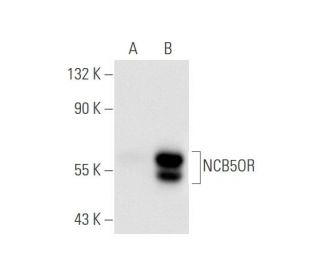


NCB5OR Antibody (L-7): sc-100529
- NCB5OR Antibody (L-7) is a mouse monoclonal IgG2a κ, cited in 4 publications, provided at 100 µg/ml
- raised against recombinant NCB5OR of human origin
- recommended for detection of NCB5OR of human origin by WB, IP and ELISA
- At present, we have not yet completed the identification of the preferred secondary detection reagent(s) for NCB5OR Antibody (L-7). This work is in progress.

QUICK LINKS
SEE ALSO...
NCB5OR Antibody (L-7) is a mouse monoclonal IgG2a light chain antibody that detects NCB5OR in human samples through applications such as western blotting (WB), immunoprecipitation (IP), and enzyme-linked immunosorbent assay (ELISA). NCB5OR, also known as cytochrome b5 reductase 4, is a flavohemoprotein that plays a vital role in cellular metabolism by facilitating the reduction of various substrates, including cytochrome c and methemoglobin, which is crucial for maintaining redox balance within cells. NCB5OR is predominantly located in the endoplasmic reticulum, where NCB5OR colocalizes with calreticulin, highlighting NCB5OR′s importance in the endoplasmic reticulum stress response pathway. By mitigating oxidative stress and preventing the accumulation of reactive oxygen species, NCB5OR is essential for protecting pancreatic beta-cells, and NCB5OR deficiency can lead to insulin-deficient diabetes. The structural features of NCB5OR, including cytochrome b5 heme-binding domain and multiple binding motifs for flavin adenine dinucleotide and iron, further underscore NCB5OR′s functional significance in electron transfer processes. Anti-NCB5OR antibody (L-7) is an invaluable tool for researchers investigating NCB5OR′s role in metabolic disorders and oxidative stress responses.
Alexa Fluor® is a trademark of Molecular Probes Inc., OR., USA
LI-COR® and Odyssey® are registered trademarks of LI-COR Biosciences
NCB5OR Antibody (L-7) References:
- NCB5OR is a novel soluble NAD(P)H reductase localized in the endoplasmic reticulum. | Zhu, H., et al. 2004. J Biol Chem. 279: 30316-25. PMID: 15131110
- Absence of a reductase, NCB5OR, causes insulin-deficient diabetes. | Xie, J., et al. 2004. Proc Natl Acad Sci U S A. 101: 10750-5. PMID: 15247412
- The reductase NCB5OR is responsive to the redox status in beta-cells and is not involved in the ER stress response. | Larade, K., et al. 2007. Biochem J. 404: 467-76. PMID: 17343567
- Loss of Ncb5or results in impaired fatty acid desaturation, lipoatrophy, and diabetes. | Larade, K., et al. 2008. J Biol Chem. 283: 29285-91. PMID: 18682384
- The flavoheme reductase Ncb5or protects cells against endoplasmic reticulum stress-induced lipotoxicity. | Zhang, Y., et al. 2010. J Lipid Res. 51: 53-62. PMID: 19609006
- Ncb5or deficiency increases fatty acid catabolism and oxidative stress. | Xu, M., et al. 2011. J Biol Chem. 286: 11141-54. PMID: 21300801
- Development of diabetes in lean Ncb5or-null mice is associated with manifestations of endoplasmic reticulum and oxidative stress in beta cells. | Wang, W., et al. 2011. Biochim Biophys Acta. 1812: 1532-41. PMID: 21839170
- Cytosolic localization of NADH cytochrome b₅ oxidoreductase (Ncb5or). | Zámbó, V., et al. 2016. FEBS Lett. 590: 661-71. PMID: 26878259
- Loss of NCB5OR in the cerebellum disturbs iron pathways, potentiates behavioral abnormalities, and exacerbates harmaline-induced tremor in mice. | Stroh, MA., et al. 2016. Metab Brain Dis. 31: 951-64. PMID: 27188291
- NCB5OR Deficiency in the Cerebellum and Midbrain Leads to Dehydration and Alterations in Thirst Response, Fasted Feeding Behavior, and Voluntary Exercise in Mice. | Stroh, MA., et al. 2018. Cerebellum. 17: 152-164. PMID: 28887630
Ordering Information
| Product Name | Catalog # | UNIT | Price | Qty | FAVORITES | |
NCB5OR Antibody (L-7) | sc-100529 | 100 µg/ml | $339.00 |