
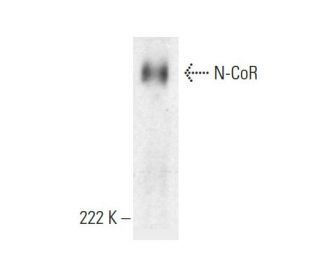

N-CoR Antibody (F-1): sc-515934
- N-CoR Antibody (F-1) is a mouse monoclonal IgM κ N-CoR antibody, cited in 4 publications, provided at 200 µg/ml
- specific for an epitope mapping between amino acids 2429-2453 at the C-terminus of N-CoR of mouse origin
- recommended for detection of N-CoR of mouse, rat and human origin by WB, IP, IF and ELISA
- TransCruz reagent for ChIP application (sc-515934 X, 200 µg/0.1 ml)
- m-IgGκ BP-HRP is the preferred secondary detection reagent for N-CoR Antibody (F-1) for WB applications. This reagent is now offered in a bundle with N-CoR Antibody (F-1) (see ordering information below). For additional m-IgGκ BP conjugates see our complete list of Mouse IgG Binding Proteins.

QUICK LINKS
SEE ALSO...
N-CoR Antibody (F-1) is a mouse monoclonal IgM antibody that detects N-CoR protein of mouse, rat, and human origin by western blotting (WB), immunoprecipitation (IP), immunofluorescence (IF), and enzyme-linked immunosorbent assay (ELISA). N-CoR (F-1) antibody is available as the non-conjugated form. N-CoR protein, also known as Nuclear Receptor Corepressor 1, plays a crucial role in gene expression regulation by acting as a transcriptional repressor. N-CoR protein is primarily located in the nucleus, where N-CoR interacts with various nuclear receptors, including retinoic acid receptors and thyroid hormone receptors, to inhibit transcription in the absence of ligands. This interaction maintains cellular homeostasis and regulates developmental processes, as N-CoR release upon ligand binding allows for target gene activation necessary for processes such as differentiation and metabolism. N-CoR protein consists of 2,440 amino acids and features multiple domains that facilitate interaction with nuclear receptors, underscoring N-CoR′s importance in gene regulation. Using anti-N-CoR antibody (F-1) in research can provide insights into transcriptional repression mechanisms and retinoids′ role in developmental biology.
Alexa Fluor® is a trademark of Molecular Probes Inc., OR., USA
LI-COR® and Odyssey® are registered trademarks of LI-COR Biosciences
N-CoR Antibody (F-1) References:
- The nuclear receptor corepressor N-CoR regulates differentiation: N-CoR directly interacts with MyoD. | Bailey, P., et al. 1999. Mol Endocrinol. 13: 1155-68. PMID: 10406466
- Multiple N-CoR complexes contain distinct histone deacetylases. | Jones, PL., et al. 2001. J Biol Chem. 276: 8807-11. PMID: 11254656
- The N-CoR-HDAC3 nuclear receptor corepressor complex inhibits the JNK pathway through the integral subunit GPS2. | Zhang, J., et al. 2002. Mol Cell. 9: 611-23. PMID: 11931768
- N-CoR controls differentiation of neural stem cells into astrocytes. | Hermanson, O., et al. 2002. Nature. 419: 934-9. PMID: 12410313
- Characterization of DNA binding and retinoic acid binding properties of retinoic acid receptor. | Yang, N., et al. 1991. Proc Natl Acad Sci U S A. 88: 3559-63. PMID: 1850832
- A functional retinoic acid receptor encoded by the gene on human chromosome 12. | Ishikawa, T., et al. 1990. Mol Endocrinol. 4: 837-44. PMID: 2172793
- USP44 Is an Integral Component of N-CoR that Contributes to Gene Repression by Deubiquitinating Histone H2B. | Lan, X., et al. 2016. Cell Rep. 17: 2382-2393. PMID: 27880911
- Ligand-independent repression by the thyroid hormone receptor mediated by a nuclear receptor co-repressor. | Hörlein, AJ., et al. 1995. Nature. 377: 397-404. PMID: 7566114
- Polarity-specific activities of retinoic acid receptors determined by a co-repressor. | Kurokawa, R., et al. 1995. Nature. 377: 451-4. PMID: 7566126
- A transcriptional co-repressor that interacts with nuclear hormone receptors. | Chen, JD. and Evans, RM. 1995. Nature. 377: 454-7. PMID: 7566127
- Phosphorylation enhances the target gene sequence-dependent dimerization of thyroid hormone receptor with retinoid X receptor. | Bhat, MK., et al. 1994. Proc Natl Acad Sci U S A. 91: 7927-31. PMID: 8058736
- The SANT domain: a putative DNA-binding domain in the SWI-SNF and ADA complexes, the transcriptional co-repressor N-CoR and TFIIIB. | Aasland, R., et al. 1996. Trends Biochem Sci. 21: 87-8. PMID: 8882580
Ordering Information
| Product Name | Catalog # | UNIT | Price | Qty | FAVORITES | |
N-CoR Antibody (F-1) | sc-515934 | 200 µg/ml | $322.00 | |||
N-CoR Antibody (F-1): m-IgGκ BP-HRP Bundle | sc-552764 | 200 µg Ab; 40 µg BP | $361.00 | |||
N-CoR Antibody (F-1) X | sc-515934 X | 200 µg/0.1 ml | $322.00 |