
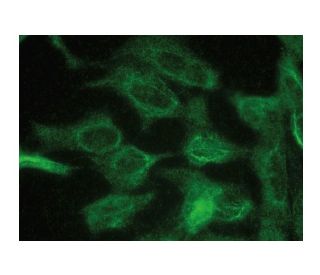


MIS Anticuerpo (B-9): sc-365643
- MIS Anticuerpo (B-9) es un monoclonal de ratón IgG2a κ, ver las 2 publicaciones, proporcionado como 200 µg/ml
- específico para un epítopo localizado entre los amino ácidos 27-51 en el N-terminus de MIS de origen mouse
- recomendado para detectarprecursor and mature MIS de mouse, rat y human origen, mediante WB, IP, IF y ELISA
- Ver MIS (B-11): sc-166752 para MIS anticuerpos conjugados, incluyendo AC, HRP, FITC, PE, Alexa Fluor® 488, 594, 647, 680 y 790.
- 2a BP-HRP">m-IgG2a BP-HRP y m-IgGκ BP-HRP son los reactivos de detección secundarios preferidos para MIS Anticuerpo (B-9) para aplicaciones WB. Estos reactivos se ofrecen ahora en paquetes con MIS Anticuerpo (B-9)(véase la información de pedido más abajo).

ENLACES RÁPIDOS
VER TAMBIÉN ....
La super familia del factor de crecimiento transformador β (TGFβ) está compuesta por numerosos factores de crecimiento y diferenciación, incluyendo TGFβ1-3, la sustancia inhibidora mülleriana (MIS), el factor de crecimiento/diferenciación (GDF) 1-9, la proteína ósea morfogenética (BMP) 2-8, el factor neurotrófico derivado de la línea celular glial (GDNF), Inhibina α, β-A, β-B y β-C, Lefty y Nodal. Los miembros de la super familia TGFβ están involucrados en el desarrollo embrionario y la homeostasis de tejidos adultos. La glicoproteína MIS es producida por las células de Sertoli del testículo. El testículo fetal produce tanto MIS como testosterona, cuya presencia resulta en descendencia masculina. La ausencia de MIS y testosterona en un feto en desarrollo resulta en la inducción de la diferenciación del conducto mülleriano, y el desarrollo del conducto de Wolff no es inducido. La testosterona induce la diferenciación de los conductos de Wolff, mientras que el MIS causa la regresión del conducto mülleriano. El MIS inhibe el crecimiento de tumores derivados de tejidos de origen del conducto mülleriano. El MIS también puede inhibir la autofosforilación del receptor del EGF in vitro. Los defectos en la hormona antimülleriana son la causa del síndrome persistente del conducto mülleriano tipo I (PMDS-1). El PMDS-1 es una forma de pseudohermafroditismo masculino caracterizado por una falla en la regresión del conducto mülleriano en hombres por lo demás normales.
Alexa Fluor® es una marca registrada de Molecular Probes Inc., OR., USA
REIVEW LI-COR® y Odyssey® son marcas registradas de LI-COR Biosciences.
MIS Anticuerpo (B-9) Referencias:
- Sustancia inhibidora mülleriana: una hormona instructiva del desarrollo con aplicaciones diagnósticas y posibles aplicaciones terapéuticas. | Teixeira, J., et al. 2001. Endocr Rev. 22: 657-74. PMID: 11588147
- Mejora de la purificación y producción de la sustancia inhibidora mülleriana para aplicaciones terapéuticas. | Donahoe, PK., et al. 2003. Mol Cell Endocrinol. 211: 37-42. PMID: 14656474
- Localización celular del ácido ribonucleico mensajero de la sustancia inhibidora de Müller durante el desarrollo folicular ovárico humano. | Whitman, GF. and Pantazis, CG. 1991. Am J Obstet Gynecol. 165: 1881-6. PMID: 1750488
- Sustancia inhibidora mülleriana: una hormona fetal con implicaciones quirúrgicas. | Hutson, JM., et al. 1985. Aust N Z J Surg. 55: 599-605. PMID: 2870703
- Cuantificación del polipéptido de la sustancia inhibidora mülleriana/hormona antimülleriana mediante espectrometría de masas por dilución isotópica. | Whiting, G., et al. 2018. Anal Biochem. 560: 50-55. PMID: 29742446
- Expresión de la sustancia inhibidora de la mülleriana/receptor de la hormona antimülleriana de tipo II en las células tecas humanas. | Cheon, KY., et al. 2018. J Clin Endocrinol Metab. 103: 3376-3385. PMID: 29947765
- Sustancia inhibidora de Müller/hormona antimülleriana como predictor de parto prematuro en el síndrome de ovario poliquístico. | Hsu, JY., et al. 2018. J Clin Endocrinol Metab. 103: 4187-4196. PMID: 30239805
- Perfiles funcionales de la sustancia inhibidora mülleriana/hormona antimülleriana (MIS/AMH) en células de cáncer de endometrio cultivadas primariamente. | Kim, SI., et al. 2021. J Cancer. 12: 6289-6300. PMID: 34539902
- Coordinadores de riesgo de cáncer de mama: Medición de la densidad basada en inteligencia artificial y sustancia inhibidora mülleriana. | Pedük, Ş., et al. 2023. Ir J Med Sci. 192: 1601-1606. PMID: 36229588
- Nuevos conocimientos sobre la sustancia inhibidora mulleriana y su mecanismo de acción. | Lane, AH. and Donahoe, PK. 1998. J Endocrinol. 158: 1-6. PMID: 9713320
Información sobre pedidos
| Nombre del producto | Número de catálogo | UNIDAD | Precio | CANTIDAD | Favoritos | |
MIS Anticuerpo (B-9) | sc-365643 | 200 µg/ml | $322.00 | |||
Paquete de MIS (B-9): m-IgGκ BP-HRP | sc-535231 | 200 µg Ab; 40 µg BP | $361.00 | |||
Paquete de MIS (B-9): m-IgG2a BP-HRP | sc-546216 | 200 µg Ab; 10 µg BP | $361.00 | |||
MIS (B-9) péptido neutralizante | sc-365643 P | 100 µg/0.5 ml | $69.00 |