
Date published: 2026-1-30

1-800-457-3801

SCBT Portrait Logo
Seach Input

Max Antibody (H-2): sc-8011

4.5(11)
Write a reviewAsk a question

Datasheets
  • Max Antibody (H-2) is a mouse monoclonal IgG1 κ Max antibody, cited in 29 publications, provided at 200 µg/ml
  • raised against amino acids 28-151 mapping at the C-terminus of Max of human origin
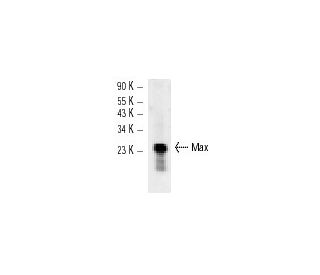
  • Max Antibody (H-2) is recommended for detection of Max p21 and Max p22 of mouse, rat and human origin by WB, IP, IF, IHC(P) and ELISA; also reactive with additional species, including canine
  • Anti-Max Antibody (H-2) is available conjugated to agarose for IP; HRP for WB, IHC(P) and ELISA; and to either phycoerythrin or FITC for IF, IHC(P) and FCM
  • also available conjugated to Alexa Fluor® 488, Alexa Fluor® 546, Alexa Fluor® 594 or Alexa Fluor® 647 for WB (RGB), IF, IHC(P) and FCM, and for use with RGB fluorescent imaging systems, such as iBright™ FL1000, FluorChem™, Typhoon, Azure and other comparable systems
  • also available conjugated to Alexa Fluor® 680 or Alexa Fluor® 790 for WB (NIR), IF and FCM; for use with Near-Infrared (NIR) detection systems, such as LI-COR®Odyssey®, iBright™ FL1000, FluorChem™, Typhoon, Azure and other comparable systems
  • TransCruz reagent for Gel Supershift and ChIP applications (sc-8011 X, 200 µg/0.1 ml)
  • m-IgG Fc BP-HRP, m-IgG1 BP-HRP and m-IgGκ BP-HRP are the preferred secondary detection reagents for Max Antibody (H-2) for WB and IHC(P) applications. These reagents are now offered in bundles with Max Antibody (H-2) (see ordering information below).
Crispr Promo Banner

QUICK LINKS

SEE ALSO...

Max Antibody (H-2) is a mouse monoclonal IgG1 kappa light chain antibody that detects Max protein in mouse, rat, and human samples through western blotting (WB), immunoprecipitation (IP), immunofluorescence (IF), immunohistochemistry with paraffin-embedded sections (IHCP), and enzyme-linked immunosorbent assay (ELISA). Max antibody (H-2) comes in non-conjugated forms and various conjugates, including agarose, horseradish peroxidase (HRP), phycoerythrin (PE), fluorescein isothiocyanate (FITC), and multiple Alexa Fluor® options. Max protein functions as a key regulator of gene expression within transcription factor complexes, notably forming heterodimers with Myc proteins to enhance DNA binding and transcriptional activation. Max-Myc heterodimers bind to E-box sequence CACGTG more strongly than Max homodimers, influencing target gene expression. Max′s stable presence in cells, unlike highly regulated Myc, ensures proper function of transcriptional networks. Max interactions with proteins like Mad and Mxi1 can inhibit Max-Myc activity, highlighting complex regulatory mechanisms in cellular behavior and oncogenesis.

For Research Use Only. Not Intended for Diagnostic or Therapeutic Use.

Alexa Fluor® is a trademark of Molecular Probes Inc., OR., USA

LI-COR® and Odyssey® are registered trademarks of LI-COR Biosciences

Max Antibody (H-2) References:

  1. Determination of binding constant of transcription factor myc-max/max-max and E-box DNA: the effect of inhibitors on the binding.  |  Park, S., et al. 2004. Biochim Biophys Acta. 1670: 217-28. PMID: 14980448
  2. Myc family oncoproteins function through a common pathway to transform normal cells in culture: cross-interference by Max and trans-acting dominant mutants.  |  Mukherjee, B., et al. 1992. Genes Dev. 6: 1480-92. PMID: 1644290
  3. Association of Myn, the murine homolog of max, with c-Myc stimulates methylation-sensitive DNA binding and ras cotransformation.  |  Prendergast, GC., et al. 1991. Cell. 65: 395-407. PMID: 1840505
  4. Intracellular leucine zipper interactions suggest c-Myc hetero-oligomerization.  |  Dang, CV., et al. 1991. Mol Cell Biol. 11: 954-62. PMID: 1990293
  5. Max: a helix-loop-helix zipper protein that forms a sequence-specific DNA-binding complex with Myc.  |  Blackwood, EM. and Eisenman, RN. 1991. Science. 251: 1211-7. PMID: 2006410
  6. Small-molecule modulators of c-Myc/Max and Max/Max interactions.  |  Berg, T. 2011. Curr Top Microbiol Immunol. 348: 139-49. PMID: 20680803
  7. Transcriptional regulation by dimerization: two sides to an incestuous relationship.  |  Jones, N. 1990. Cell. 61: 9-11. PMID: 2180585
  8. Unexpected link between MAX and meiotic onset.  |  Okuda, A. and Suzuki, A. 2016. Cell Cycle. 15: 2235-6. PMID: 27267300
  9. Distinct DNA binding preferences for the c-Myc/Max and Max/Max dimers.  |  Solomon, DL., et al. 1993. Nucleic Acids Res. 21: 5372-6. PMID: 8265351
  10. Mad: a heterodimeric partner for Max that antagonizes Myc transcriptional activity.  |  Ayer, DE., et al. 1993. Cell. 72: 211-22. PMID: 8425218
  11. Mxi1, a protein that specifically interacts with Max to bind Myc-Max recognition sites.  |  Zervos, AS., et al. 1993. Cell. 72: 223-32. PMID: 8425219
  12. Oncogenic activity of the c-Myc protein requires dimerization with Max.  |  Amati, B., et al. 1993. Cell. 72: 233-45. PMID: 8425220

Ordering Information

Product NameCatalog #UNITPriceQtyFAVORITES

Max Antibody (H-2)

sc-8011
200 µg/ml
$322.00

Max Antibody (H-2): m-IgG Fc BP-HRP Bundle

sc-528200
200 µg Ab; 10 µg BP
$361.00

Max Antibody (H-2): m-IgGκ BP-HRP Bundle

sc-520522
200 µg Ab, 40 µg BP
$361.00

Max Antibody (H-2): m-IgG1 BP-HRP Bundle

sc-542812
200 µg Ab; 20 µg BP
$361.00

Max Antibody (H-2) X

sc-8011 X
200 µg/0.1 ml
$322.00

Max Antibody (H-2) AC

sc-8011 AC
500 µg/ml, 25% agarose
$424.00

Max Antibody (H-2) HRP

sc-8011 HRP
200 µg/ml
$322.00

Max Antibody (H-2) FITC

sc-8011 FITC
200 µg/ml
$336.00

Max Antibody (H-2) PE

sc-8011 PE
200 µg/ml
$349.00

Max Antibody (H-2) Alexa Fluor® 488

sc-8011 AF488
200 µg/ml
$364.00

Max Antibody (H-2) Alexa Fluor® 546

sc-8011 AF546
200 µg/ml
$364.00

Max Antibody (H-2) Alexa Fluor® 594

sc-8011 AF594
200 µg/ml
$364.00

Max Antibody (H-2) Alexa Fluor® 647

sc-8011 AF647
200 µg/ml
$364.00

Max Antibody (H-2) Alexa Fluor® 680

sc-8011 AF680
200 µg/ml
$364.00

Max Antibody (H-2) Alexa Fluor® 790

sc-8011 AF790
200 µg/ml
$364.00

What is the recommended secondary reagent to be used with this mouse monoclonal primary?

Asked by: DefinitelyNotMatt
Thank you for your question. We recommend using one our exclusive Mouse IgG Binding Proteins as a secondary detection reagent. A complete list of available binding proteins is available on our website here: https://www.scbt.com/scbt/browse/support-products-mouse-igg-binding-proteins/_/N-ecrety Please contact Technical Service if you have further questions concerning this product.
Answered by: Technical Service 11
Date published: 2017-01-11

Can I use this mouse monoclonal antibody for immunohistochemical staining of mouse tissue? Or even double or triple staining on the same samples?

Asked by: DefinitelyNotMatt
Thank you for your question. Yes. We recommend using a directly conjugated mouse monoclonal primary antibody. This antibody is currently available conjugated to phycoerythrin (sc-8011 PE), fluorescein (sc-8011 FITC), Alexa Fluor® 488 (sc-8011 AF488) or Alexa Fluor® 647 (sc-8011 AF647). Please contact Technical Service if you have further questions concerning this product.
Answered by: Technical Service 11
Date published: 2017-01-11
  • y_2026, m_1, d_23, h_8CST
  • bvseo_bulk, prod_bvqa, vn_bulk_3.0.42
  • cp_1, bvpage1
  • co_hasquestionsanswers, tq_2
  • loc_en_US, sid_8011, prod, sort_[SortEntry(order=LAST_APPROVED_ANSWER_SUBMISSION_TIME, direction=DESCENDING)]
  • clientName_scbt
  • bvseo_sdk, java_sdk, bvseo-4.0.0
  • CLOUD, getContent, 98ms
  • QUESTIONS, PRODUCT
Rated 1 out of 5 by from Hat leider nicht funktioniert.Verschiedene Verdünnungen (1:1000 bis herunter auf 1:50) unter Verwendung von Standard Immunoblot Methoden und Proteinextrakten aus humanen Zellen führten zu keinem Signal auf Höhe der 22-kDa Bande.
Date published: 2021-07-06
Rated 5 out of 5 by from Check MAX protein expression cancer cellsWestern blot antibody:sc-8011 result:Postive in prostate cancer cell line(LNCaP Cell)
Date published: 2017-10-31
Rated 5 out of 5 by from works wellWorks well in western blot analysis with clean background.
Date published: 2017-10-15
Rated 4 out of 5 by from mouse ES cellsthis max antibody could work in mouse ES cells ,good
Date published: 2017-04-07
Rated 5 out of 5 by from Superb westernVery clear western blot data; strong signal with low background
Date published: 2017-01-29
Rated 5 out of 5 by from Great, versatile antibodyThe Max Antibody (H-2): sc-8011 works very well for a variety of applications including WB, IP, IF, and IHC(P). It has also been cited multiple times for further verification.
Date published: 2017-01-13
Rated 5 out of 5 by from Worked well for western blot with human cellWorked well for western blot with human cell lines: HT29-APC & HT29-beta-galactosidase. -SCBT Publication Review
Date published: 2015-05-08
Rated 5 out of 5 by from EMSA and Western Blot: published results in HeLaEMSA and Western Blot: published results in HeLa, RMS-13, and Tera-1 using H-2 antibody. -SCBT Publication Review
Date published: 2015-04-01
  • y_2026, m_1, d_23, h_8
  • bvseo_bulk, prod_bvrr, vn_bulk_3.0.42
  • cp_1, bvpage1
  • co_hasreviews, tv_0, tr_11
  • loc_en_US, sid_8011, prod, sort_[SortEntry(order=SUBMISSION_TIME, direction=DESCENDING)]
  • clientName_scbt
  • bvseo_sdk, java_sdk, bvseo-4.0.0
  • CLOUD, getReviews, 9ms
  • REVIEWS, PRODUCT
Max Antibody (H-2) is rated 4.5 out of 5 by 11.
  • y_2026, m_1, d_23, h_8
  • bvseo_bulk, prod_bvrr, vn_bulk_3.0.42
  • cp_1, bvpage1
  • co_hasreviews, tv_0, tr_11
  • loc_en_US, sid_8011, prod, sort_[SortEntry(order=SUBMISSION_TIME, direction=DESCENDING)]
  • clientName_scbt
  • bvseo_sdk, java_sdk, bvseo-4.0.0
  • CLOUD, getAggregateRating, 106ms
  • REVIEWS, PRODUCT
