
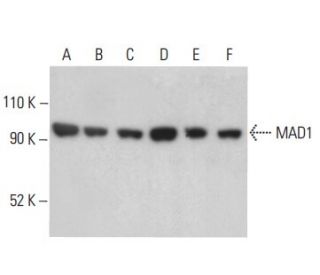
MAD1 Antibody (9B10): sc-47746
- MAD1 Antibody (9B10) is a mouse monoclonal IgG2b κ, cited in 21 publications, provided at 200 µg/ml
- raised against full length MAD1 of human origin
- MAD1 Antibody (9B10) is recommended for detection of MAD1 of human origin by WB, IP, IF, IHC(P), FCM and ELISA
- MAD1 Antibody (9B10) is available conjugated to either phycoerythrin or FITC for IF, IHC(P) and FCM
- also available conjugated to Alexa Fluor® 594 for IF, IHC(P) and FCM
- also available conjugated to Alexa Fluor® 680 or Alexa Fluor® 790 for WB (NIR), IF and FCM; for use with Near-Infrared (NIR) detection systems, such as LI-COR®Odyssey®, iBright™ FL1000, FluorChem™, Typhoon, Azure and other comparable systems
- m-IgG2b BP-HRP is the preferred secondary detection reagent for MAD1 Antibody (9B10) for WB and IHC(P) applications. This reagent is now offered in a bundle with MAD1 Antibody (9B10) (see ordering information below).

QUICK LINKS
MAD1 Antibody (9B10) is a mouse monoclonal IgG2b kappa light chain antibody that detects MAD1 protein of human origin by western blotting (WB), immunoprecipitation (IP), immunofluorescence (IF), immunohistochemistry with paraffin-embedded sections (IHCP), flow cytometry (FCM), and enzyme-linked immunosorbent assay (ELISA). MAD1 (9B10) antibody is available in both conjugated and non-conjugated forms, providing flexibility for various experimental needs. MAD1 protein plays a critical role in cell cycle regulation, particularly at the mitotic spindle assembly checkpoint, where MAD1 ensures cell division proceeds only when all chromosomes are properly aligned. This function is vital for maintaining genomic stability, as errors in chromosome segregation can lead to aneuploidy and contribute to cancer development. MAD1 interacts with MAD2 to form a tetrameric core complex, which is essential for the checkpoint′s function. MAD1′s localization is dynamic; MAD1 primarily resides in the nucleus but translocates to the centrosome and spindle midzone during mitosis, highlighting MAD1′s importance in coordinating cell division. MAD1 undergoes hyperphosphorylation in response to spindle damage, a modification that enhances MAD1′s activity and underscores MAD1′s role in cellular stress responses. Defects in MAD1 have been implicated in various cancers, making MAD1 a significant target for research in cancer biology and therapeutic development.
Alexa Fluor® is a trademark of Molecular Probes Inc., OR., USA
LI-COR® and Odyssey® are registered trademarks of LI-COR Biosciences
MAD1 Antibody (9B10) References:
- Expression of Mad1 protein inhibits proliferation of cancer cells and inversely correlated with Myc protein expression in primary gastric cancer. | Han, S., et al. 1999. Oncol Rep. 6: 569-74. PMID: 10203593
- Myc family oncoproteins function through a common pathway to transform normal cells in culture: cross-interference by Max and trans-acting dominant mutants. | Mukherjee, B., et al. 1992. Genes Dev. 6: 1480-92. PMID: 1644290
- Association of Myn, the murine homolog of max, with c-Myc stimulates methylation-sensitive DNA binding and ras cotransformation. | Prendergast, GC., et al. 1991. Cell. 65: 395-407. PMID: 1840505
- Intracellular leucine zipper interactions suggest c-Myc hetero-oligomerization. | Dang, CV., et al. 1991. Mol Cell Biol. 11: 954-62. PMID: 1990293
- Max: a helix-loop-helix zipper protein that forms a sequence-specific DNA-binding complex with Myc. | Blackwood, EM. and Eisenman, RN. 1991. Science. 251: 1211-7. PMID: 2006410
- Transcriptional regulation by dimerization: two sides to an incestuous relationship. | Jones, N. 1990. Cell. 61: 9-11. PMID: 2180585
- Mad1 mediates hypoxia-induced doxorubicin resistance in colon cancer cells by inhibiting mitochondrial function. | Cho, K., et al. 2013. Free Radic Biol Med. 60: 201-10. PMID: 23459071
- Alterations of DNA damage response pathway: Biomarker and therapeutic strategy for cancer immunotherapy. | Jiang, M., et al. 2021. Acta Pharm Sin B. 11: 2983-2994. PMID: 34729299
- The Sin3A/MAD1 Complex, through Its PAH2 Domain, Acts as a Second Repressor of Retinoic Acid Receptor Beta Expression in Breast Cancer Cells. | Dahiya, NR., et al. 2022. Cells. 11: PMID: 35406744
- Mad: a heterodimeric partner for Max that antagonizes Myc transcriptional activity. | Ayer, DE., et al. 1993. Cell. 72: 211-22. PMID: 8425218
- Mxi1, a protein that specifically interacts with Max to bind Myc-Max recognition sites. | Zervos, AS., et al. 1993. Cell. 72: 223-32. PMID: 8425219
- Oncogenic activity of the c-Myc protein requires dimerization with Max. | Amati, B., et al. 1993. Cell. 72: 233-45. PMID: 8425220
Ordering Information
| Product Name | Catalog # | UNIT | Price | Qty | FAVORITES | |
MAD1 Antibody (9B10) | sc-47746 | 200 µg/ml | $322.00 | |||
MAD1 Antibody (9B10): m-IgG2b BP-HRP Bundle | sc-548655 | 200 µg Ab; 10 µg BP | $361.00 | |||
MAD1 Antibody (9B10) FITC | sc-47746 FITC | 200 µg/ml | $336.00 | |||
MAD1 Antibody (9B10) PE | sc-47746 PE | 200 µg/ml | $349.00 | |||
MAD1 Antibody (9B10) Alexa Fluor® 546 | sc-47746 AF546 | 200 µg/ml | $364.00 | |||
MAD1 Antibody (9B10) Alexa Fluor® 594 | sc-47746 AF594 | 200 µg/ml | $364.00 | |||
MAD1 Antibody (9B10) Alexa Fluor® 680 | sc-47746 AF680 | 200 µg/ml | $364.00 | |||
MAD1 Antibody (9B10) Alexa Fluor® 790 | sc-47746 AF790 | 200 µg/ml | $364.00 |