
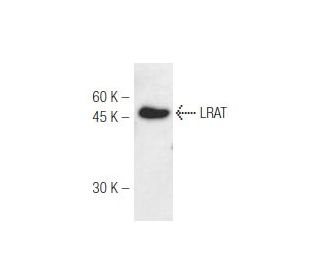


LRAT Antibody (M34-P1F10): sc-101391
- LRAT Antibody (M34-P1F10) is a mouse monoclonal IgG1 λ LRAT antibody, cited in 1 publications, provided at 200 µg/ml
- raised against a synthetic peptide corresponding to amino acids 190-199 of LRAT of human origin
- LRAT Antibody (M34-P1F10) is recommended for detection of LRAT of mouse, rat and human origin by WB, IP, IF and ELISA
- Anti-LRAT Antibody (M34-P1F10) is available conjugated to agarose for IP; HRP for WB, IHC(P) and ELISA; and to either phycoerythrin or FITC for IF, IHC(P) and FCM
- also available conjugated to Alexa Fluor® 488, Alexa Fluor® 546, Alexa Fluor® 594 or Alexa Fluor® 647 for WB (RGB), IF, IHC(P) and FCM, and for use with RGB fluorescent imaging systems, such as iBright™ FL1000, FluorChem™, Typhoon, Azure and other comparable systems
- also available conjugated to Alexa Fluor® 680 or Alexa Fluor® 790 for WB (NIR), IF and FCM; for use with Near-Infrared (NIR) detection systems, such as LI-COR®Odyssey®, iBright™ FL1000, FluorChem™, Typhoon, Azure and other comparable systems
- m-IgG Fc BP-HRP and m-IgG1 BP-HRP are the preferred secondary detection reagents for LRAT Antibody (M34-P1F10) for WB applications. These reagents are now offered in bundles with LRAT Antibody (M34-P1F10) (see ordering information below).

QUICK LINKS
SEE ALSO...
LRAT Antibody (M34-P1F10) is a mouse monoclonal IgG1 antibody that detects LRAT in mouse, rat, and human samples through applications such as western blotting (WB), immunoprecipitation (IP), immunofluorescence (IF), and enzyme-linked immunosorbent assay (ELISA). Anti-LRAT antibody (M34-P1F10) is available in both non-conjugated and various conjugated forms, including agarose, horseradish peroxidase (HRP), phycoerythrin (PE), fluorescein isothiocyanate (FITC), and multiple Alexa Fluor® conjugates. Lecithin retinol acyltransferase (LRAT) plays a crucial role in the visual cycle by catalyzing the conversion of vitamin A into all-trans-retinyl esters, which are essential for the synthesis of the visual pigment chromophore. LRAT is primarily located in the liver, retinal pigmented epithelium, and some extrahepatic tissues, where LRAT facilitates the dietary mobilization, transport, and storage of vitamin A. Proper functioning of LRAT is vital for maintaining vision, as LRAT ensures the availability of retinyl esters necessary for the regeneration of visual pigments. Additionally, LRAT monomers can form homodimers in cellular membranes through disulfide bonds, which is important for enzymatic activity. A deficiency in LRAT has been linked to severe retinal dystrophy and retinyl ester deprivation, while reduced expression levels may be associated with invasive bladder cancer, highlighting LRAT′s significance in both ocular health and potential cancer pathways.
Alexa Fluor® is a trademark of Molecular Probes Inc., OR., USA
LI-COR® and Odyssey® are registered trademarks of LI-COR Biosciences
LRAT Antibody (M34-P1F10) References:
- Two histidine residues are essential for catalysis by lecithin retinol acyl transferase. | Mondal, MS., et al. 2001. FEBS Lett. 489: 14-8. PMID: 11231005
- On the mechanism of isomerization of all-trans-retinol esters to 11-cis-retinol in retinal pigment epithelial cells: 11-fluoro-all-trans-retinol as substrate/inhibitor in the visual cycle. | Fishkin, N., et al. 2005. Bioorg Med Chem. 13: 5189-94. PMID: 15922603
- Lecithin:retinol acyltransferase in ARPE-19. | Trevino, SG., et al. 2005. Exp Eye Res. 80: 897-900. PMID: 15939047
- Mechanisms of digestion and absorption of dietary vitamin A. | Harrison, EH. 2005. Annu Rev Nutr. 25: 87-103. PMID: 16011460
- Acyl CoA:retinol acyltransferase (ARAT) activity is present in bovine retinal pigment epithelium. | Kaschula, CH., et al. 2006. Exp Eye Res. 82: 111-21. PMID: 16054134
- Retinoid absorption and storage is impaired in mice lacking lecithin:retinol acyltransferase (LRAT). | O'Byrne, SM., et al. 2005. J Biol Chem. 280: 35647-57. PMID: 16115871
- Chicken retinas contain a retinoid isomerase activity that catalyzes the direct conversion of all-trans-retinol to 11-cis-retinol. | Mata, NL., et al. 2005. Biochemistry. 44: 11715-21. PMID: 16128572
- Palmitoyl transferase activity of lecithin retinol acyl transferase. | Xue, L., et al. 2006. Biochemistry. 45: 10710-8. PMID: 16939223
- Reduced lecithin:retinol acyl transferase activity in cultured squamous cell carcinoma lines results in increased substrate-driven retinoic acid synthesis. | Jurukovski, V. and Simon, M. 1999. Biochim Biophys Acta. 1436: 479-90. PMID: 9989277
Ordering Information
| Product Name | Catalog # | UNIT | Price | Qty | FAVORITES | |
LRAT Antibody (M34-P1F10) | sc-101391 | 200 µg/ml | $322.00 | |||
LRAT Antibody (M34-P1F10): m-IgG Fc BP-HRP Bundle | sc-527070 | 200 µg Ab; 10 µg BP | $361.00 | |||
LRAT Antibody (M34-P1F10): m-IgG1 BP-HRP Bundle | sc-532443 | 200 µg Ab; 20 µg BP | $361.00 | |||
LRAT Antibody (M34-P1F10) AC | sc-101391 AC | 500 µg/ml, 25% agarose | $424.00 | |||
LRAT Antibody (M34-P1F10) HRP | sc-101391 HRP | 200 µg/ml | $322.00 | |||
LRAT Antibody (M34-P1F10) FITC | sc-101391 FITC | 200 µg/ml | $336.00 | |||
LRAT Antibody (M34-P1F10) PE | sc-101391 PE | 200 µg/ml | $349.00 | |||
LRAT Antibody (M34-P1F10) Alexa Fluor® 488 | sc-101391 AF488 | 200 µg/ml | $364.00 | |||
LRAT Antibody (M34-P1F10) Alexa Fluor® 546 | sc-101391 AF546 | 200 µg/ml | $364.00 | |||
LRAT Antibody (M34-P1F10) Alexa Fluor® 594 | sc-101391 AF594 | 200 µg/ml | $364.00 | |||
LRAT Antibody (M34-P1F10) Alexa Fluor® 647 | sc-101391 AF647 | 200 µg/ml | $364.00 | |||
LRAT Antibody (M34-P1F10) Alexa Fluor® 680 | sc-101391 AF680 | 200 µg/ml | $364.00 | |||
LRAT Antibody (M34-P1F10) Alexa Fluor® 790 | sc-101391 AF790 | 200 µg/ml | $364.00 |