
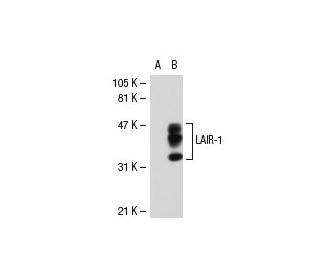
CRISPR 데이터가 아님: 이 이미지는 CRISPR 실험 결과를 시각화하기 위한 항체 품질을 보여줍니다.
CRISPR 데이터가 아님: 이 이미지는 CRISPR 실험 결과를 시각화하기 위한 항체 품질을 보여줍니다.
LAIR-1 CRISPR/Cas9 케이오 플라스미드 (h): sc-403542
- Target species: human
- 20 µg of transfection-ready, purified plasmid DNA; Suitable for up to 20 transfections
- LAIR-1 CRISPR/Cas9 녹아웃(KO) 플라스미드 (h)은 플라스미드 풀로, 각 플라스미드는 Cas9 뉴클레아제와 표적 특이적 20nt 가이드 RNA(gRNA)를 암호화하며, GeCKO v2 라이브러리에서 유래한 서열을 사용하여 녹아웃 효율을 극대화하도록 설계되었습니다.
- gRNA 서열은 Cas9가 LAIR-1 게놈 위치에서 부위 특이적 이중 가닥 절단(DSBs)을 유도하도록 유도하며, 이는 비동종 말단 결합(NHEJ)을 통해 유전자 녹아웃을 초래합니다
- 푸로마이신 내성 및 RFP 유전자는 LoxP 사이트로 둘러싸여 있어, 안정적인 녹아웃 세포주를 확립한 후 Cre 재조합효소(Cre 벡터: sc-418923)를 통해 선택 마커를 제거할 수 있습니다
- Transfection, gene knockout효율은 WB, IF나 IHC등 방법으로 측정할수있습니다, 권장하는 항체는 LAIR-1 Antibody (F-5): sc-398141

주문정보
| 제품명 | 카탈로그 번호 | 단위 | 가격 | 수량 | 관심품목 | |
LAIR-1 CRISPR/Cas9 케이오 플라스미드 (h) | sc-403542 | 20 µg | $397.00 |
개요
LAIR1은 백혈구 연관 면역글로불린 유사 수용체 1(LAIR-1)을 암호화하며, LAIR-1은 T 세포, B 세포, NK 세포, 단핵구, 수지상세포를 포함한 다양한 면역세포에 널리 발현되는 억제성 콜라겐 수용체입니다. LAIR-1은 세포외기질(ECM) 콜라겐과 결합하면 ITIM 모티프를 통해 SHP-1/2와 같은 인산가수분해효소(포스파테이스)를 모집하여 항원 수용체 및 Fc 수용체 경로를 약화시키고, 활성화·사이토카인 생성·세포독성을 제한합니다. 이러한 체크포인트 유사 기능은 조직 기질의 신호를 면역 항상성과 연결하며, 백혈구 이동과 염증 반응의 역치에도 영향을 미칩니다. LAIR-1 신호의 이상 조절은 자가면역, 만성 염증, 감염, 종양 관련 면역억제에서 변화된 면역 조절과 연관되어 왔으며, 기전 면역학 연구에 유용한 표적(노드)로 여겨집니다.
LAIR-1 CRISPR/Cas9 KO 플라스미드 (h)는 human 세포주에서 LAIR1 유전자의 표적 파괴를 위해 설계된 플라스미드 풀입니다. 각 플라스미드는 LAIR1 유전자 내의 서로 다른 부위를 표적으로 하는 고유한 단일 가이드 RNA(sgRNA)와 Streptococcus pyogenes Cas9 뉴클레아제를 함께 발현합니다. 또한 이 플라스미드들은 GFP를 암호화하여, 형광 현미경이나 유세포 분석기를 통해 성공적으로 형질전환된 세포를 형광으로 식별하고 농축할 수 있게 합니다.
다중 가이드 설계는 Cas9에 의한 이중 가닥 절단 형성 후 LAIR1의 개방 독서 틀(ORF)을 파괴하는 삽입 또는 결실(indel)이 발생할 가능성을 높입니다. CRISPR/Cas9 시스템에 의해 유발된 DNA 절단은 내인성 비동종 말단 결합(NHEJ) 경로를 통해 복구되며, 이는 종종 LAIR-1 단백질 발현을 소멸시키는 프레임 시프트 돌연변이를 초래합니다.
이 CRISPR 녹아웃 시스템은 LAIR-1 신호 전달 연구, 기능 유전체학 연구, 암 생물학 연구 및 인간 세포주에서의 치료 반응 평가를 위한 LAIR1 결핍 세포 모델을 효율적으로 생성할 수 있게 합니다.
주요 특징
- LAIR-1 기능에 중요한 LAIR1 엑손을 표적하는 sgRNA
전달을 단순화하기 위해 단일 플라스미드에서 SpCas9 및 sgRNA의 공동 발현
형질전환된 세포 식별을 위한 GFP 리포터
녹아웃 효율 향상을 위해 여러 LAIR1 게놈 부위를 표적하는 플라스미드 풀
형질전환을 통한 전달과 호환
설계 변형
CRISPRs +/- HDR
- LAIR-1 CRISPR/Cas9 KO 플라스미드 (h) 및 LAIR-1 CRISPR/Cas9 KO 플라스미드 (h2)에 의해 암호화되는 gRNA는 LAIR1 유전자좌 내의 서로 다른 부위를 표적화합니다. 표적화 설계 중 하나 또는 둘 다 이용 가능할 수 있습니다. 구입 가능 여부는 관련 제품을 참조하십시오.
LAIR-1 HDR 플라스미드 (h) 및 LAIR-1 HDR 플라스미드 (h2)에 의해 암호화되는
HDR 기증자 컨스트럭트는 푸로마이신 내성 카세트와 RFP 리포터를 포함하며, 이는 CRISPR/Cas9 KO 설계에 해당하는 정의된 LAIR1 표적 부위에서의 상동성 유도 복구를 지원하기 위해 LAIR1 상동성 암으로 둘러싸여 있습니다. HDR 기증자의 재고 여부는 달라질 수 있습니다. 재고 여부는 관련 제품을 참조하십시오.
연구용으로만 사용하세요. 진단 또는 치료용이 아닙니다.