
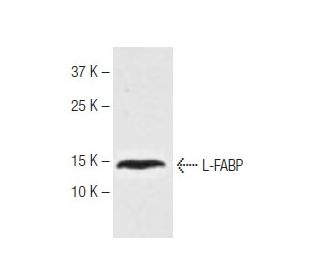

L-FABP Antibody (2G4): sc-135628
- L-FABP Antibody (2G4) is a mouse monoclonal IgG1 provided at 100 µg/ml
- raised against full-length recombinant L-FABP of human origin
- recommended for detection of L-FABP of human origin by WB, IP and ELISA
- At present, we have not yet completed the identification of the preferred secondary detection reagent(s) for L-FABP Antibody (2G4). This work is in progress.

QUICK LINKS
SEE ALSO...
L-FABP Antibody (2G4) is a mouse monoclonal IgG1 antibody that detects L-FABP in human samples through applications such as western blotting (WB), immunoprecipitation (IP), and enzyme-linked immunosorbent assay (ELISA). L-FABP, or liver fatty acid-binding protein, is a crucial cytoplasmic protein that plays a significant role in lipid metabolism, particularly in the liver, where L-FABP facilitates the uptake, transport, and intracellular targeting of fatty acids. L-FABP is essential for maintaining lipid homeostasis and is involved in the regulation of cholesterol synthesis and metabolism, which is vital for various physiological processes, including energy production and membrane integrity. L-FABP expression is influenced by developmental, hormonal, dietary, and pharmacological factors, highlighting L-FABP′s importance in metabolic regulation and potential implications in metabolic disorders. Anti-L-FABP antibody (2G4) is an invaluable tool for researchers studying lipid metabolism and its associated pathways, providing insights into the physiological and pathological roles of fatty acid-binding proteins in human health.
Alexa Fluor® is a trademark of Molecular Probes Inc., OR., USA
LI-COR® and Odyssey® are registered trademarks of LI-COR Biosciences
L-FABP Antibody (2G4) References:
- L-FABP and I-FABP expression in newborn rats changes inversely in the model of necrotizing enterocolitis. | Mitidiero, LF., et al. 2014. Acta Cir Bras. 29 Suppl 2: 43-9. PMID: 25229514
- I-FABP and L-FABP are early markers for abdominal injury with limited prognostic value for secondary organ failures in the post-traumatic course. | Voth, M., et al. 2015. Clin Chem Lab Med. 53: 771-80. PMID: 25324448
- Liver fatty acid-binding protein (L-FABP) promotes cellular angiogenesis and migration in hepatocellular carcinoma. | Ku, CY., et al. 2016. Oncotarget. 7: 18229-46. PMID: 26919097
- L-FABP and IL-6 as markers of chronic kidney damage in children after hemolytic uremic syndrome. | Lipiec, K., et al. 2018. Adv Clin Exp Med. 27: 955-962. PMID: 29905409
- Clinical significance of urinary L-FABP in the emergency department. | Suzuki, G., et al. 2019. Int J Emerg Med. 12: 24. PMID: 31470789
- Urinary I-FABP, L-FABP, TFF-3, and SAA Can Diagnose and Predict the Disease Course in Necrotizing Enterocolitis at the Early Stage of Disease. | Coufal, S., et al. 2020. J Immunol Res. 2020: 3074313. PMID: 32190704
- Evaluation of urinary L-FABP as an early marker for diabetic nephropathy in type 2 diabetic patients. | Thi, TND., et al. 2020. J Med Biochem. 39: 224-230. PMID: 33033456
- Urinary L-FABP is a promising prognostic biomarker of ACLF and mortality in patients with decompensated cirrhosis. | Juanola, A., et al. 2022. J Hepatol. 76: 107-114. PMID: 34530063
- Quantitative and qualitative analyses of urinary L-FABP for predicting acute kidney injury after emergency laparotomy. | Okuda, H., et al. 2022. J Anesth. 36: 38-45. PMID: 34716487
- L-FABP and NGAL are novel biomarkers for detection of abdominal injury and hemorrhagic shock. | Voth, M., et al. 2023. Injury. 54: 1246-1256. PMID: 36621362
Ordering Information
| Product Name | Catalog # | UNIT | Price | Qty | FAVORITES | |
L-FABP Antibody (2G4) | sc-135628 | 100 µg/ml | $322.00 |