
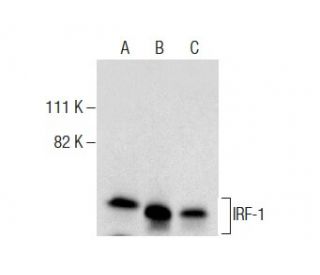


IRF-1 Antibody (20): sc-135952
- IRF-1 Antibody (20) is a mouse monoclonal IgG1, cited in 2 publications, provided at 50 µg/0.5 ml
- raised against amino acids 159-279 of IRF-1 of human origin
- recommended for detection of IRF-1 of human origin by WB and IP
- See IRF-1 (E-4): sc-514544 for IRF-1 antibody conjugates, including AC, HRP, FITC, PE, Alexa Fluor® 488, 594, 647, 680 and 790.
- At present, we have not yet completed the identification of the preferred secondary detection reagent(s) for IRF-1 Antibody (20). This work is in progress.

IRF-1 Antibody (20) is a mouse monoclonal IgG1 antibody that detects interferon regulatory factor-1 (IRF-1) in human samples through applications such as western blotting (WB) and immunoprecipitation (IP). Anti-IRF-1 antibody (20) recognizes a protein that plays a crucial role in the immune response by acting as a transcriptional activator for type I interferons, which are vital for the antiviral response and regulation of immune cell activity. IRF-1 is primarily located in the nucleus, where IRF-1 binds to specific DNA sequences in the promoters of interferon-α and interferon-β genes, thereby influencing their expression. IRF-1 (20) monoclonal antibody targets a protein essential for proper immune system functioning, as IRF-1 helps to initiate and sustain the antiviral state in cells. IRF-1′s interaction with IRF-2, which acts as a repressor, highlights the delicate balance of regulatory mechanisms that govern immune responses. The dynamic interplay between these two factors is critical, as overexpression of IRF-2 can lead to cell transformation, while increased levels of IRF-1 can reverse this effect, underscoring IRF-1′s importance in maintaining cellular homeostasis and immune integrity.
Alexa Fluor® is a trademark of Molecular Probes Inc., OR., USA
LI-COR® and Odyssey® are registered trademarks of LI-COR Biosciences
IRF-1 Antibody (20) References:
- IRF-1 as a negative regulator of cell proliferation. | Romeo, G., et al. 2002. J Interferon Cytokine Res. 22: 39-47. PMID: 11846974
- IRF-1 promotes renal fibrosis by downregulation of Klotho. | Li, Y., et al. 2020. FASEB J. 34: 4415-4429. PMID: 31965641
- IRF-1 mediates the suppressive effects of mTOR inhibition on arterial endothelium. | Peng, K., et al. 2020. J Mol Cell Cardiol. 140: 30-41. PMID: 32087218
- IFI44L expression is regulated by IRF-1 and HIV-1. | Li, Y., et al. 2021. FEBS Open Bio. 11: 105-113. PMID: 33159419
- Interferon regulatory factor 1(IRF-1) activates anti-tumor immunity via CXCL10/CXCR3 axis in hepatocellular carcinoma (HCC). | Yan, Y., et al. 2021. Cancer Lett. 506: 95-106. PMID: 33689775
- Interferon-γ/IRF-1 pathway regulatory mechanisms of PD-L1 expression and relevance for immune checkpoint blockade in hepatocellular carcinoma (HCC). | Yan, Y., et al. 2021. Oncotarget. 12: 2316-2317. PMID: 34786183
- B3GALT4 remodels the tumor microenvironment through GD2-mediated lipid raft formation and the c-met/AKT/mTOR/IRF-1 axis in neuroblastoma. | Sha, YL., et al. 2022. J Exp Clin Cancer Res. 41: 314. PMID: 36284313
- Non-canonical NF-κB contributes to endothelial pyroptosis and atherogenesis dependent on IRF-1. | Fan, X., et al. 2023. Transl Res. 255: 1-13. PMID: 36384204
- IRF-1-inhibited lncRNA XIST regulated the osteogenic differentiation via miR-450b/FBXW7 axis. | Song, C., et al. 2023. Apoptosis. 28: 669-680. PMID: 36800052
- Key role of interferon regulatory factor 1 (IRF-1) in regulating liver disease: progress and outlook. | Chen, T., et al. 2024. J Zhejiang Univ Sci B. 25: 451-470. PMID: 38910492
Ordering Information
| Product Name | Catalog # | UNIT | Price | Qty | FAVORITES | |
IRF-1 Antibody (20) | sc-135952 | 50 µg/0.5 ml | $322.00 |