
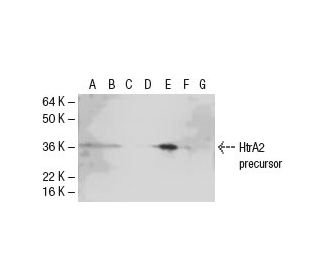
HtrA2 Antibody (1B3): sc-58371
- HtrA2 Antibody (1B3) is a mouse monoclonal IgG1, cited in 4 publications, provided at 50 µg/0.5 ml
- raised against recombinant HtrA2 of human origin
- recommended for detection of HtrA2 of mouse, rat and human origin by WB and IP
- At present, we have not yet completed the identification of the preferred secondary detection reagent(s) for HtrA2 Antibody (1B3). This work is in progress.

QUICK LINKS
HtrA2 Antibody (1B3) is a mouse monoclonal IgG1 antibody that detects HtrA2 in mouse, rat, and human samples through western blotting (WB) and immunoprecipitation (IP) applications. HtrA2, also known as Omi, is a crucial member of the HtrA serine protease family, playing a significant role in cellular homeostasis by degrading misfolded proteins, particularly during cellular stress. anti-HtrA2 antibody (1B3) recognizes a protein predominantly expressed in the nucleus and known for its ability to undergo autoproteolysis, which is essential for its function in regulating apoptosis and maintaining cellular integrity. HtrA2 exists in two polypeptide forms, with one being an alternatively spliced variant called D-Omi, primarily found in the kidney, colon, and thyroid. D-Omi lacks interaction with the Mxi2 protein due to a modified PDZ domain, highlighting the complexity of HtrA2′s interactions and functions. HtrA2 acts as a chaperone-like protein under normal conditions, emphasizing HtrA2′s importance in cellular stress responses and protein quality control. With conserved structure and functional significance across mammalian species, HtrA2 monoclonal antibody (1B3) serves as an invaluable tool for researchers investigating the roles of this protease in various biological processes and disease states.
Alexa Fluor® is a trademark of Molecular Probes Inc., OR., USA
LI-COR® and Odyssey® are registered trademarks of LI-COR Biosciences
HtrA2 Antibody (1B3) References:
- Pathogenic Role of Serine Protease HtrA2/Omi in Neurodegenerative Diseases. | Goo, HG., et al. 2017. Curr Protein Pept Sci. 18: 746-757. PMID: 26965693
- Pathogenic variants in HTRA2 cause an early-onset mitochondrial syndrome associated with 3-methylglutaconic aciduria. | Oláhová, M., et al. 2017. J Inherit Metab Dis. 40: 121-130. PMID: 27696117
- Progress in research on the role of Omi/HtrA2 in neurological diseases. | Su, XJ., et al. 2019. Rev Neurosci. 30: 279-287. PMID: 30205651
- Omi/HtrA2 Protease Associated Cell Apoptosis Participates in Blood-Brain Barrier Dysfunction. | Hu, Y., et al. 2019. Front Mol Neurosci. 12: 48. PMID: 30853894
- Association study of DNAJC13, UCHL1, HTRA2, GIGYF2, and EIF4G1 with Parkinson's disease. | Saini, P., et al. 2021. Neurobiol Aging. 100: 119.e7-119.e13. PMID: 33239198
- HtrA2/Omi mitigates NAFLD in high-fat-fed mice by ameliorating mitochondrial dysfunction and restoring autophagic flux. | Zhou, W., et al. 2022. Cell Death Discov. 8: 218. PMID: 35449197
- Insufficient HtrA2 causes meiotic defects in aging germinal vesicle oocytes. | Gao, M., et al. 2022. Reprod Biol Endocrinol. 20: 173. PMID: 36539842
- HtrA2 Independently Predicts Poor Prognosis and Correlates with Immune Cell Infiltration in Hepatocellular Carcinoma. | Feng, L., et al. 2023. J Oncol. 2023: 4067418. PMID: 36704205
- HTRA2/OMI-Mediated Mitochondrial Quality Control Alters Macrophage Polarization Affecting Systemic Chronic Inflammation. | Liu, Q., et al. 2024. Int J Mol Sci. 25: PMID: 38338855
- Cytosolic retention of HtrA2 during mitochondrial protein import stress triggers the DELE1-HRI pathway. | Bi, PY., et al. 2024. Commun Biol. 7: 391. PMID: 38555279
Ordering Information
| Product Name | Catalog # | UNIT | Price | Qty | FAVORITES | |
HtrA2 Antibody (1B3) | sc-58371 | 50 µg/0.5 ml | $322.00 |