
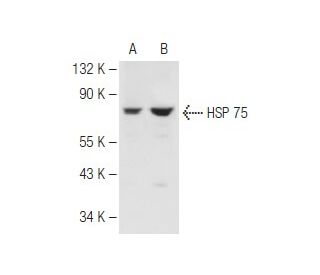


HSP 75 Antibody (42): sc-135944
- HSP 75 Antibody (42) is a mouse monoclonal IgG1, cited in 2 publications, provided at 50 µg/500 µl
- raised against amino acids 253-464 of HSP 75 of human origin
- recommended for detection of HSP 75 of mouse, rat, human and canine origin by WB, IP and IF
- At present, we have not yet completed the identification of the preferred secondary detection reagent(s) for HSP 75 Antibody (42). This work is in progress.

HSP 75 Antibody (42) is a mouse monoclonal IgG1 antibody that detects heat shock protein 75 in mouse, rat, human, and canine samples through applications such as western blotting (WB), immunoprecipitation (IP), and immunofluorescence (IF). HSP 75, also known as tumor necrosis factor type 1 receptor-associated protein (TRAP1), is a crucial member of the heat shock protein 90 family, consisting of 704 amino acids. HSP 75 primarily localizes to the mitochondrion, where HSP 75 plays a vital role in maintaining mitochondrial function and cellular homeostasis. By acting as a molecular chaperone, HSP 75 assists in the proper folding of proteins and the assembly of multiprotein complexes, which is essential for preventing protein aggregation and ensuring efficient cellular processes. HSP 75′s ATPase activity further enhances chaperoning capabilities, making HSP 75 indispensable for cellular stress responses and the protection of cells from damage during stressful conditions. Anti-HSP 75 antibody (42) is an invaluable tool for researchers studying mitochondrial dynamics, protein folding, and cellular response to stress, providing insights into various physiological and pathological processes.
Alexa Fluor® is a trademark of Molecular Probes Inc., OR., USA
LI-COR® and Odyssey® are registered trademarks of LI-COR Biosciences
HSP 75 Antibody (42) References:
- Heat shock protein 75 (TRAP1) antagonizes reactive oxygen species generation and protects cells from granzyme M-mediated apoptosis. | Hua, G., et al. 2007. J Biol Chem. 282: 20553-60. PMID: 17513296
- Heat shock proteins, cell survival and drug resistance: the mitochondrial chaperone TRAP1, a potential novel target for ovarian cancer therapy. | Landriscina, M., et al. 2010. Gynecol Oncol. 117: 177-82. PMID: 19942270
- TRAP1 regulation of mitochondrial life or death decision in cancer cells and mitochondria-targeted TRAP1 inhibitors. | Kang, BH. 2012. BMB Rep. 45: 1-6. PMID: 22281005
- The Chaperone TRAP1 As a Modulator of the Mitochondrial Adaptations in Cancer Cells. | Masgras, I., et al. 2017. Front Oncol. 7: 58. PMID: 28405578
- New insights into molecular chaperone TRAP1 as a feasible target for future cancer treatments. | Li, XT., et al. 2020. Life Sci. 254: 117737. PMID: 32376268
- Honokiol Bis-Dichloroacetate Is a Selective Allosteric Inhibitor of the Mitochondrial Chaperone TRAP1. | Sanchez-Martin, C., et al. 2021. Antioxid Redox Signal. 34: 505-516. PMID: 32438819
- The molecular chaperone TRAP1 in cancer: From the basics of biology to pharmacological targeting. | Masgras, I., et al. 2021. Semin Cancer Biol. 76: 45-53. PMID: 34242740
- Synthesis and antiproliferative activity of 6BrCaQ-TPP conjugates for targeting the mitochondrial heat shock protein TRAP1. | Mathieu, C., et al. 2022. Eur J Med Chem. 229: 114052. PMID: 34952432
- Elucidation of novel TRAP1-Selective inhibitors that regulate mitochondrial processes. | Merfeld, T., et al. 2023. Eur J Med Chem. 258: 115531. PMID: 37307624
- The role of TRAP1 in regulating mitochondrial dynamics during acute hypoxia-induced brain injury. | Liu, F., et al. 2024. J Transl Med. 22: 974. PMID: 39468583
Ordering Information
| Product Name | Catalog # | UNIT | Price | Qty | FAVORITES | |
HSP 75 Antibody (42) | sc-135944 | 50 µg/500 µl | $322.00 |