
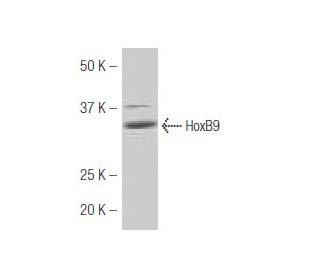

HoxB9 Antibody (45.9): sc-130377
- HoxB9 Antibody (45.9) is a mouse monoclonal IgG2a κ provided at 100 µg/ml
- raised against recombinant HoxB9 of human origin
- recommended for detection of HoxB9 of human origin by WB and IP
- At present, we have not yet completed the identification of the preferred secondary detection reagent(s) for HoxB9 Antibody (45.9). This work is in progress.

HoxB9 Antibody (45.9) is a mouse monoclonal IgG2a antibody that detects HoxB9 in human samples through western blotting (WB) and immunoprecipitation (IP) applications. HoxB9 is a crucial member of the Hox gene family, which plays a significant role in developmental processes and cellular differentiation by regulating downstream target genes. Specifically, HoxB9 is involved in directing DNA-protein and protein-protein interactions that are essential for establishing the morphologic features along the anterior-posterior body axis. HoxB9 is located in the nucleus, where HoxB9 binds to specific DNA sequences to modulate gene expression, making proper function vital for normal embryonic development and tissue patterning. Notably, HoxB9 interacts with transcriptional cofactors such as BTG1 and BTG2, which enhance transcriptional activity, thereby influencing the expression of target genes. Dysregulation of HoxB9 expression has been linked to various forms of leukemia, highlighting importance in both normal physiology and disease states. Anti-HoxB9 antibody (45.9) is an invaluable tool for researchers studying the intricate roles of Hox proteins in development and cancer biology.
Alexa Fluor® is a trademark of Molecular Probes Inc., OR., USA
LI-COR® and Odyssey® are registered trademarks of LI-COR Biosciences
HoxB9 Antibody (45.9) References:
- HOXB9 acetylation at K27 is responsible for its suppression of colon cancer progression. | Song, J., et al. 2018. Cancer Lett. 426: 63-72. PMID: 29654889
- HOXB9 promotes endometrial cancer progression by targeting E2F3. | Wan, J., et al. 2018. Cell Death Dis. 9: 509. PMID: 29724991
- HOXB9 blocks cell cycle progression to inhibit pancreatic cancer cell proliferation through the DNMT1/RBL2/c-Myc axis. | Yao, Y., et al. 2022. Cancer Lett. 533: 215595. PMID: 35182659
- HOXB9 Overexpression Promotes Colorectal Cancer Progression and Is Associated with Worse Survival in Liver Resection Patients for Colorectal Liver Metastases. | Martinou, E., et al. 2022. Int J Mol Sci. 23: PMID: 35216396
- HOXB9 mediates resistance to chemotherapy and patient outcomes through the TGFβ pathway in pancreatic cancer. | Chiba, N., et al. 2022. Oncotarget. 13: 747-754. PMID: 35634239
- The AMPK-HOXB9-KRAS axis regulates lung adenocarcinoma growth in response to cellular energy alterations. | Wang, T., et al. 2022. Cell Rep. 40: 111210. PMID: 36001969
- HOXB9 Overexpression Confers Chemoresistance to Ovarian Cancer Cells by Inducing ERCC-1, MRP-2, and XIAP. | Suh, DH., et al. 2023. Int J Mol Sci. 24: PMID: 36674764
- The E2F1-HOXB9/PBX2-CDK6 axis drives gastric tumorigenesis and serves as a therapeutic target in gastric cancer. | Zhang, J., et al. 2023. J Pathol. 260: 402-416. PMID: 37272544
- HOXB9 promotes osteosarcoma cell survival and malignancy under glucose starvation via upregulating SPP1 expression. | Han, J., et al. 2024. Biochem Pharmacol. 224: 116208. PMID: 38621423
- Cold atmospheric plasma enhances SLC7A11-mediated ferroptosis in non-small cell lung cancer by regulating PCAF mediated HOXB9 acetylation. | Zhang, C., et al. 2024. Redox Biol. 75: 103299. PMID: 39127016
Ordering Information
| Product Name | Catalog # | UNIT | Price | Qty | FAVORITES | |
HoxB9 Antibody (45.9) | sc-130377 | 100 µg/ml | $339.00 |