
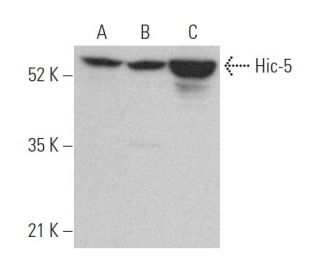
Hic-5 Antibody (C-6): sc-271353
- Hic-5 Antibody (C-6) is a mouse monoclonal IgG2b κ Hic-5 antibody provided at 200 µg/ml
- specific for an epitope mapping between amino acids 409-434 near the C-terminus of Hic-5 of human origin
- Hic-5 Antibody (C-6) is recommended for detection of Hic-5 of mouse, rat and human origin by WB, IP, IF, IHC(P) and ELISA; also reactive with additional species, including and equine, canine and bovine
- TransCruz reagent for ChIP application (sc-271353 X, 200 µg/0.1 ml)
- Anti-Hic-5 Antibody (C-6) is available conjugated to agarose for IP; HRP for WB, IHC(P) and ELISA; and to either phycoerythrin or FITC for IF, IHC(P) and FCM
- also available conjugated to Alexa Fluor® 488, Alexa Fluor® 546, Alexa Fluor® 594 or Alexa Fluor® 647 for WB (RGB), IF, IHC(P) and FCM, and for use with RGB fluorescent imaging systems, such as iBright™ FL1000, FluorChem™, Typhoon, Azure and other comparable systems
- also available conjugated to Alexa Fluor® 680 or Alexa Fluor® 790 for WB (NIR), IF and FCM; for use with Near-Infrared (NIR) detection systems, such as LI-COR®Odyssey®, iBright™ FL1000, FluorChem™, Typhoon, Azure and other comparable systems
- m-IgG2b BP-HRP is the preferred secondary detection reagent for Hic-5 Antibody (C-6) for WB and IHC(P) applications. This reagent is now offered in a bundle with Hic-5 Antibody (C-6) (see ordering information below).

QUICK LINKS
SEE ALSO...
Hic-5 Antibody (C-6) is a mouse monoclonal IgG2b kappa light chain antibody that detects Hic-5 protein of mouse, rat, and human origin by western blotting (WB), immunoprecipitation (IP), immunofluorescence (IF), immunohistochemistry with paraffin-embedded sections (IHCP), and enzyme-linked immunosorbent assay (ELISA). Hic-5 (C-6) antibody is available in both non-conjugated and various conjugated forms, including agarose, horseradish peroxidase (HRP), phycoerythrin (PE), fluorescein isothiocyanate (FITC), and multiple Alexa Fluor® conjugates. Hic-5 protein, also known as transforming factor beta 1 induced transcript 1, plays a crucial role in cellular signaling and adhesion, as a member of the LIM family containing four LIM motifs and seven zinc finger domains. Localization to the nuclear matrix and focal adhesion complexes facilitates interactions with focal adhesions, which are essential for cell attachment and communication with the extracellular matrix. Hic-5′s ability to inhibit integrin-mediated cell spreading on fibronectin by competing with paxillin for focal adhesion kinase underscores Hic-5′s importance in regulating focal adhesion dynamics and downstream signaling pathways. Increased expression of Hic-5 can lead to cellular senescence in developing fibroblasts and block differentiation while inducing apoptosis in developing myoblasts, highlighting Hic-5′s dual role in both promoting and inhibiting cellular processes. Human Hic-5 gene location on chromosome 16 emphasizes Hic-5′s relevance in human biology and potential implications in various diseases.
Alexa Fluor® is a trademark of Molecular Probes Inc., OR., USA
LI-COR® and Odyssey® are registered trademarks of LI-COR Biosciences
Hic-5 Antibody (C-6) References:
- Lepidopteran DALP, and its mammalian ortholog HIC-5, function as negative regulators of muscle differentiation. | Hu, Y., et al. 1999. Proc Natl Acad Sci U S A. 96: 10218-23. PMID: 10468589
- LIM domain protein Trip6 has a conserved nuclear export signal, nuclear targeting sequences, and multiple transactivation domains. | Wang, Y. and Gilmore, TD. 2001. Biochim Biophys Acta. 1538: 260-72. PMID: 11336797
- Hic-5-reduced cell spreading on fibronectin: competitive effects between paxillin and Hic-5 through interaction with focal adhesion kinase. | Nishiya, N., et al. 2001. Mol Cell Biol. 21: 5332-45. PMID: 11463817
- Hic-5 regulates epithelial to mesenchymal transition in ovarian cancer cells in a TGFβ1-independent manner. | Sheta, R., et al. 2017. Oncotarget. 8: 82506-82530. PMID: 29137281
- Hic-5 deficiency attenuates hepatic ischemia reperfusion injury through TLR4/NF-κB signaling pathways. | Gao, L., et al. 2020. Life Sci. 249: 117517. PMID: 32147431
- Preclinical trial of targeting the Hic-5-mediated pathway to prevent the progression of hepatocellular carcinoma. | Wu, WS., et al. 2023. Am J Cancer Res. 13: 4903-4917. PMID: 37970347
- Cloning from a mouse osteoblastic cell line of a set of transforming-growth-factor-beta 1-regulated genes, one of which seems to encode a follistatin-related polypeptide. | Shibanuma, M., et al. 1993. Eur J Biochem. 217: 13-9. PMID: 7901004
- Characterization of the TGF beta 1-inducible hic-5 gene that encodes a putative novel zinc finger protein and its possible involvement in cellular senescence. | Shibanuma, M., et al. 1994. J Biol Chem. 269: 26767-74. PMID: 7929412
- Induction of senescence-like phenotypes by forced expression of hic-5, which encodes a novel LIM motif protein, in immortalized human fibroblasts. | Shibanuma, M., et al. 1997. Mol Cell Biol. 17: 1224-35. PMID: 9032249
- Cell adhesion kinase beta forms a complex with a new member, Hic-5, of proteins localized at focal adhesions. | Matsuya, M., et al. 1998. J Biol Chem. 273: 1003-14. PMID: 9422762
- Interaction of Hic-5, A senescence-related protein, with focal adhesion kinase. | Fujita, H., et al. 1998. J Biol Chem. 273: 26516-21. PMID: 9756887
- Characterization of a focal adhesion protein, Hic-5, that shares extensive homology with paxillin. | Thomas, SM., et al. 1999. J Cell Sci. 112 (Pt 2): 181-90. PMID: 9858471
Ordering Information
| Product Name | Catalog # | UNIT | Price | Qty | FAVORITES | |
Hic-5 Antibody (C-6) | sc-271353 | 200 µg/ml | $322.00 | |||
Hic-5 Antibody (C-6): m-IgG2b BP-HRP Bundle | sc-548699 | 200 µg Ab; 10 µg BP | $361.00 | |||
Hic-5 Antibody (C-6) X | sc-271353 X | 200 µg/0.1 ml | $322.00 | |||
Hic-5 Antibody (C-6) AC | sc-271353 AC | 500 µg/ml, 25% agarose | $424.00 | |||
Hic-5 Antibody (C-6) HRP | sc-271353 HRP | 200 µg/ml | $322.00 | |||
Hic-5 Antibody (C-6) FITC | sc-271353 FITC | 200 µg/ml | $336.00 | |||
Hic-5 Antibody (C-6) PE | sc-271353 PE | 200 µg/ml | $349.00 | |||
Hic-5 Antibody (C-6) Alexa Fluor® 488 | sc-271353 AF488 | 200 µg/ml | $364.00 | |||
Hic-5 Antibody (C-6) Alexa Fluor® 546 | sc-271353 AF546 | 200 µg/ml | $364.00 | |||
Hic-5 Antibody (C-6) Alexa Fluor® 594 | sc-271353 AF594 | 200 µg/ml | $364.00 | |||
Hic-5 Antibody (C-6) Alexa Fluor® 647 | sc-271353 AF647 | 200 µg/ml | $364.00 | |||
Hic-5 Antibody (C-6) Alexa Fluor® 680 | sc-271353 AF680 | 200 µg/ml | $364.00 | |||
Hic-5 Antibody (C-6) Alexa Fluor® 790 | sc-271353 AF790 | 200 µg/ml | $364.00 | |||
Hic-5 (C-6) Neutralizing Peptide | sc-271353 P | 100 µg/0.5 ml | $69.00 |