
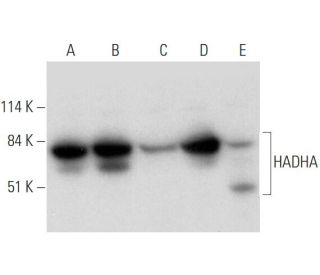

HADHA Antibody (G-9): sc-515278
- HADHA Antibody (G-9) is a mouse monoclonal IgG2b κ provided at 200 µg/ml
- specific for an epitope mapping between amino acids 420-436 within an internal region of HADHA of human origin
- recommended for detection of HADHA of human origin by WB, IP, IF and ELISA
- m-IgG Fc BP-HRP, m-IgG2b BP-HRP and m-IgGκ BP-HRP are the preferred secondary detection reagents for HADHA Antibody (G-9) for WB applications. These reagents are now offered in bundles with HADHA Antibody (G-9) (see ordering information below).

QUICK LINKS
HADHA Antibody (G-9) is a mouse monoclonal IgG2b antibody that detects HADHA in human samples through applications such as western blotting (WB), immunoprecipitation (IP), immunofluorescence (IF), and enzyme-linked immunosorbent assay (ELISA). HADHA, also known as trifunctional enzyme subunit alpha, is a crucial 763 amino acid component of the mitochondrial trifunctional protein complex, which plays a vital role in the final three steps of mitochondrial beta-oxidation of long-chain fatty acids. This complex is composed of four alpha (HADHA) and four beta (HADHB) subunits, with the alpha subunit specifically responsible for catalyzing the 3-hydroxyacyl-CoA dehydrogenase and enoyl-CoA hydratase activities. Proper functioning of HADHA is essential for efficient fatty acid metabolism, as deficiencies in HADHA can lead to severe metabolic disorders such as long-chain 3-hydroxyacyl-coenzyme A dehydrogenase deficiency and mitochondrial trifunctional protein deficiency. These conditions can result in a range of clinical symptoms, including hypoglycemia, cardiomyopathy, and liver dysfunction, highlighting HADHA′s importance in maintaining metabolic homeostasis. Anti-HADHA antibody (G-9) is an invaluable tool for researchers studying these metabolic pathways and their associated disorders, providing insights into HADHA′s function and implications in human health.
Alexa Fluor® is a trademark of Molecular Probes Inc., OR., USA
LI-COR® and Odyssey® are registered trademarks of LI-COR Biosciences
HADHA Antibody (G-9) References:
- Association of HADHA with human RNA silencing machinery. | Kakumani, PK., et al. 2015. Biochem Biophys Res Commun. 466: 481-5. PMID: 26367179
- HADHA overexpression disrupts lipid metabolism and inhibits tumor growth in clear cell renal cell carcinoma. | Liu, S., et al. 2019. Exp Cell Res. 384: 111558. PMID: 31472118
- UBE2O promotes lipid metabolic reprogramming and liver cancer progression by mediating HADHA ubiquitination. | Ma, M., et al. 2022. Oncogene. 41: 5199-5213. PMID: 36273042
- HADHA alleviates hepatic steatosis and oxidative stress in NAFLD via inactivation of the MKK3/MAPK pathway. | Ding, J., et al. 2023. Mol Biol Rep. 50: 961-970. PMID: 36376538
- Obesity Enables NLRP3 Activation and Induces Myocardial Fibrosis via Hyperacetylation of HADHa. | Deng, Y., et al. 2023. Diabetes. 72: 1597-1608. PMID: 37625146
- Morphine induces HADHA succinylation, while HADHA desuccinylation alleviates morphine tolerance by influencing autophagy. | Huang, Y., et al. 2024. Naunyn Schmiedebergs Arch Pharmacol. 397: 1589-1600. PMID: 37688624
- HADHA promotes ovarian cancer outgrowth via up-regulating CDK1. | Liu, Y. and Xiong, Y. 2023. Cancer Cell Int. 23: 283. PMID: 37986001
- HADHA promotes glioma progression by accelerating MDM2-mediated p53 ubiquitination. | Chen, R., et al. 2024. Cancer Gene Ther. 31: 1380-1389. PMID: 39039194
- HADHA promotes esophageal cancer progression by activating mTOR signaling and the SP1/MDM2 axis. | Ding, X., et al. 2024. Acta Biochim Biophys Sin (Shanghai).. PMID: 39327932
- HADHA Regulates Respiratory Complex Assembly and Couples FAO and OXPHOS. | Qin, C., et al. 2024. Adv Sci (Weinh). 11: e2405147. PMID: 39488787
Ordering Information
| Product Name | Catalog # | UNIT | Price | Qty | FAVORITES | |
HADHA Antibody (G-9) | sc-515278 | 200 µg/ml | $322.00 | |||
HADHA Antibody (G-9): m-IgG Fc BP-HRP Bundle | sc-538766 | 200 µg Ab; 10 µg BP | $361.00 | |||
HADHA Antibody (G-9): m-IgGκ BP-HRP Bundle | sc-536436 | 200 µg Ab; 40 µg BP | $361.00 | |||
HADHA Antibody (G-9): m-IgG2b BP-HRP Bundle | sc-549981 | 200 µg Ab; 10 µg BP | $361.00 | |||
HADHA (G-9) Neutralizing Peptide | sc-515278 P | 100 µg/0.5 ml | $69.00 |