
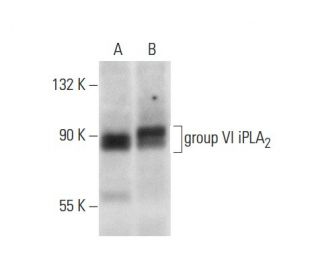
group VI iPLA2 Antibody (A-10): sc-137189
- group VI iPLA2 Antibody (A-10) is a mouse monoclonal IgG1 κ provided at 200 µg/ml
- raised against amino acids 1-120 of group VI iPLA2 of human origin
- recommended for detection of calcium-independent PLA2 of mouse, rat and human origin by WB, IP, IF and ELISA
- m-IgG Fc BP-HRP, m-IgG1 BP-HRP and m-IgGκ BP-HRP are the preferred secondary detection reagents for group VI iPLA2 Antibody (A-10) for WB applications. These reagents are now offered in bundles with group VI iPLA2 Antibody (A-10) (see ordering information below).

QUICK LINKS
SEE ALSO...
Group VI iPLA2 Antibody (A-10) is a mouse monoclonal IgG1 antibody that detects group VI iPLA2 in mouse, rat, and human samples through applications such as western blotting (WB), immunoprecipitation (IP), immunofluorescence (IF), and enzyme-linked immunosorbent assay (ELISA). Group VI iPLA2 plays a crucial role in lipid metabolism by catalyzing the hydrolysis of phospholipids, which is essential for maintaining cellular membrane integrity and signaling pathways. Group VI iPLA2 is primarily localized in the cytoplasm, where group VI iPLA2 interacts with various membrane-bound substrates, facilitating the release of fatty acids that are vital for energy production and cellular signaling. The presence of multiple isoforms, resulting from alternative splicing, adds complexity to regulation and function; for instance, the Ankyrin-iPLA2 isoforms lack the catalytic domain and are believed to negatively regulate the activity of the full-length enzyme. The human gene encoding group VI iPLA2 is located on chromosome 22q13.1, highlighting evolutionary significance and potential implications in various physiological and pathological processes. With an ability to modulate phospholipid metabolism and eicosanoid biosynthesis, group VI iPLA2 is an important target for research into inflammatory responses and other lipid-related disorders, making anti-group VI iPLA2 antibody (A-10) an invaluable tool for scientists studying these critical biological pathways.
Alexa Fluor® is a trademark of Molecular Probes Inc., OR., USA
LI-COR® and Odyssey® are registered trademarks of LI-COR Biosciences
group VI iPLA2 Antibody (A-10) References:
- Human pancreatic islets express mRNA species encoding two distinct catalytically active isoforms of group VI phospholipase A2 (iPLA2) that arise from an exon-skipping mechanism of alternative splicing of the transcript from the iPLA2 gene on chromosome 22q13.1. | Ma, Z., et al. 1999. J Biol Chem. 274: 9607-16. PMID: 10092647
- Apoptosis of insulin-secreting cells induced by endoplasmic reticulum stress is amplified by overexpression of group VIA calcium-independent phospholipase A2 (iPLA2 beta) and suppressed by inhibition of iPLA2 beta. | Ramanadham, S., et al. 2004. Biochemistry. 43: 918-30. PMID: 14744135
- H2O2-dependent hyperoxidation of peroxiredoxin 6 (Prdx6) plays a role in cellular toxicity via up-regulation of iPLA2 activity. | Kim, SY., et al. 2008. J Biol Chem. 283: 33563-8. PMID: 18826942
- The roles of iPLA2, TRPM8 and TRPA1 in chemically induced cold hypersensitivity. | Gentry, C., et al. 2010. Mol Pain. 6: 4. PMID: 20092626
- PRDX6 promotes lung tumor progression via its GPx and iPLA2 activities. | Yun, HM., et al. 2014. Free Radic Biol Med. 69: 367-76. PMID: 24512906
- Loss of presenilin 2 is associated with increased iPLA2 activity and lung tumor development. | Yun, HM., et al. 2014. Oncogene. 33: 5193-200. PMID: 24858037
- IPLA2 mRNA expression by human neutrophils in type 2 diabetes and chronic periodontitis. | Ayilavarapu, S., et al. 2014. J Int Acad Periodontol. 16: 121-6. PMID: 25654966
- Mitochondria from a mouse model of the human infantile neuroaxonal dystrophy (INAD) with genetic defects in VIA iPLA2 have disturbed Ca(2+) regulation with reduction in Ca(2+) capacity. | Strokin, M. and Reiser, G. 2016. Neurochem Int. 99: 187-193. PMID: 27395788
- An investigation of calcium-independent phospholipase A2 (iPLA2) and cytosolic phospholipase A2 (cPLA2) in schizophrenia. | Xu, C., et al. 2019. Psychiatry Res. 273: 782-787. PMID: 31207866
- Parkinson's disease-associated iPLA2-VIA/PLA2G6 regulates neuronal functions and α-synuclein stability through membrane remodeling. | Mori, A., et al. 2019. Proc Natl Acad Sci U S A. 116: 20689-20699. PMID: 31548400
Ordering Information
| Product Name | Catalog # | UNIT | Price | Qty | FAVORITES | |
group VI iPLA2 Antibody (A-10) | sc-137189 | 200 µg/ml | $322.00 | |||
group VI iPLA2 Antibody (A-10): m-IgG Fc BP-HRP Bundle | sc-537417 | 200 µg Ab; 10 µg BP | $361.00 | |||
group VI iPLA2 Antibody (A-10): m-IgGκ BP-HRP Bundle | sc-534674 | 200 µg Ab; 40 µg BP | $361.00 | |||
group VI iPLA2 Antibody (A-10): m-IgG1 BP-HRP Bundle | sc-545177 | 200 µg Ab; 20 µg BP | $361.00 |