
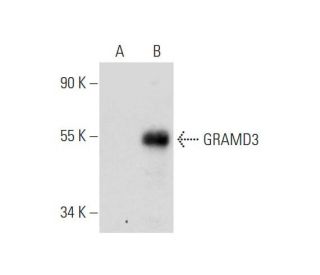


GRAMD3 Antikörper (G-10): sc-515266
- GRAMD3 Antikörper G-10 ist ein monoklonales IgG2a (kappa light chain) GRAMD3 Antikörper in einer Menge von 200 µg/ml
- gezogen gegen die Aminosäuresequenz 206-299 lokalisiert innerhalb einer internen Region von GRAMD3 aus der Spezies human
- GRAMD3 Antikörper (G-10) ist empfohlen für die Detektion von GRAMD3 aus der Spezies mouse, rat, human per WB, IP, IF und ELISA
- Anti-GRAMD3 Antikörper (G-10) ist erhältlich als Konjugat mit Agarose für IP; HRP für WB, IHC(P) und ELISA; und entweder mit Phycoerythrin oder FITC für IF, IHC(P) und FCM
- auch erhältlich als Konjugat mit Alexa Fluor® 488, Alexa Fluor® 546, Alexa Fluor® 594 oder Alexa Fluor® 647 für IF, IHC(P) und FCM
- auch erhältlich als Konjugat mit Alexa Fluor® 680 oder Alexa Fluor® 790 für WB (NIR), IF und FCM
- m-IgG Fc BP-HRP, 2a BP-HRP">m-IgG2a BP-HRP und m-IgGκ BP-HRP sind die bevorzugten sekundären Nachweisreagenzien für GRAMD3 Antikörper (G-10) für WB-Anwendungen. Diese Reagenzien werden jetzt in Bündeln mit GRAMD3 Antikörper (G-10) angeboten(siehe Bestellinformationen unten).

Direktverknüpfungen
Siehe auch...
Der GRAMD3-Antikörper (G-10) ist ein monoklonaler IgG2a-kappa-Leichtketten-Antikörper der Maus, der das GRAMD3-Protein von Mäusen, Ratten und Menschen durch Western Blot (WB), Immunopräzipitation (IP), Immunfluoreszenz (IF) und Enzyme-linked Immunosorbent Assay (ELISA) nachweist. Der Anti-GRAMD3-Antikörper (G-10) ist sowohl in nicht konjugierter als auch in verschiedenen konjugierten Formen erhältlich, darunter Agarose, Meerrettichperoxidase (HRP), Phycoerythrin (PE), Fluoresceinisothiocyanat (FITC) und mehrere Alexa Fluor®-Konjugate. GRAMD3, das aus 432 Aminosäuren besteht und durch eine einzelne GRAM-Domäne gekennzeichnet ist, spielt eine entscheidende Rolle bei zellulären Prozessen wie dem Membrantransport und der Apoptoseregulierung. Die Lokalisierung von GRAMD3 im endoplasmatischen Retikulum ist besonders wichtig, da GRAMD3 an der Regulierung des Lipidstoffwechsels und der Reaktion auf zellulären Stress beteiligt ist. Eine Fehlregulation von GRAMD3 wurde mit verschiedenen Krankheiten in Verbindung gebracht, darunter Krebs und neurodegenerative Erkrankungen, was die Bedeutung von GRAMD3 als potenzielles therapeutisches Ziel unterstreicht. Das GRAMD3-Gen befindet sich auf dem menschlichen Chromosom 5q23.2, einer Region, die mit mehreren genetischen Störungen in Verbindung gebracht wird, darunter das Cockayne-Syndrom und die familiäre adenomatöse Polyposis, was die Bedeutung von GRAMD3 sowohl für die Gesundheit als auch für Krankheiten unterstreicht.
Alexa Fluor® ist ein Markenzeichen von Molecular Probes Inc., OR., USA
LI-COR® und Odyssey® sind Markenzeichen von LI-COR Biosciences
GRAMD3 Antikörper (G-10) Literaturhinweise:
- Duodenale Adenomatose bei familiärer adenomatöser Polyposis coli. Ein Überblick über die Literatur und die Ergebnisse des Heidelberger Polyposeregisters. | Kadmon, M., et al. 2001. Int J Colorectal Dis. 16: 63-75. PMID: 11355321
- Das Gen für das Treacher-Collins-Syndrom befindet sich auf dem langen Arm von Chromosom 5. | Dixon, MJ., et al. 1991. Am J Hum Genet. 49: 17-22. PMID: 1676560
- Das Cockayne-Syndrom zeigt eine Dysregulation von p21 und anderen Genprodukten, die möglicherweise unabhängig von der transkriptionsgekoppelten Reparatur ist. | Cleaver, JE., et al. 2007. Neuroscience. 145: 1300-8. PMID: 17055654
- Ein neuer genomischer Mechanismus, der zum Cri-du-Chat-Syndrom führt. | South, ST., et al. 2006. Am J Med Genet A. 140: 2714-20. PMID: 17103439
- Neudefinition der Monosomie 5 durch molekulare Zytogenetik bei 23 Patienten mit MDS/AML. | Herry, A., et al. 2007. Eur J Haematol. 78: 457-67. PMID: 17391336
- Somatischer APC-Mosaizismus: eine häufige Ursache der familiären adenomatösen Polyposis (FAP). | Aretz, S., et al. 2007. Hum Mutat. 28: 985-92. PMID: 17486639
- Telomerase-Reverse-Transkriptase-Haploinsuffizienz und Telomerlänge bei Personen mit 5p-Syndrom. | Du, HY., et al. 2007. Aging Cell. 6: 689-97. PMID: 17875000
- Molekulare Mechanismen der Hautalterung: Stand der Wissenschaft. | Makrantonaki, E. and Zouboulis, CC. 2007. Ann N Y Acad Sci. 1119: 40-50. PMID: 18056953
- Eine physische Karte von 15 Loci auf dem menschlichen Chromosom 5q23-q33 durch zweifarbige Fluoreszenz-in-situ-Hybridisierung. | Saltman, DL., et al. 1993. Genomics. 16: 726-32. PMID: 8325647
Bestellinformation
| Produkt | Katalog # | EINHEIT | Preis | ANZAHL | Favoriten | |
GRAMD3 Antikörper (G-10) | sc-515266 | 200 µg/ml | $322.00 | |||
GRAMD3 (G-10): m-IgG Fc BP-HRP Bundle | sc-531325 | 200 µg Ab; 10 µg BP | $361.00 | |||
GRAMD3 (G-10): m-IgGκ BP-HRP Bundle | sc-524988 | 200 µg Ab, 40 µg BP | $361.00 | |||
GRAMD3 (G-10): m-IgG2a BP-HRP Bundle | sc-547763 | 200 µg Ab; 10 µg BP | $361.00 | |||
GRAMD3 Antikörper (G-10) AC | sc-515266 AC | 500 µg/ml, 25% agarose | $424.00 | |||
GRAMD3 Antikörper (G-10) HRP | sc-515266 HRP | 200 µg/ml | $322.00 | |||
GRAMD3 Antikörper (G-10) FITC | sc-515266 FITC | 200 µg/ml | $336.00 | |||
GRAMD3 Antikörper (G-10) PE | sc-515266 PE | 200 µg/ml | $349.00 | |||
GRAMD3 Antikörper (G-10) Alexa Fluor® 488 | sc-515266 AF488 | 200 µg/ml | $364.00 | |||
GRAMD3 Antikörper (G-10) Alexa Fluor® 546 | sc-515266 AF546 | 200 µg/ml | $364.00 | |||
GRAMD3 Antikörper (G-10) Alexa Fluor® 594 | sc-515266 AF594 | 200 µg/ml | $364.00 | |||
GRAMD3 Antikörper (G-10) Alexa Fluor® 647 | sc-515266 AF647 | 200 µg/ml | $364.00 | |||
GRAMD3 Antikörper (G-10) Alexa Fluor® 680 | sc-515266 AF680 | 200 µg/ml | $364.00 | |||
GRAMD3 Antikörper (G-10) Alexa Fluor® 790 | sc-515266 AF790 | 200 µg/ml | $364.00 |