
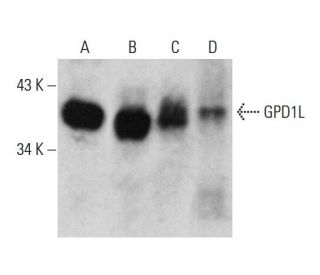

GPD1L Antibody (AT14E2): sc-517404
- GPD1L Antibody (AT14E2) is a mouse monoclonal IgG1 κ GPD1L antibody provided at 100 µg/ml
- raised against a recombinant protein corresponding to amino acids 1-351 of GPD1L of human origin
- recommended for detection of GPD1L of mouse, rat and human origin by WB, IP, IF, FCM and ELISA
- At present, we have not yet completed the identification of the preferred secondary detection reagent(s) for GPD1L Antibody (AT14E2). This work is in progress.

QUICK LINKS
GPD1L Antibody (AT14E2) is a mouse monoclonal IgG1 kappa light chain antibody that detects GPD1L protein of mouse, rat, and human origin by western blotting (WB), immunoprecipitation (IP), immunofluorescence (IF), flow cytometry (FCM), and enzyme-linked immunosorbent assay (ELISA). Anti-GPD1L antibody (AT14E2) is available as the non-conjugated format. GPD1L, or glycerol-3-phosphate dehydrogenase-1 like, is a crucial enzyme in the heart, playing a significant role in the metabolism of glycerol-3-phosphate, which is essential for energy production and lipid metabolism. This 351 amino acid protein is located primarily in the mitochondria, where GPD1L catalyzes the conversion of sn-glycerol 3-phosphate and NAD+ into glycerone phosphate and NADH, thereby influencing the cellular energy balance. Proper functioning of GPD1L is vital for maintaining cardiac health, as GPD1L is involved in the trafficking of voltage-gated sodium channels to the cell surface, which is critical for the cardiac action potential and overall heart rhythm. Mutations in the GPD1L gene have been linked to Brugada syndrome type 2, a serious cardiac condition that can lead to life-threatening arrhythmias, as well as sudden infant death syndrome, highlighting the importance of GPD1L in both cardiac function and developmental health.
Alexa Fluor® is a trademark of Molecular Probes Inc., OR., USA
LI-COR® and Odyssey® are registered trademarks of LI-COR Biosciences
GPD1L Antibody (AT14E2) References:
- Molecular biology of sodium channels and their role in cardiac arrhythmias. | Grant, AO. 2001. Am J Med. 110: 296-305. PMID: 11239848
- [Long QT syndrome and Brugada syndrome: 2 aspects of the same disease?]. | Cerrone, M., et al. 2001. Ital Heart J Suppl. 2: 253-7. PMID: 11307783
- Na(+) channel mutation that causes both Brugada and long-QT syndrome phenotypes: a simulation study of mechanism. | Clancy, CE. and Rudy, Y. 2002. Circulation. 105: 1208-13. PMID: 11889015
- Slowed conduction and ventricular tachycardia after targeted disruption of the cardiac sodium channel gene Scn5a. | Papadatos, GA., et al. 2002. Proc Natl Acad Sci U S A. 99: 6210-5. PMID: 11972032
- Molecular and functional characterization of novel glycerol-3-phosphate dehydrogenase 1 like gene (GPD1-L) mutations in sudden infant death syndrome. | Van Norstrand, DW., et al. 2007. Circulation. 116: 2253-9. PMID: 17967976
- Mutation in glycerol-3-phosphate dehydrogenase 1 like gene (GPD1-L) decreases cardiac Na+ current and causes inherited arrhythmias. | London, B., et al. 2007. Circulation. 116: 2260-8. PMID: 17967977
- Mutation analysis of the glycerol-3 phosphate dehydrogenase-1 like (GPD1L) gene in Japanese patients with Brugada syndrome. | Makiyama, T., et al. 2008. Circ J. 72: 1705-6. PMID: 18762705
Ordering Information
| Product Name | Catalog # | UNIT | Price | Qty | FAVORITES | |
GPD1L Antibody (AT14E2) | sc-517404 | 100 µg/ml | $322.00 |