
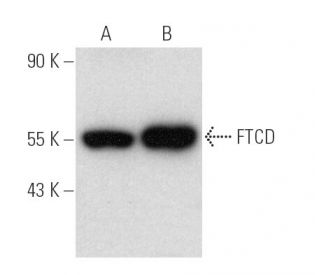
FTCD Antibody (G-3): sc-271788
- FTCD Antibody (G-3) is a mouse monoclonal IgG1 κ FTCD antibody provided at 200 µg/ml
- specific for an epitope mapping between amino acids 33-67 near the N-terminus of FTCD of human origin
- FTCD Antibody (G-3) is recommended for detection of FTCD isoforms A, D, E and C of mouse, rat and human origin by WB, IP, IF and ELISA
- Anti-FTCD Antibody (G-3) is available conjugated to agarose for IP; HRP for WB, IHC(P) and ELISA; and to either phycoerythrin or FITC for IF, IHC(P) and FCM
- also available conjugated to Alexa Fluor® 488, Alexa Fluor® 546, Alexa Fluor® 594 or Alexa Fluor® 647 for WB (RGB), IF, IHC(P) and FCM, and for use with RGB fluorescent imaging systems, such as iBright™ FL1000, FluorChem™, Typhoon, Azure and other comparable systems
- also available conjugated to Alexa Fluor® 680 or Alexa Fluor® 790 for WB (NIR), IF and FCM; for use with Near-Infrared (NIR) detection systems, such as LI-COR®Odyssey®, iBright™ FL1000, FluorChem™, Typhoon, Azure and other comparable systems
- m-IgG Fc BP-HRP and m-IgGκ BP-HRP are the preferred secondary detection reagents for FTCD Antibody (G-3) for WB applications. These reagents are now offered in bundles with FTCD Antibody (G-3) (see ordering information below).

QUICK LINKS
SEE ALSO...
FTCD Antibody (G-3) is a mouse monoclonal IgG1 kappa light chain antibody that detects FTCD protein of mouse, rat, and human origin by western blotting (WB), immunoprecipitation (IP), immunofluorescence (IF), and enzyme-linked immunosorbent assay (ELISA). FTCD (G-3) antibody is available in both non-conjugated and various conjugated forms, including agarose, horseradish peroxidase (HRP), phycoerythrin (PE), fluorescein isothiocyanate (FITC), and multiple Alexa Fluor® conjugates. FTCD protein, also known as the 58K protein, plays a crucial role as a bifunctional enzyme that facilitates the transfer of 1-carbon units from formiminoglutamate, a key metabolite in the histidine degradation pathway, to the folate pool, which is essential for DNA synthesis and repair. This function is particularly important as FTCD links amino acid metabolism to folate metabolism, thereby influencing cellular proliferation and overall health. Defects in FTCD gene can lead to glutamate formiminotransferase deficiency, an autosomal recessive disorder characterized by elevated levels of formiminoglutamate in urine, megaloblastic anemia, and developmental challenges. The severity of the phenotype can vary, with some individuals exhibiting significant symptoms while others may only show mild developmental delays. FTCD (G-3) monoclonal antibody provides researchers with a valuable tool for studying the implications of FTCD in metabolic disorders and potential role in therapeutic interventions.
Alexa Fluor® is a trademark of Molecular Probes Inc., OR., USA
LI-COR® and Odyssey® are registered trademarks of LI-COR Biosciences
FTCD Antibody (G-3) References:
- A novel type of regulation of the vimentin intermediate filament cytoskeleton by a Golgi protein. | Gao, YS., et al. 2002. Eur J Cell Biol. 81: 391-401. PMID: 12160147
- Characterization of the antigenicity of the formiminotransferase-cyclodeaminase in type 2 autoimmune hepatitis. | Renous, R., et al. 2004. Exp Cell Res. 292: 332-41. PMID: 14697341
- Structure of the bifunctional and Golgi-associated formiminotransferase cyclodeaminase octamer. | Mao, Y., et al. 2004. EMBO J. 23: 2963-71. PMID: 15272307
- Localization of Golgi 58K protein (formiminotransferase cyclodeaminase) to the centrosome. | Hagiwara, H., et al. 2006. Histochem Cell Biol. 126: 251-9. PMID: 16534631
- A formiminotransferase cyclodeaminase isoform is localized to the Golgi complex and can mediate interaction of trans-Golgi network-derived vesicles with microtubules. | Hennig, D., et al. 1998. J Biol Chem. 273: 19602-11. PMID: 9677386
- 58K, a microtubule-binding Golgi protein, is a formiminotransferase cyclodeaminase. | Bashour, AM. and Bloom, GS. 1998. J Biol Chem. 273: 19612-7. PMID: 9677387
- Molecular cloning, characterization, and dynamics of rat formiminotransferase cyclodeaminase, a Golgi-associated 58-kDa protein. | Gao, YS., et al. 1998. J Biol Chem. 273: 33825-34. PMID: 9837973
Ordering Information
| Product Name | Catalog # | UNIT | Price | Qty | FAVORITES | |
FTCD Antibody (G-3) | sc-271788 | 200 µg/ml | $322.00 | |||
FTCD Antibody (G-3): m-IgG Fc BP-HRP Bundle | sc-553001 | 200 µg Ab; 10 µg BP | $361.00 | |||
FTCD Antibody (G-3): m-IgGκ BP-HRP Bundle | sc-553000 | 200 µg Ab; 40 µg BP | $361.00 | |||
FTCD Antibody (G-3) AC | sc-271788 AC | 500 µg/ml, 25% agarose | $424.00 | |||
FTCD Antibody (G-3) HRP | sc-271788 HRP | 200 µg/ml | $322.00 | |||
FTCD Antibody (G-3) FITC | sc-271788 FITC | 200 µg/ml | $336.00 | |||
FTCD Antibody (G-3) PE | sc-271788 PE | 200 µg/ml | $349.00 | |||
FTCD Antibody (G-3) Alexa Fluor® 488 | sc-271788 AF488 | 200 µg/ml | $364.00 | |||
FTCD Antibody (G-3) Alexa Fluor® 546 | sc-271788 AF546 | 200 µg/ml | $364.00 | |||
FTCD Antibody (G-3) Alexa Fluor® 594 | sc-271788 AF594 | 200 µg/ml | $364.00 | |||
FTCD Antibody (G-3) Alexa Fluor® 647 | sc-271788 AF647 | 200 µg/ml | $364.00 | |||
FTCD Antibody (G-3) Alexa Fluor® 680 | sc-271788 AF680 | 200 µg/ml | $364.00 | |||
FTCD Antibody (G-3) Alexa Fluor® 790 | sc-271788 AF790 | 200 µg/ml | $364.00 | |||
FTCD (G-3) Neutralizing Peptide | sc-271788 P | 100 µg/0.5 ml | $69.00 |