
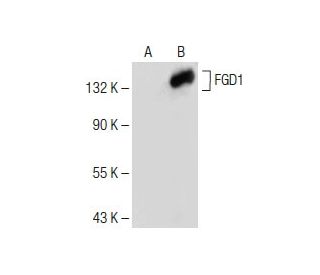

FGD1 Antibody (E-10): sc-374389
- FGD1 Antibody (E-10) is a mouse monoclonal IgG3 FGD1 antibody provided at 200 µg/ml
- specific for an epitope mapping between amino acids 71-107 near the N-terminus of FGD1 of human origin
- recommended for detection of FGD1 of mouse, rat and human origin by WB, IP, IF and ELISA; also reactive with additional species, including and equine, canine, bovine and porcine
- m-IgG3 BP-HRP is the preferred secondary detection reagent for FGD1 Antibody (E-10) for WB applications. This reagent is now offered in a bundle with FGD1 Antibody (E-10) (see ordering information below).

QUICK LINKS
FGD1 Antibody (E-10) is a mouse monoclonal IgG3 antibody that detects FGD1 protein of mouse, rat, and human origin by western blotting (WB), immunoprecipitation (IP), immunofluorescence (IF), and enzyme-linked immunosorbent assay (ELISA). FGD1 (E-10) antibody is available as the non-conjugated form. FGD1 protein plays a crucial role as a guanine nucleotide exchange factor that specifically activates the Rho GTPase Cdc42, which is essential for various cellular processes, including cell migration, cytoskeletal organization, and the formation of filopodia. These filopodia are vital for cellular signaling and communication during embryonic development, highlighting the importance of FGD1 in developmental biology. Mutations in FGD1 gene are linked to faciogenital dysplasia (FGDY, Aarskog syndrome), an X-linked developmental disorder that negatively impacts the formation of multiple skeletal structures. FGD1 is located on human chromosome Xp11.21 and shares significant sequence identity with FGD2 and FGD3, which are also involved in critical signaling pathways during embryogenesis. The conserved structural organization and equivalent signaling domains among the FGD family members suggest a canonical core structure that is fundamental for their function as Rho guanine nucleotide exchange factors, thereby underscoring their importance in regulating essential signals required for proper embryonic development.
Alexa Fluor® is a trademark of Molecular Probes Inc., OR., USA
LI-COR® and Odyssey® are registered trademarks of LI-COR Biosciences
FGD1 Antibody (E-10) References:
- Isolation, characterization, and mapping of the mouse and human Fgd2 genes, faciogenital dysplasia (FGD1; Aarskog syndrome) gene homologues. | Pasteris, NG. and Gorski, JL. 1999. Genomics. 60: 57-66. PMID: 10458911
- Genomic characterization of the human heterotrimeric G protein alpha, beta, and gamma subunit genes. | Hurowitz, EH., et al. 2000. DNA Res. 7: 111-20. PMID: 10819326
- Isolation and characterization of the faciogenital dysplasia (Aarskog-Scott syndrome) gene: a putative Rho/Rac guanine nucleotide exchange factor. | Pasteris, NG., et al. 1994. Cell. 79: 669-78. PMID: 7954831
- The faciogenital dysplasia gene product FGD1 functions as a Cdc42Hs-specific guanine-nucleotide exchange factor. | Zheng, Y., et al. 1996. J Biol Chem. 271: 33169-72. PMID: 8969170
- Faciogenital dysplasia protein (FGD1) and Vav, two related proteins required for normal embryonic development, are upstream regulators of Rho GTPases. | Olson, MF., et al. 1996. Curr Biol. 6: 1628-33. PMID: 8994827
- Genomic organization of the faciogenital dysplasia (FGD1; Aarskog syndrome) gene. | Pasteris, NG., et al. 1997. Genomics. 43: 390-4. PMID: 9268645
- CDC42 and FGD1 cause distinct signaling and transforming activities. | Whitehead, IP., et al. 1998. Mol Cell Biol. 18: 4689-97. PMID: 9671479
Ordering Information
| Product Name | Catalog # | UNIT | Price | Qty | FAVORITES | |
FGD1 Antibody (E-10) | sc-374389 | 200 µg/ml | $322.00 | |||
FGD1 Antibody (E-10): m-IgG3 BP-HRP Bundle | sc-552963 | 200 µg Ab; 40 µg BP | $361.00 | |||
FGD1 (E-10) Neutralizing Peptide | sc-374389 P | 100 µg/0.5 ml | $69.00 |